
Article written by Damian Holmes – Founder and Editor of World Landscape Architecture
Every year, I seek to provide insights into the landscape architecture trends for the coming year. You can read my review of the 2025 landscape architecture trends to see how I went last year.
2026 is going to be a year of action as many governments and organisations have realised that they have spent the last few years developing guides, tool kits(boxes) for the design profession and public, it is now time to focus on implementing them at a broader scale beyond the prototype and best practice projects.
Climate Adaptation
The last few years have seen a focus on decarbonisation and climate mitigation within the landscape industry; these efforts have been somewhat successful, but climate mitigation requires cultural shifts that seem to be slowing or stuck. Therefore, there is a greater need to start implementing climate-adaptive initiatives and projects such as sponge cities, resilience zoning (protection, retreat), urban forests, climate shelters (public parks (with dense canopies), misting systems, shade structures), seasonal programming (allowing for flooding), living shorelines, soil restoration, and cool material selections.
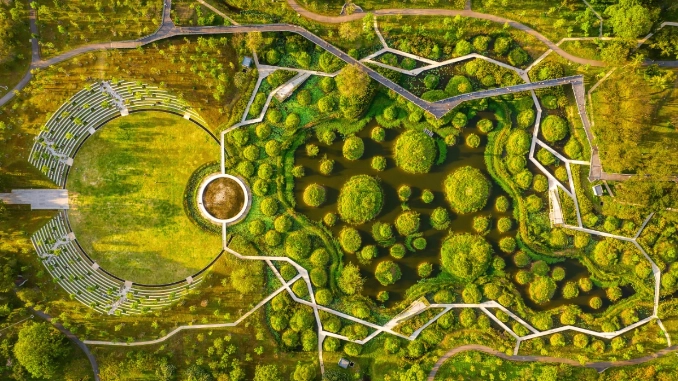
The focus will be increased on performance-based landscapes and the contribution of adaptive and resilient landscapes to cities and the broader region. There will be more analysis of urban environments due to rising investment and real estate values, increasing density, and insurance companies’ interests. National governments will take greater interest in implementing adaptation initiatives as they seek to achieve the targets outlined in the National Adaptation (and Resilience) Plans submitted to the UN.
Nature-based Solutions (NbS) will continue to shape approaches to climate adaptation and landscape architecture. However, there needs to be a shift away from discussing NbS in terms of concepts and ideas, and towards providing education and precedent examples to governments and NGOs to plan and implement NbS projects.
Artificial Intelligence (AI)
The impact of the AI trend on landscape architecture will reach various aspects of the profession. Most designers have used AI in some form or another, whether it is for idea generation, visualisation, site analysis, or business planning. Now that it is gaining more acceptance, there is little chance of not being impacted by AI as a designer or business.
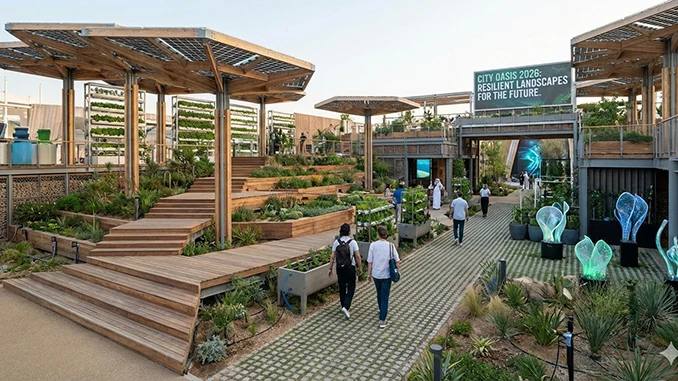
Experimentation & Processes
The number of AI apps, tools, and plugins is multiplying daily, and anyone who was around in the early 2000’s will remember the same frenzy around internet providers, browsers and ecommerce sites. AI will be no different. Currently, there are incremental improvements in models (LLMs) and the rigour of their outputs, but an explosion in applications that seek to solve problems (relevant or not).
There are many design processes, from site observation and analysis to concept visualisation to documentation to specification/maintenance schedules, that could be completed using AI, and there are design firms and startups that are creating AI apps or utilising existing software (Co-pilot, Adobe, etc.) to improve processes.
2026 will still be a year of continued experimentation by landscape architects with AI tools, while also seeking to establish a standard process or methodology within each firm. They also need to consult with clients and allied professionals to ensure they are meeting industry expectations.
AI in Physical Form
The physical impact of AI (warehouses, infrastructure) cannot go unnoticed, particularly given its rapid implementation and the level of investment. The environmental impacts include visual impacts and emissions (air, water, and acoustic), and landscape architects are asked by private and public stakeholders to provide opinions on the impacts and mitigation efforts. How this eventuates will depend on the level of local regulations, political will and community outrage. Also with the speed at which these are being built there and the possibility of a AI bubble, some warehouses may end up empty or recommissioned for other uses.
Whose Copyright?
The issue of AI and copyright remains a grey area, with many governments taking a “soft law,” risk-based approach based on current laws (besides the EU, which has a specific AI Act). The focus of governments has been to protect existing intellectual property & copyright from the training of models and illegal replication. Currently, AI-generated output cannot be copyrighted or licensed, as it does not involve human involvement or be the author’s own intellectual creation. It will take some years of government hearings and legal cases before the issues relating to copyright (existing and newly created) are fully resolved.
Will AI replace landscape architects?
The other question often asked is, will it replace jobs in landscape architecture? There may be instances of AI designing landscapes, but I feel that, in the immediate future, these will be used for residential or industrial landscapes by clients who would not have employed a landscape architect for their project.
Due to the industry’s broad scope and scale, there is always a need for graduates and designers. I see AI as a tool for the industry rather than a replacement for people, given the creativity and nuance required for design and contextual design.
Ethics of AI?
There are many ethical issues related to AI for landscape architects to work through, and each firm needs to determine how comfortable they are with utilising AI, decide which tool is best suited to the task, and educate clients on how they use AI.
Scenarios and Efficiency
AI will be used to explore scenarios/alternatives, whether at the site planning scale or in planting design, to increase biodiversity. It will also be utilised to create more efficient structures, furniture, paving patterns and more.
What we need to remember is that AI is a tool for creativity, not a replacement for it. Human involvement will be required at various stages of the design and construction process. I think we are a long way away from the autonomous design & construct AI company.
Computational Design/Climate Assessment
There is an increased focus on using computational design and data analysis to generate reports on risk assessments, performance analytics, climate impact assessments, lifecycle assessments, circular procurement, biodiversity net gain, and related areas. This shift will drive investment in AI-powered modelling and Digital Twins to evaluate design options and management strategies during significant climate events.
Additionally, pre- and post-monitoring will be necessary to evaluate how well the design performs and whether it achieves its objectives and targets. This can be implemented through sensors and digital twin models.
Biodiversity
As discussed in last year’s trends article, greater biodiversity is required to address biodiversity loss. This is not a trend that will play out in the next year; it is a decades-long trend. As it has been two years since many nations signed the Kunming-Montreal Global Biodiversity Framework (KMGBF) and issued or updated their biodiversity plans[1] [2], I would expect to see a greater focus on biodiversity (implementation and monitoring) at all levels of government as they head towards 2030 and seek to meet the 23 targets of the KMGBF.
At a more local level, landscape architects will need to work with governments, ecologists, horticulturists, and other allied professionals to increase biodiversity within projects and restore degraded landscapes, thereby reducing weed infestations and biodiversity loss.
Wellbeing and Inclusion
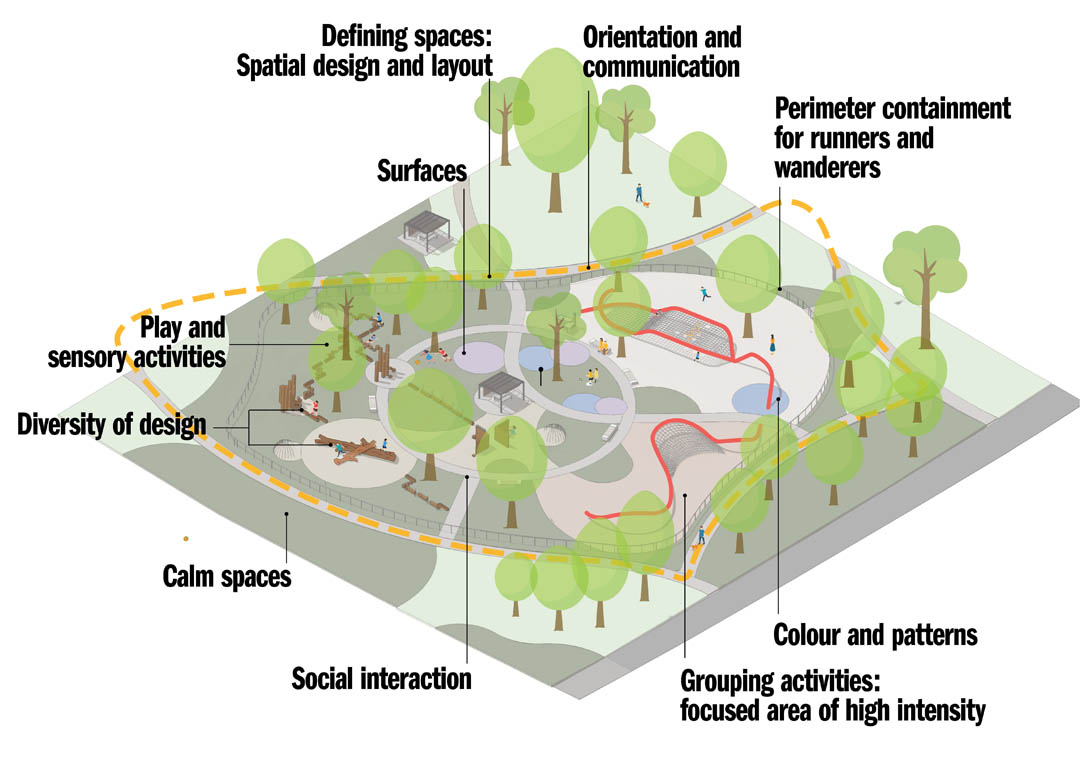
As we move beyond the post-pandemic era, there is still a realisation that landscapes can improve mental health and wellbeing – an increased focus on designing slow living, quiet, low-stimulation spaces for well-being, and also for neurodivergent individuals. Creating spaces where people can slow down and connect with nature through planting and textures like aromatic foliage, rough stones and sands. These areas are important because, over the past decade, the trend has been to “activate” every space, whether commercial or public. While both types of spaces have their roles in the landscape, the current trend is shifting toward a balanced mix of passive and active areas.
The Shift Toward Locally Appropriate and Resilient Species
Following on from biodiversity, planting design will increasingly look to more locally appropriate species. Although there has been a shift over the last decade toward local (indigenous, endemic, native) species, there needs to be greater trailing and planting of species suited to the local climate (influenced by climate change & microclimate). This will require landscape architects to work more closely with nurseries, botanists, ecologists and horticulturalists to explore the possibilities, as not all species can be propagated and be commercially viable.
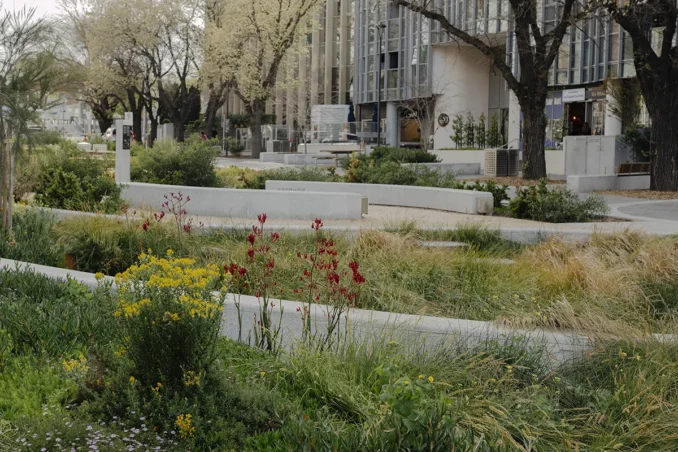
Residential and commercial landscapes will still trend toward aesthetic planting styles that go through short-term fads, such as Ligularias, which become fashionable worldwide on Instagram and Pinterest. Nevertheless, there is a need for more biodiverse planting in all landscape typologies to provide habitat across cities and regions.

Pressure on professional and registration organisations
I think that, with the recent news over the past few months about the President of RIBA not renewing his ARB registration [3], US government changing the classification of architecture [4] and AILA facing financial issues [5]. I think 2026 will require professional organisations to deliver value to members and push back against governments and other industries that seek to deregister or dilute landscape architecture’s professional standing.
Push back against closing higher education courses
In 2025, some landscape programs faced cancellation [6], and anecdotal conversations suggested that programs saw a decrease in post-graduate students but an increase in undergraduate students, prompting universities to shift funding, structure, and staffing, and to consider closing courses.
Design firms and landscape architecture organisations will continue to react and push back against the cancellation of courses to ensure the industry has ongoing research and talented people to work in design firms, government agencies, and allied professional firms.
More Face-to-Face Consultation
In recent years, clients and landscape architects have increasingly used social media and online surveys to consult with stakeholders, but social media is often 40-50% bots or external actors rather than stakeholders. These bots can distort outcomes, and there are tools to remove outside influences and anomalies from the data. However, I foresee a trend towards increased face-to-face consultation to obtain a more accurate and true representation of stakeholders’ input into projects. Whether through town halls, door-to-door stops, weekend meet-and-greets, or exhibitions, I think face-to-face consultation can help lead to more well-informed and appropriate design decisions.

Incorporating Indigenous, Local and Traditional Knowledge
In recent times, indigenous knowledge has become more integrated into landscape design, driven by a greater understanding of its importance. There is also an increasing understanding that local and traditional knowledge, separate from indigenous knowledge, can provide insights into the landscape, its history, context, and stories. This knowledge, Indigenous, Traditional, and Local Knowledge (ITLK), enhances landscape architects’ ability to create better frameworks, guides, and designs. Designers need to integrate ITLK and knowledge systems into their design process while also respecting and communicating with cultural sensitivity.
Trends with differing speeds
Many of the trends mentioned above will be developed and implemented at varying speeds, depending on the profession’s focus and maturity, as well as government policy. As we have seen, some countries have slowed the implementation of climate change policies, as the realisation that the resources required (financial and trained people) exceed what governments, businesses, consumers and communities are willing to tolerate (e.g., roll back of goals for car emissions).
As with every year, it is hard to curate the trends article due to the large number of current issues and topics. I aim to cover what I consider essential to the landscape architecture profession. There are many issues and challenges that landscape architects face; however, I feel that these trends offer opportunities for learning, training and improving our problem-solving abilities. I hope that you have enjoyed reading this year’s trend article.
I have also published 2026 Business Trends for Landscape Architects on my personal blog, which may interest principals, business managers, and managers, as it focuses on the business and operations side of the profession.
Article written by Damian Holmes – Founder and Editor of World Landscape Architecture
References
[1] UK national biodiversity strategy and action plan (26 Feb 2025) https://www.gov.uk/government/publications/uk-national-biodiversity-strategy-and-action-plan
[2] Australia’s National Biodiversity Strategy and Action Plan (18 November 2025) https://www.dcceew.gov.au/environment/biodiversity/conservation/strategy
[3] RIBA President will not renew ARB registration – https://www.riba.org/news/riba-president-will-not-renew-arb-registration/
[4] AIA opposes federal policy failing to recognize architects as professionals https://www.aia.org/about-aia/press/aia-opposes-federal-policy-failing-recognize-architects-professionals
[5] AILA seeks to rebuild for the future – https://worldlandscapearchitect.com/aila-seeks-to-rebuild-for-the-future/
[6] Landscape Architects Urge University of Nebraska-Lincoln to Retain Landscape Architecture Program https://www.asla.org/news-insights/press-releases/landscape-architects-urge-university-of-nebraska-lincoln-to-retain-landscape-architecture-program
→ Continue reading at World Landscape Architecture

