
MONUMENTS
Geffen Contemporary at the Museum of Contemporary Art (MOCA)
Los Angeles
Through May 3
Whether they inspire pride, rage, despair, or indifference, Confederate monuments erected across the South during the post-Reconstruction era (1877–1960s) have long appeared as plain and indisputable as propaganda often does when cast in public space. But having since been vandalized, toppled, and shipped over 2,000 miles to a contemporary art museum in Los Angeles, many of these same monuments appear unsettled without their historical placement, and they unsettle the conventional function of history itself.
MONUMENTS, on view in the Geffen Contemporary at the Museum of Contemporary Art (MOCA) and presented in collaboration with The Brick, is the largest exhibition held at MOCA to date. Curated by Bennett Simpson and Hamza Walker—both of whom were raised in “the land of monuments” (Virginia and Maryland, respectively)—the exhibition was first conceived in 2017, following the “Unite the Right” rally in Charlottesville held in response to the removal of Confederate statues from public spaces, and opened eight years later, during the first year of Trump’s second term, shortly after signing an executive order aimed at “restoring truth and sanity to American history” by restoring these same public monuments. Within the eight-year span, the exhibition gained significance amid forces indicating that anti-Blackness was never in our rear-view mirror; it has always been galloping alongside the present.
There are about four or five ways to enter MONUMENTS. “We knew we couldn’t privilege one way through,” Simpson, MOCA senior curator, told AN. “The materials are too varied, and on the other hand, they’re all pointing to the same thing. It’s one big experience, one big package.”
Cleansed of chronology and thematic sequencing, the familiar arc of American history bending toward justice is cracked open across nearly an acre of gallery space, hinting at tales of regression and retribution that overlap in every direction—just as they do everywhere in America in the 21st century. Viewers, thrown ceaselessly back and forth in time, witness the unraveling of ten Confederate monuments dedicated to an imagined past as they come into contact with the unflinching present they both set into motion and failed to prevent.
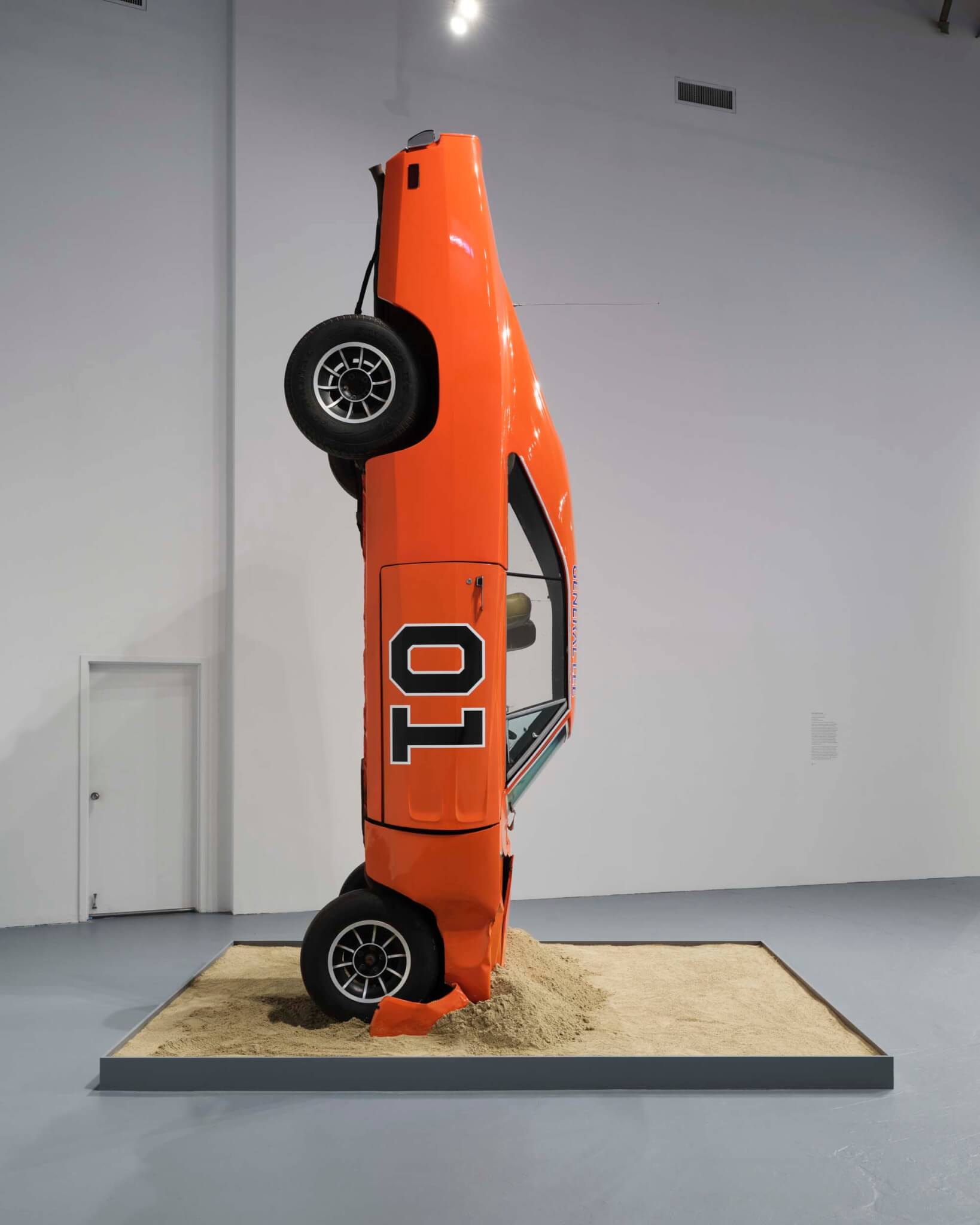
Some of these dialogues are set up like a punchy joke. An oversized sculpture of Robert E. Lee and Stonewall Jackson on horseback, first erected in Baltimore in 1948 and later tagged with the words “BEWARE TRAITORS,” shares a large room with A Suspension of Hostilities (2019), the artist Hank Willis Thomas’s replica of the “General Lee” car from The Dukes of Hazzard damaged beyond repair, raised upright like a middle finger in Lee and Jackson’s direction. “We knew pretty early on we wanted those two pieces in dialogue,” said Simpson. “Sometimes you go with the least subtle option.
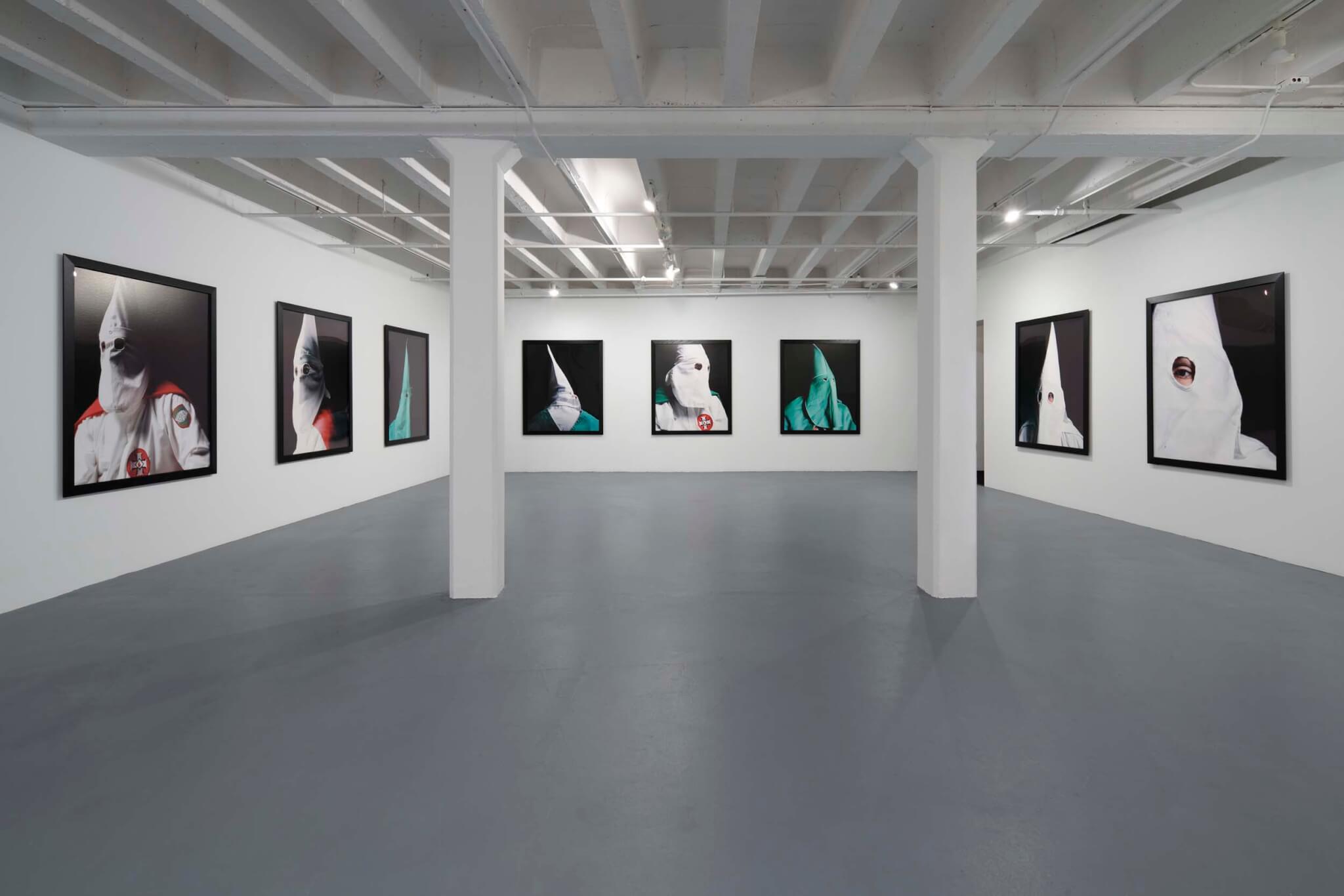
Other dialogues inspire an odd sort of pity for the losing party. In the corner of one room is a monument originally constructed in 1903 in honor of Jefferson Davis, the first and only President of the Confederate States of America, that was later dishonored in June 2020 following the police murder of George Floyd. Thrust on his side, his outstretched arm nearly ripped off and his body paint-bombed, Davis is humiliated a second time by the resistance he helped make necessary. On the opposite walls are a series of portraits, taken by photographer Andres Serrano in 1990, of members of the Ku Klux Klan that all appear a bit frightened behind the eye holes of their hoods. Together, the sculpture and the Klan garments converse as an attempt to hide behind lies undone by truths that inevitably rose to the surface.
Others reveal that one of the most enduring monuments to the Confederacy was not produced in the South at all, but in sunny Los Angeles; not in marble, but in celluloid. In a dark room near the center, the artist Stan Douglas presents four alternate scenes alongside the original ending of D. W. Griffith’s The Birth of a Nation (1915), a counterfactual epic of the Reconstruction era, that altogether forms a parable about the short-sightedness of prejudice against free Black citizens. Douglas’s remastering, commissioned specifically for MONUMENTS, turns the mythic power of film on its head by looping a new historical rupture onto an old one.
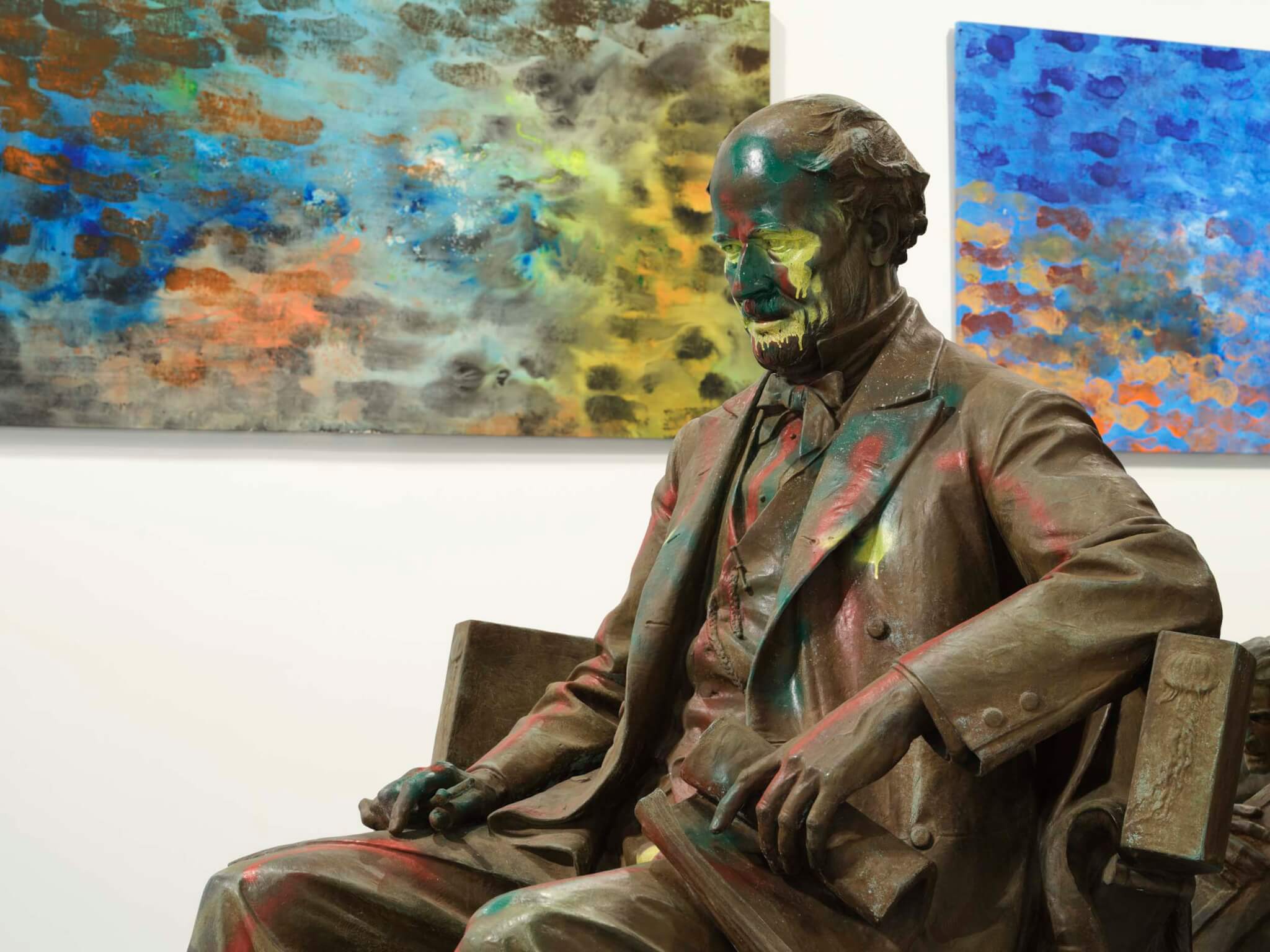
MONUMENTS is not a traveling exhibition. When the exhibition closes on May 3 its elements will be returned to their lenders, contributing to new dialogues in whatever contexts they will be placed. But here, in Los Angeles, they briefly serve as a portrait of a nation always at odds with itself in a long and rhyming rhythm. “Things don’t change very much in America,” said Simpson, “and yet they change dramatically as well. We’re not very far removed from things we are ashamed of.”
Honoring the Confederacy was—is—one of many methods of preserving older values under conditions that threaten to destroy them. If the plain legibility of Confederate monuments was in the service of teaching a specific narrative to an impressionable public, the ambiguity of MONUMENTS is in the service of unlearning.
Shane Reiner-Roth is a writer and lecturer on architecture and urbanism in Los Angeles.
→ Continue reading at The Architect's Newspaper

