
This year has been a lot. In 2025, we’ve seen a heavy helping of more, more, and more, and bigger, bigger, and bigger—more income inequality; more AI slop clogging our screens; a bigger ballroom; a towering temple for a return-to-work demands; an influx of collectible design; major mergers among architecture offices; the centennial year of art deco, marked by a return to its flourished tropes; and a crop of luxury projects, including members clubs, hotels, spas, and so much more. Does anyone else feel exhausted?
Given this fusillade, The Architect’s Newspaper editors are pleased to share our second-annual Architecture Word of the Year: “glut.”
Last year’s Architecture Word of the Year by AN was “slippery.” It signaled a descent into fascism and the increasing difficulty in discerning between human versus AI-generated content. Today, we’re still living in that uncanny valley, except now the feeling has gone into overdrive: Data centers are drying up water bodies at warp speed, meanwhile Time has named the architects of AI as its Person of the Year. In Washington, President Trump aims to build a gilded, $300 million ballroom and continues partying at Mar-a-Lago at the same time he cuts SNAP benefits and 47 million Americans face food insecurity. To appropriate Gen Z: Chat, are we cooked?
Here are the definitions of glut, according to Merriam-Webster:
Transitive verb
- to flood (the market) with goods so that supply exceeds demand
- to fill especially with food to excess
Noun
- An excessive quantity: oversupply
- The act or process of glutting
Verb
- To swallow greedily
Why Glut?
Etymologically, glut derives from the word gluttony, and gluttonous. Gluttony dates back to the 1300s and originally comes from the Latin gluttire, which means “to swallow” or “gulp down” something with your gula (throat). In Latin, a glutto is an “overeater.” Today’s ruling class fits this bill: In 2025, Jeff Bezos racked up a $55 million tab with his wedding in Venice—filling the city with superyachts and helicopters—and now will be the lead sponsor for the 2026 Met Gala.
Our current moment is one in which we’ve never been more connected to one another and yet never more isolated. Artists have responded to this mixture of inundation and alienation: For her 2021 artwork GLUT: A Superabundance of Nothing, Johanna Hedva created an AI vocal clone for an immersive sound installation meant for “a lonely person” during the COVID-19 lockdown, leveraging machine learning to help tell bedtime stories. We have “a superabundance of nothing,” Hedva posited.
To Hedva’s point: What good is all this tech if it just makes us lonelier, more jaded, and more financially, socially, and emotionally poor? Similarly, earlier this year as a part of MoMA PS1’s The Gatherers exhibition, Georgian artist Tolia Astakhishvili explored similar themes in a piece that affirmed how “our lives [have] become increasingly shaped by the glut of garbage and information” today.
The Road Ahead
“Glut” embodies our drive to always be doing more. This year, Ezra Klein and Derek Thompson published Abundance which made the case for a new liberal agenda “that builds,” as the authors put it. In the book the authors blame two culprits responsible for our societal woes: bureaucracy and regulation. Projects—outside of Washington, D.C., apparently—are delayed by red tape. Abundance has become so influential that California Governor Gavin Newsom started folding its innuendo into his talks, as recently he did on Klein’s podcast. Klein delivered the keynote speech at MASS Design Group’s 15-year anniversary party in Boston. While there’s a glut of luxe attention-grabbing projects, the abundance arrives with a related mass of needy causes, like broken infrastructure, deferred maintenance, and widespread discontent.
But the ideals of the opposite idea, degrowth, are also a growing movement within architecture. Its factions question the need to build more new buildings. This year, Charlotte Malterre-Barthes published A Moratorium on Construction which, as the title suggests, posed an unsettling question for many architects: What if we stopped building? The idea is seen in projects like pihlmann architects’s Thoravej 29 project in Copenhagen, which cut up an existing structure to become a coworking center. Søren Pihlmann told AN: “We demolish and build anew more than we use what we already have, and we do it in a way that damages not only our basis of existence but the basis of existence of future generations, especially. … Has this harsh reality truly not dawned on us yet?”
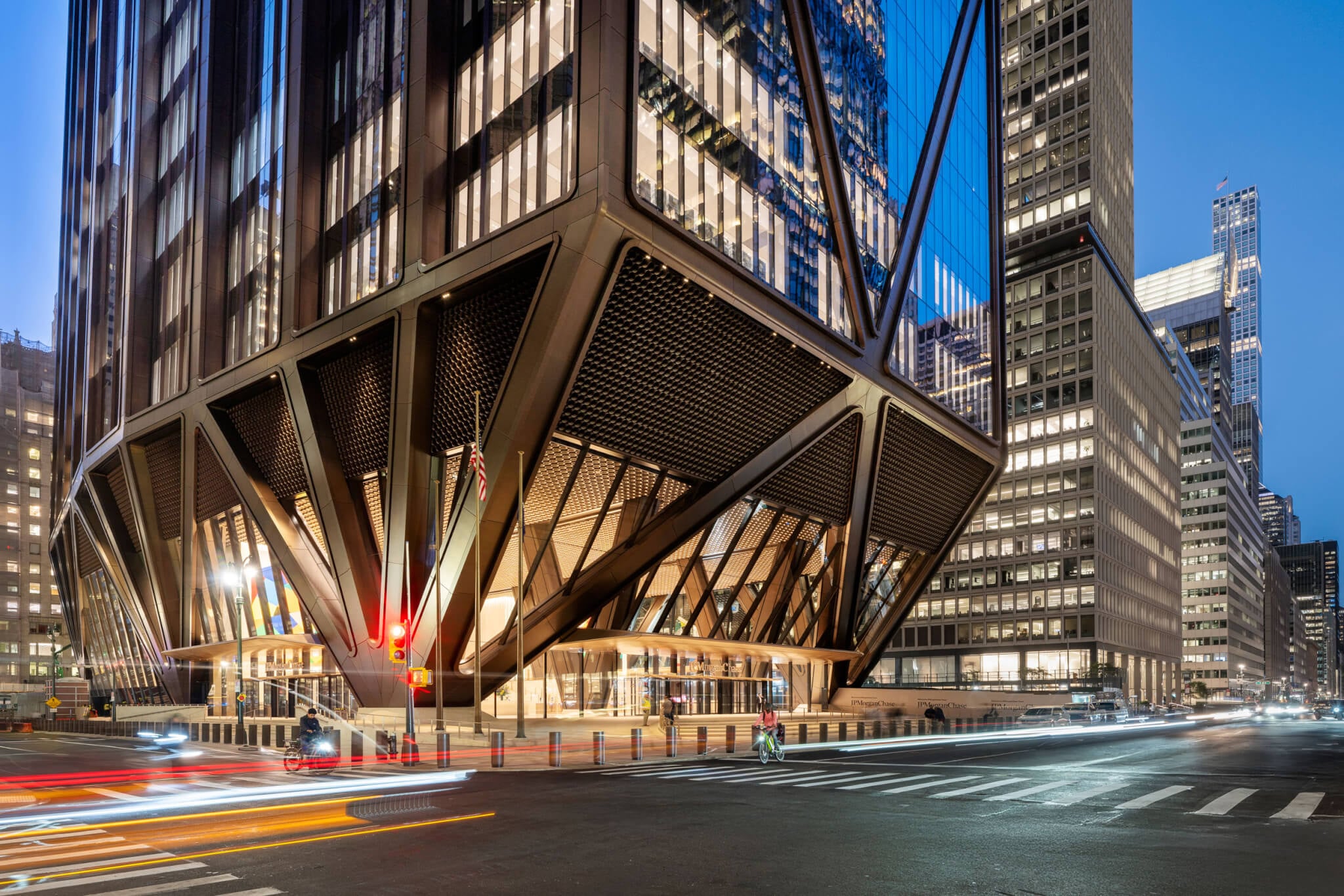
Glut threads this needle. It is the antithesis of “scarcity” and “dearth,” but it points to what lies in abundance’s shadows: waste. This year’s word conjures images of hubristic excess. Perhaps its most fitting architectural symbol is 270 Park Avenue, the tower designed by Foster + Partners with Gensler for JPMorgan Chase and topped by an LED installation by Leo Villareal. 270 Park rose on the site of the demolished Union Carbide Building, designed by SOM’s Natalie de Blois, and it consumed an egregious amount of natural resources despite what the architects said about the tower’s sustainability merits. The $4 billion “Brobdingnagian pile,” as Olly Wainwright described it in The Guardian, uses 95,000 tons of steel, 60 percent more than the Empire State Building. (Christopher Hawthone also used the term Brobdingnagian in his review of the office tower; the word refers to the fictional place in Jonathan Swift’s Gulliver’s Travels where everything is bigger. Sound familiar?)
Things are looking brighter in New York, but it’s not all thanks to Villareal’s installation. We have a new incoming mayor, Zohran Mamdani, who has pledged to raise the income tax for New Yorkers who make over $1 million by 2 percent to pay for affordable housing, transit improvements, and municipal grocery stores. Seattle has a new progressive mayor, too, in Katie Wilson. The needle is moving. In 2026, let’s work to make it move faster.
“Glut” in Context
“The works speak to how ‘our lives [have] become increasingly shaped by the glut of garbage and information,’ curators Ruba Katrib with Sheldon Gooch continued.”—Daniel Jonas Roche in The Architect’s Newspaper
“A pandemic-era upswing in life sciences investment created a lab building boom in 2021 and 2022, which has since created a supply glut, with tens of millions of square feet of brand-new, empty lab space in top markets such as San Diego, Boston, and the Bay Area.”—Patrick Sisson in The Architect’s Newspaper
“During the 20th century, the city experienced population decline due to urban renewal, deindustrialization, and suburbanization, all contributing to a glut of vacant buildings.—Cyrus Peñarroyo and De Peter Yi in The Architect’s Newspaper
“The industry can move away from decision-making mechanisms based on cheapness and availability, exiting its imagination crisis to reform obsolete regulations and challenge gluttonous developers’ mindsets.”—Charlotte Malterre-Barthes in Moratorium on New Construction
“The city’s downtown has struggled with a highest-in-the-nation glut of vacant corporate office space.”—Matt Hickman in Architectural Record
“In keeping with the building’s modest size and inclination toward craft—and Greenwich Village’s somewhat historicist disdain for shiny trappings and ostentatious displays of opulence—common spaces are scarcer at 64 University than at some of the city’s glossier developments, where a glut of amenities can make them feel more like hotels or college dormitories.”—Akiva Blander in Metropolis
→ Continue reading at The Architect's Newspaper

