
Micropolitan America
Banvard Gallery at Ohio State University
Through February 20
As I took a left onto the main street of Laurens in northern Iowa, an old man towed a kid in a trailer down the street with his riding mower, a towering grain elevator loomed and groaned, and empty storefronts appeared unchanged from their fifteen minutes of fame in David Lynch’s 1999 film the Straight story. In my brief time in Laurens last summer—no longer than an hour as I raced to the Loess Hills south of Sioux City to catch a park ranger–recommended sunset over the Missouri River—I caught a glimpse of 3rd Street, famously crystallized in Lynch’s true-to-life film about a cross-state road trip taken on a lawn tractor. But this easy-to-grasp image that risks turning Laurens into Mayberry is obviously no longer the reality of a place nearly thirty years gone from its tender, cinematic representation.
The architecture of small towns like Laurens might change slowly, but within that brick and wood carapace, life continues on. The brevity of my visit occludes that life from my view and reveals a critical question of teaching the rural in a university: How can instructors turn their students’ attention toward different paces of life while locked in an academic calendar? Curator Kyriakos Kyriakou turns our attention to small towns in his traveling exhibition Micropolitan America, now on view in the Banvard Gallery at Ohio State University’s Knowlton School of Architecture. Micropolitan America features drawings by students from Kyriakos Kyriakou and Sofia Krimizi’s classes at Texas Tech University, the University of Texas at Austin, and the University of Houston. In these classes, students were challenged to engage small-town America and thus with the temporal disparity between rural life and academia.
“A Veritable Zoo of Views”
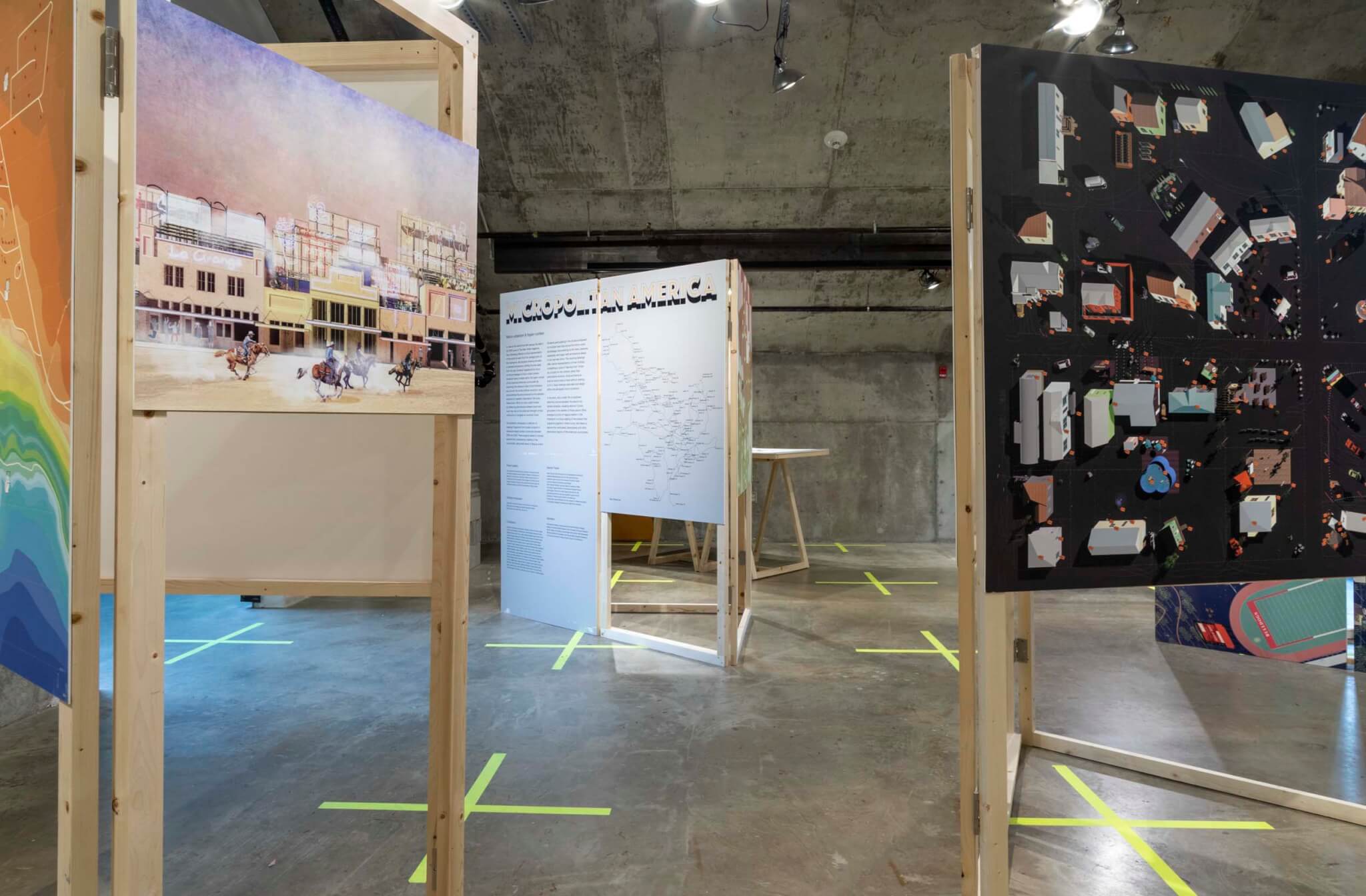
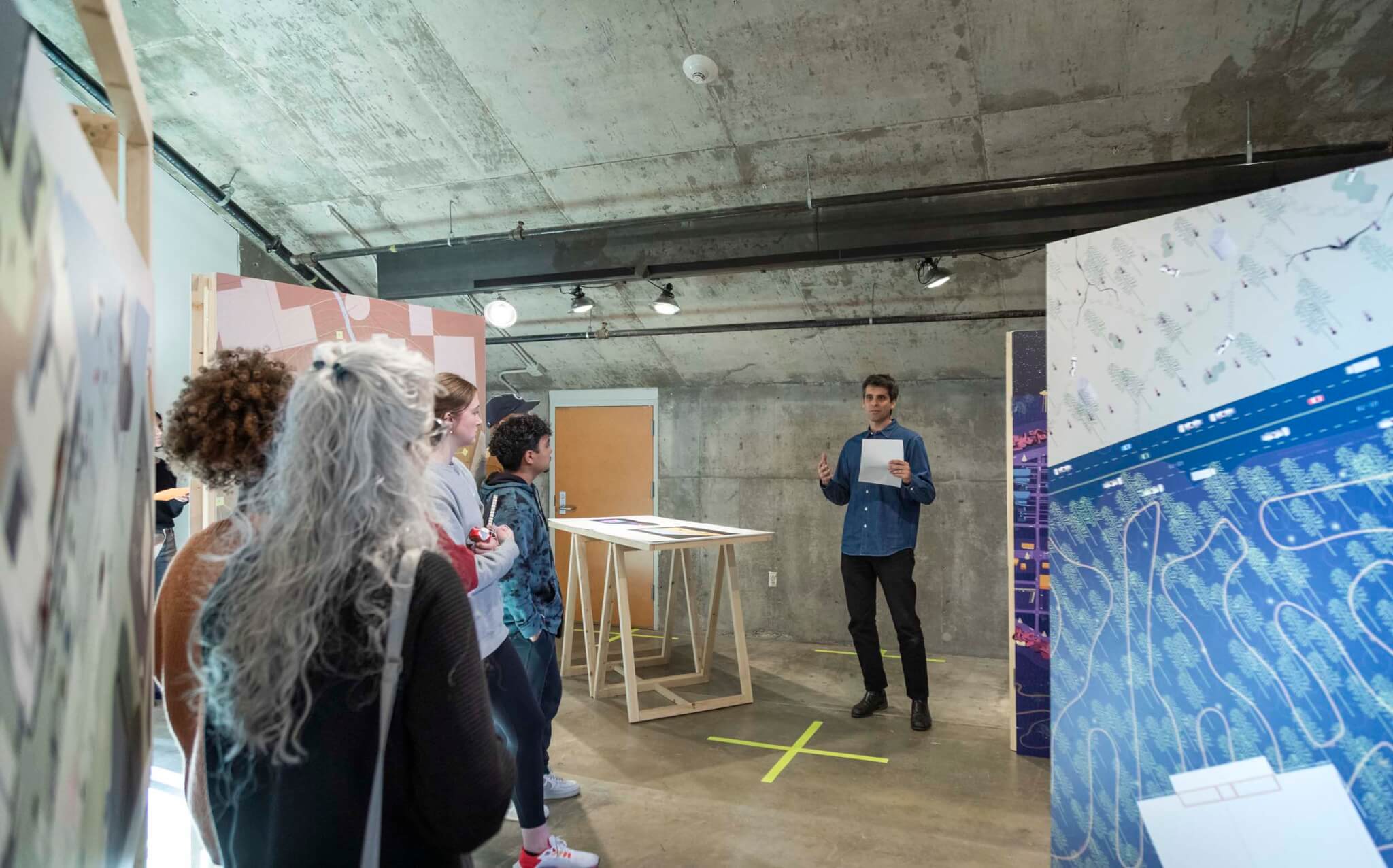
In the tucked-away concrete gallery, the large-format drawings are hung in triples from wood frames loosely scattered throughout the space in an organizational manner that evokes the Jeffersonian Grid. The drawings themselves are wildly variable in composition: plans, perspectives, axonometrics, and elevations with spectacular compositional intrusions. A veritable zoo of views is brought to bear on these small rural towns: fish-eye, bird’s eye, worm’s eye, and the view of a car-human-cyborg strapped into its passenger seat.
The drawings are maximalist: highly saturated, over-abundant in entourage both human and beyond, hyper-annotated with unnecessary dimensions, and a Real Tree camo pattern so gaudy as to be more Bushwick than bucolic. And while the drawings might pull you through the door, the rich conceptual body of work lurks below the surface in collected survey drawings and attendant fictions that support the visual flash.
Tucked just behind the exhibition text and roadmap of the surveyed towns that first welcomes you to the space is a large, barely bound collection of drawings. These “Surveys of the Ordinary” embody the principle tenet of how the show was explained in the curatorial statement: “record what is without seeking to fix it.” These surveys—produced in simultaneous seminars—are visually similar to the larger studio-based drawings that fill the space. Even the studio drawings, which might be reduced to a kind of post-digital spectacle, a necessary concession to discursive myopia, are revealed to be only snapshots of models that are more re-creation than representation, temporary shots of evolving digital worlds rather than still constructions.
But, where the large drawings make projections and offer future narratives, these simple drawings record only what is. They attempt to capture the humble, handy, and, as Lynch knew, often surreal structures of the American hinterland as they are, with no judgment or editorialization. Most critically, these surveys come from first-hand visits captured on road trips across Oklahoma, West Texas, and New Mexico. They are records of the road just as much as they are the places themselves. It’s in these surveys where the teaching work of Kyriakou and Krimizi really starts to sing.
Pedagogical Experimentation
The university is a place of exception, a space of supposed transcendence. Within this suspended irreality, students are often removed from the world around them, washed of the dirt under their nails, and immersed in a body of knowledge that purports to stretch beyond the petty concerns of place. In the classes that produced Micropolitan America, Kyriakou and Krimizi ejected their students from this intellectual fiction at highway speeds into the ignored and contested landscapes that both surround them, and, in many cases, where they’ve lived.
The road trip became a tool of resistance to the norms of education that erase regional specificity. The surveys became the record of this protest. But, the road trip is itself a contested method of experiencing the world. Left to one’s own devices, we might slide back onto the interstate and re-enter the nodal network of American metropolitanism that reduces these spaces to a peripheral blur. It is in this friction where Micropolitan America’s most provocative lessons might be felt.
Within each class, Kyriakou and Krimizi had to offer the students a crash course on rurality and impart the deep patience it takes to both see a place and earn its trust. The model of the contemporary university resists this. The duration of a semester restricts participation to a fifteen-week window where the subject at hand might not budge an inch. Micropolitan America reveals the temporal friction between the length of time needed to understand a rural place and the brief window students are given to learn from it. It’s no wonder these small towns so often get ignored in academia, the university is structurally ignorant of them. In design schools, this blindness might be most typically seen in short-term projects that scheme quick fixes for flyover country, or in the importing of metropolitan pedagogies to rural institutions.
If the road trip only allows for an immediate bodily impression of these out-of-the-way places, in studios, Kyriakou and Krimizi task the students with fictionalizing the chosen communities in order to produce more material for intervention. The fictions themselves wait patiently in the back corner of the exhibition beside a rustic loveseat, at once the most modestly presented information and the most critical. In these fictions—most often written as performance scripts—the students are allowed free reign to imagine the lives tucked behind the western facades. In these writings, they are able to break beyond the visual and into the lived, even if only imagined.
As the years of American deindustrialization have shown, the politics of the provinces have a strong hand on the rudder of federal policy. In the long decades of being ignored by the American liberal mainstream, many of these small towns have been captured by a conservative imagination once seemingly beyond the pale. And, while a reporter from the New York Times might show up once every four years to patronize and a more typical academic engagement might pass through town with a gale of unkept promises, Kyriakos and Krimizi’s pedagogy offers an introduction to the skills it might take to make real change: attention, patience, and a willingness to make-do. As the pedagogy bumps against the limits of university time, and the show demands a slow consumption even as it offers slick images, the patient viewer might leave the gallery with much the same tools as the well-learned student, and with a desire and heart aching to get off the beaten path, and stay there.
On March 12, the exhibition will open in the Rhode Island School of Design’s Bayard Ewing Gallery.
Adrienne Economos-Miller is a builder and teacher made from trash, ruins, and other obscene matters. She is working on and through collective labor practices, vernacular languages, and the architectures of desire.
→ Continue reading at The Architect's Newspaper

