
Passive House retrofits have long catered to deep-pocketed clients willing to stomach six-figure price tags and months of invasive construction. A new modular system called The Block, by Brooklyn design and build practice CO Adaptive, wants to flip that script. Made from salvaged wood and designed for quick assembly, the demountable wall system promises to make Passive House–level retrofits faster, cheaper, and more accessible.
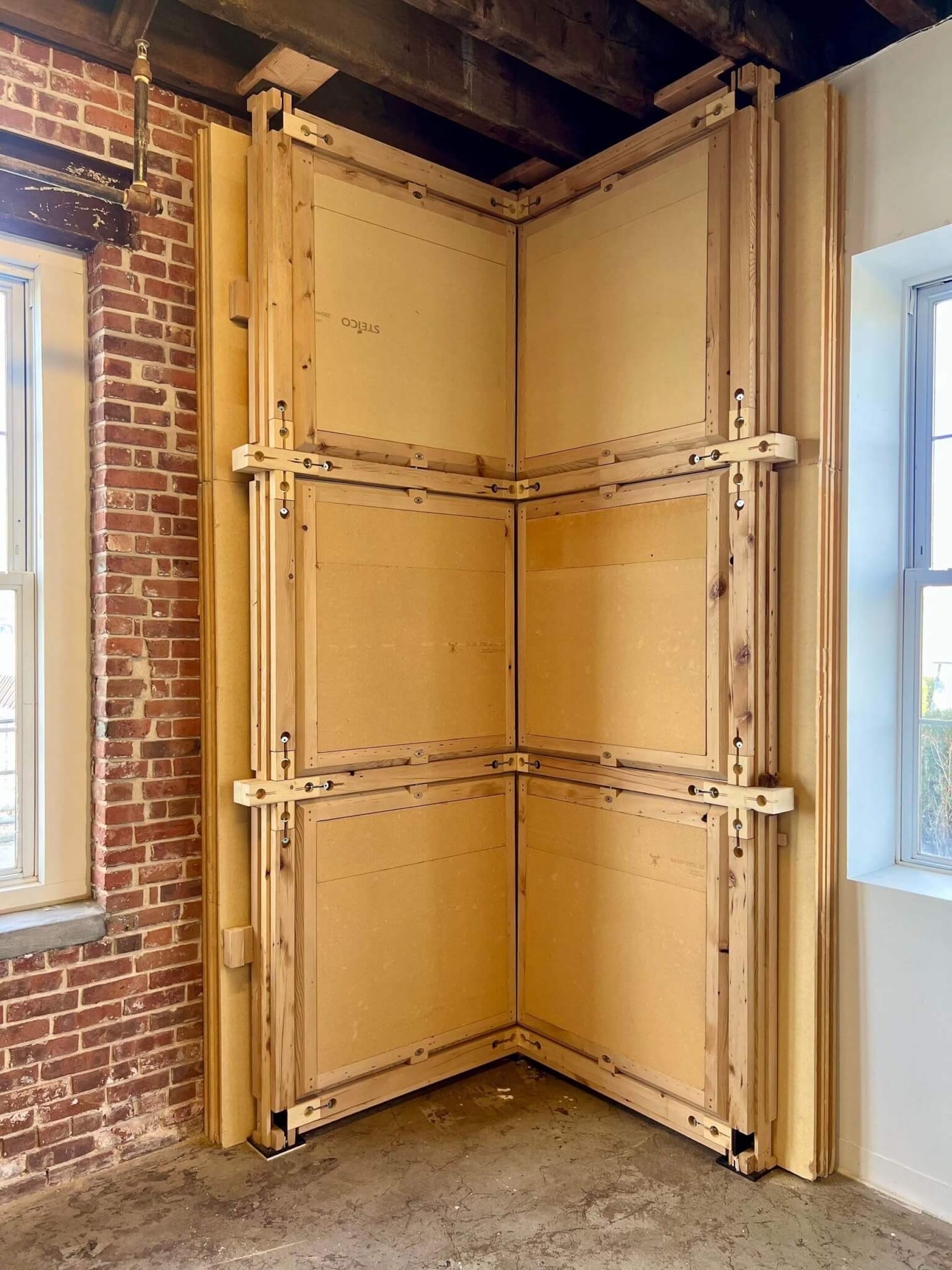
A prototype of The Block was recently installed at the Arts Center on Governors Island as part of the Trust for Governors Island’s Climate Solutions Piloting Program. There, the architects will conduct air-leakage and thermal testing over the course of a year. If successful, The Block could unlock a path to decarbonizing the city’s aging housing stock.
CO Adaptive has built a reputation for elegant Passive House retrofits and adaptive reuse projects across New York City. Ruth Mandl and Bobby Johnston cofounded the studio in 2015, and last year launched Co-Disassembly, a service arm that allows them to get involved in projects early, carefully deconstruct buildings, and harvest reusable materials. They might stay on to design the new structure, but when offering this particular service, their primary focus remains deconstruction, not construction. “There’s definitely a gap between a circularity broker who knows what’s getting deconstructed, and connecting it with the needs of a project,” Johnston said.
The stakes couldn’t be higher. Buildings account for nearly 40 percent of global carbon emissions, with a significant chunk stemming from the embodied carbon that is baked into manufacturing new materials like steel, concrete, and insulation. Meanwhile, New York State’s landfills are projected to reach capacity within the next 16 to 25 years, with construction and demolition waste representing the largest waste stream. Without a radical rethinking of how the city builds—and un-builds—both garbage and climates crises are bound to collide.
Enter The Block. The system—which in this case repurposes salvaged framing lumber from the studio’s own townhouse retrofits—works by installing prefabricated, insulated panels on the interior side of existing exterior walls. This creates an airtight thermal barrier without having to touch the facade, which is a common roadblock in New York’s historic districts, where landmarked facades often complicate renovations. It also makes required building upgrades more accessible to all New Yorkers—particularly those living in old tenement buildings, rented apartments, and public housing.
The firm’s interest in designing for disassembly dates back to 2022, when they converted a century-old metal foundry in Gowanus into a flexible theater space. Most recently, CO Adaptive has been working at SPARC Kips Bay, a sciences and healthcare campus set to become the first project built under NYC EDC’s new circularity guidelines. The existing building, a nursing school built in the 1950s, has been deemed obsolete and slated for demolition, but the architects are currently in the process of salvaging various materials, including glazed concrete blocks, and maple acoustic wall panels from the auditorium. Some of these materials are already listed on Orbit Exchange, an online marketplace for reclaimed construction materials that Kelly Tigera, a business consultant and advocate for sustainable construction, launched in November. The marketplace allows contractors, salvage companies, and material resellers to sell or donate materials, while giving architects an opportunity to lower the carbon footprint of their projects by specifying salvaged materials.
Convincing architects to specify salvaged goods, however, remains an uphill battle. “A lot of the people who came to look at the material that was available said there is no market for it, which is exactly where the problem lies,” said Mandl. “It’s the designer who creates the market, and so our thought was to create the market.”
CO Adaptive’s mindset around disassembly is already trickling into the practice’s build work. The studio is currently developing an “insert” system that would allow builders to slot the glazed bricks salvaged from SPARC into a framework with no adhesive—and remove them intact later, without resorting to a sledgehammer.
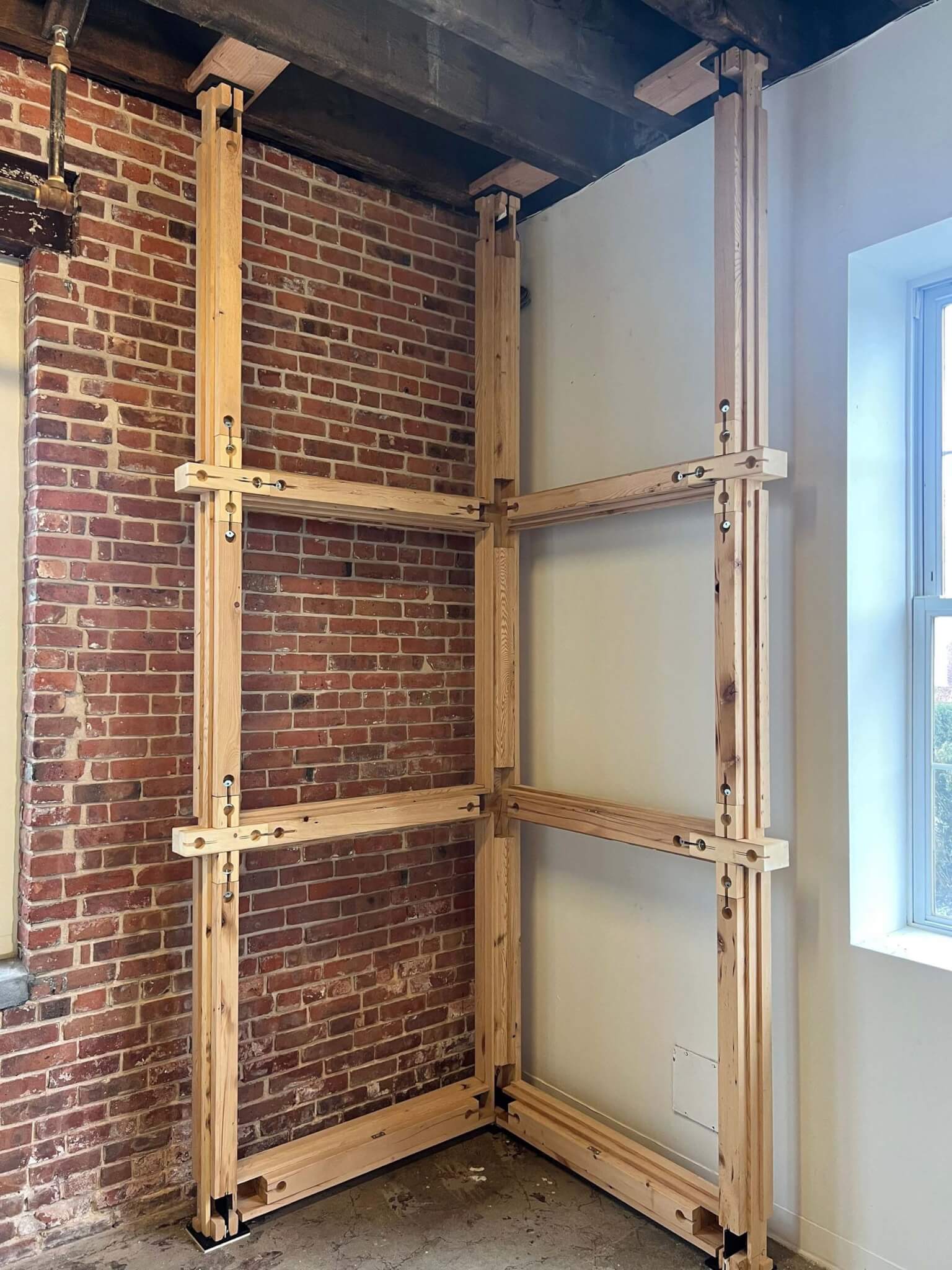
The Block operates on similar logic, creating flexible interiors where individual panels can be removed without compromising the integrity of the wall. If owners or renters ever need to access plumbing or rewire a circuit behind the wall, they can simply remove a panel, make the fix, and snap it back in without having to cut into drywall. “I mean, it sounds like a dream,” said Johnston. “Why hasn’t it been done before?”
Elissaveta M. Brandon is an independent journalist whose work explores the intersection of design, cities, and culture, with frequent detours into other curiosities.
→ Continue reading at The Architect's Newspaper

