
Throughout the 16-acre Kingsborough Houses campus, tall steel forms rise from grass patches and courtyards, their perforated surfaces catch daylight like lacework cast in metal. At dusk they glow from within, some clustered along walkways, others emerging from open lawns. Etched across their planes are swirling constellations, motifs inspired by Ancient Egypt, and bold stanzas shaped during months of workshops with Kingsborough residents. Children’s sketches, recollections of front-stoop life, and references to Black migration and diaspora mingle with the expressive silhouettes that recall Richmond Barthé’s sculptural style.
This field of 35 sculptures is Migration, a new permanent outdoor installation and the second phase of a years-long cultural revitalization led by the Public Housing Community Fund (PHCF) with the New York City Housing Authority (NYCHA), the Mellon Foundation, and New York–based artists and designers including Ifeoma Ebo of Creative Urban Alchemy and Jerome Haferd of Jerome Haferd Studio. The initiative, part of NYCHA’s Connected Communities program, extends the work begun earlier this year with the restoration of Barthé’s monumental frieze Exodus and Dance, an 80-foot-long bas-relief known to residents simply as “the Wall.”
Barthé created Exodus and Dance in 1939 for Harlem River Houses under the Works Progress Administration and was moved to its permanent home in Kingsborough in 1942. The piece has since become central to the campus’s cultural life, hosting movie nights, community gatherings, and everyday passersby who read its figures as embodiments of shared history. The relief draws from Old Testament narratives reframed through a 1930 play, The Green Pastures, as well as a 1929 ballet by David Wendell Guion. The result is a sweeping meditation on Black migration, movement, theater, and dance rendered in a mix of classical and art deco figures.
By 2018, decades of freeze-thaw cycles left the frieze cracked and pitted. PHCF, NYCHA, and the Mellon Foundation partnered with Jablonski Building Conservation to restore the work, supported by a $2 million Mellon grant and shepherded locally by the late Larry Weekes, a beloved artist-in-residence who championed Barthé’s legacy. Completed earlier this year, the restoration returned clarity to the stone figures and renewed the artwork as a landmark of Black artistic heritage.
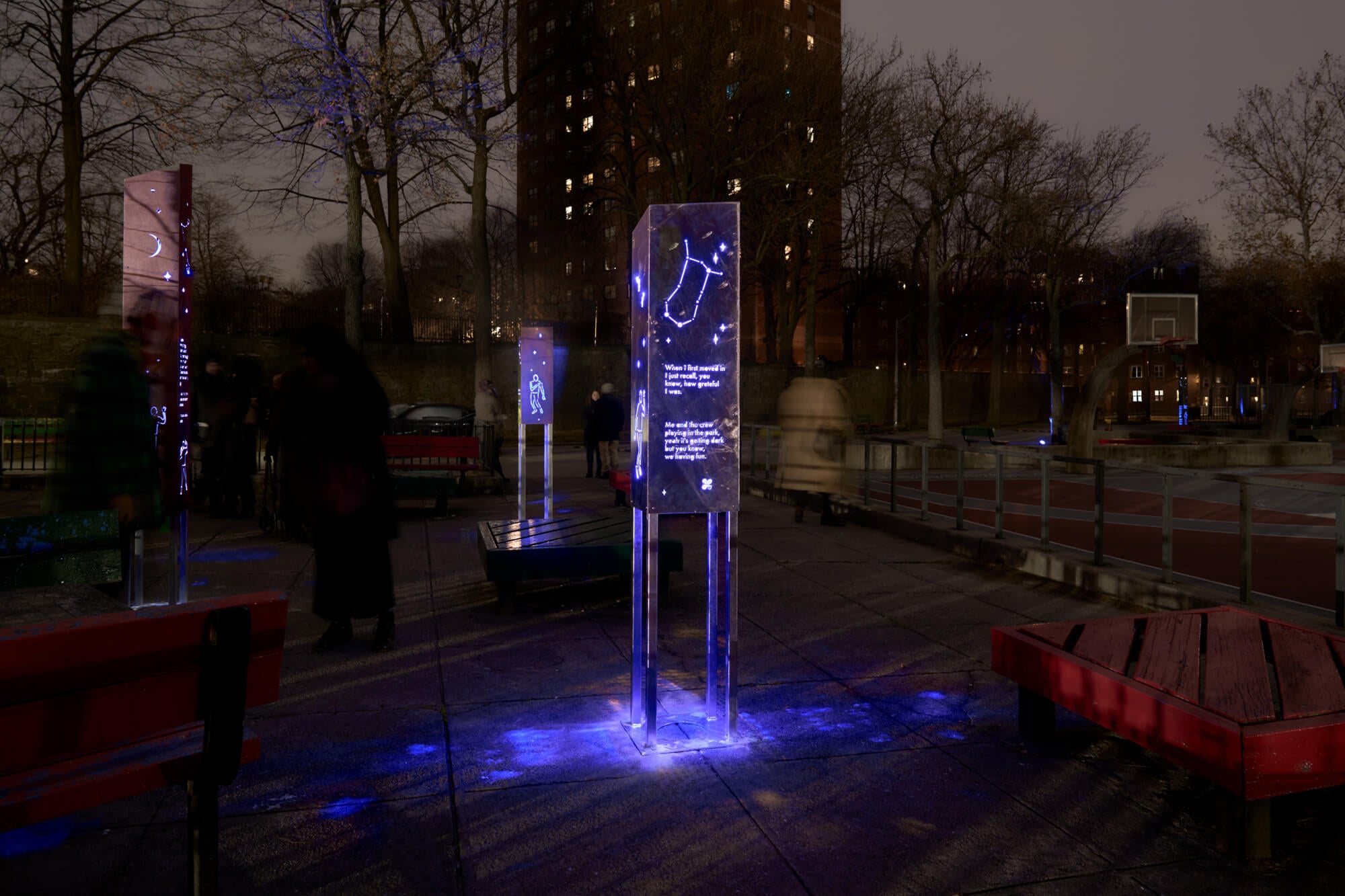
With the frieze restored to clarity, its narrative of movement flows outward. Positioned across the campus, Migration forms a procession, echoing the motion found in Barthé’s dancers and wanderers.
Each steel sculpture for Migration was fabricated in Brooklyn, but its content grew from within Kingsborough itself. Ebo and Haferd, both known for their community-engaged approaches, structured the design process as a series of co-creative workshops. Ebo described the work as “a celebration where Richmond Barthé’s historic frieze meets the living creativity of present-day Brooklyn.”
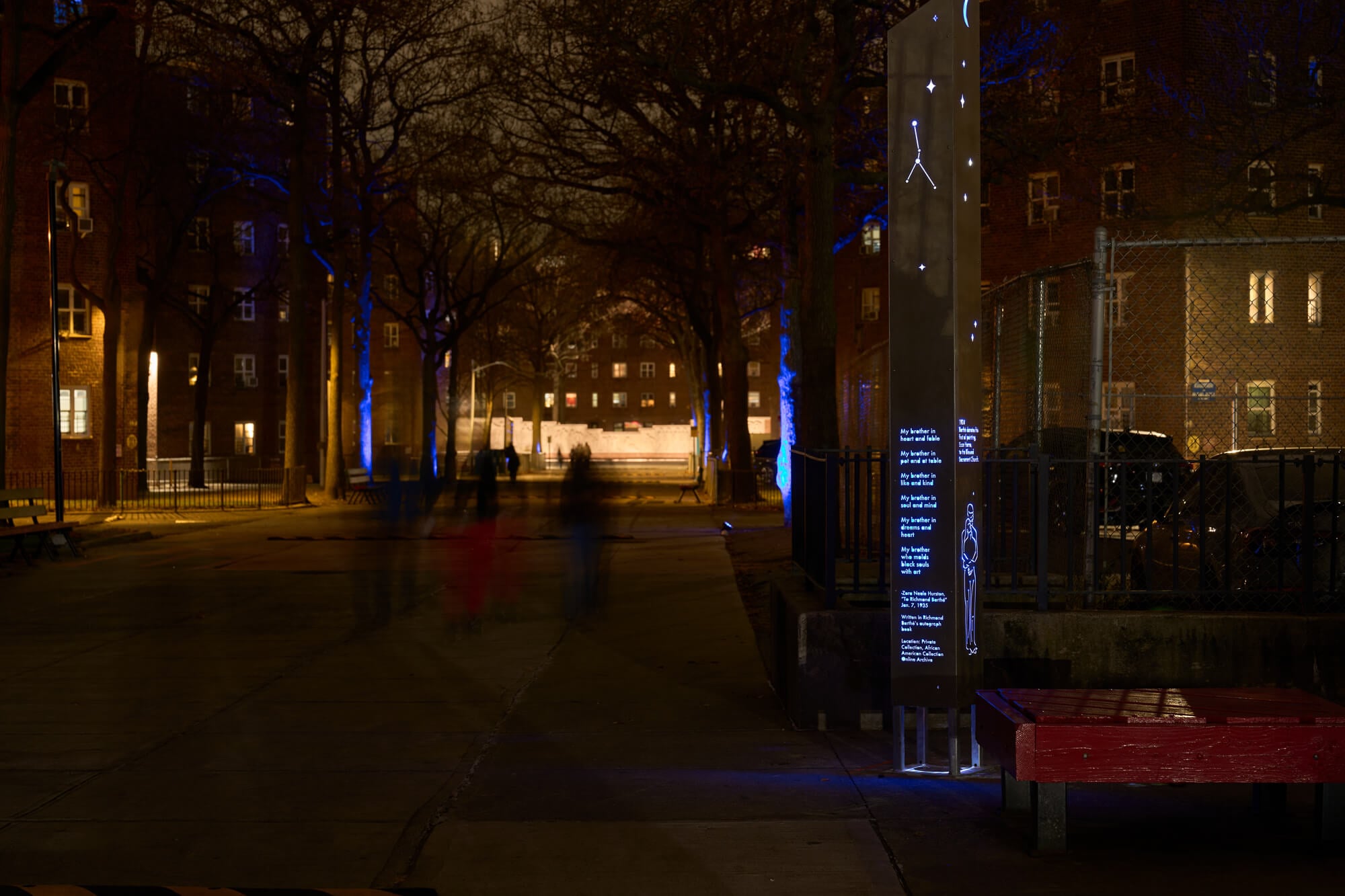
The installation effectively turns the landscape, originally shaped by Gilmore Clarke in 1941, into an open-air narrative about African American history. Evoking the historical journeys in Exodus and Dance, and the lived, ongoing passages that define Kingsborough today.
“Migration honors the generations who came before us and celebrates those who continue to make Kingsborough home today,” Angelina Whitaker, president of the Kingsborough Houses Resident Association said. “The stories, art, and light now woven throughout our campus remind us that our community is alive with creativity and resilience.”
→ Continue reading at The Architect's Newspaper

