
This weekend, the American Swedish Historical Museum will once again be ringed with warm plumes of cedar-scented steam. Scout, the Philadelphia-based design and development practice, reopens its Ebba Sparre Sauna Collective on December 13 for a second season, inviting Philadelphians to slow down and gather in three wood-fired barrel saunas set on the museum’s grounds in FDR Park.
“We see the sauna as a gathering space. A ritual. A moment to slow down together,” said Lindsey Scannapieco, Scout’s managing partner. “Projects like this remind us how even small interventions can create powerful opportunities for connection.”
Named for Ebba Sparre, the close companion and rumored partner of Queen Christina of Sweden, the project points to a little-known chapter of Swedish history. Queen Christina, an early-modern intellectual who later left the throne rather than marry, is central to that story. Scout uses this historical backdrop to frame the installation, linking Nordic sauna traditions with themes of independence, friendship, and community.
Last year’s debut quickly became a regional winter phenomenon. It was named Best Winter Warmer 2025 by Philadelphia Magazine, solidifying the Sauna Collective as one of the city’s more joyful cold-weather traditions. Each reservation includes free entry to the American Swedish Historical Museum, encouraging guests to explore exhibitions on Swedish culture before or after their session.
Set against the museum’s pale stucco arches and copper-green cupola, the saunas sit in a row along the forecourt. Each cylindrical pod is clad in honey-toned wood staves held in place by steel bands, with dark, curved roof caps that extend over the rounded entrances. Inside, is a continuous wood-lined interior. Tight-grained planks follow the curve of the structure, and slatted benches run along the perimeter.
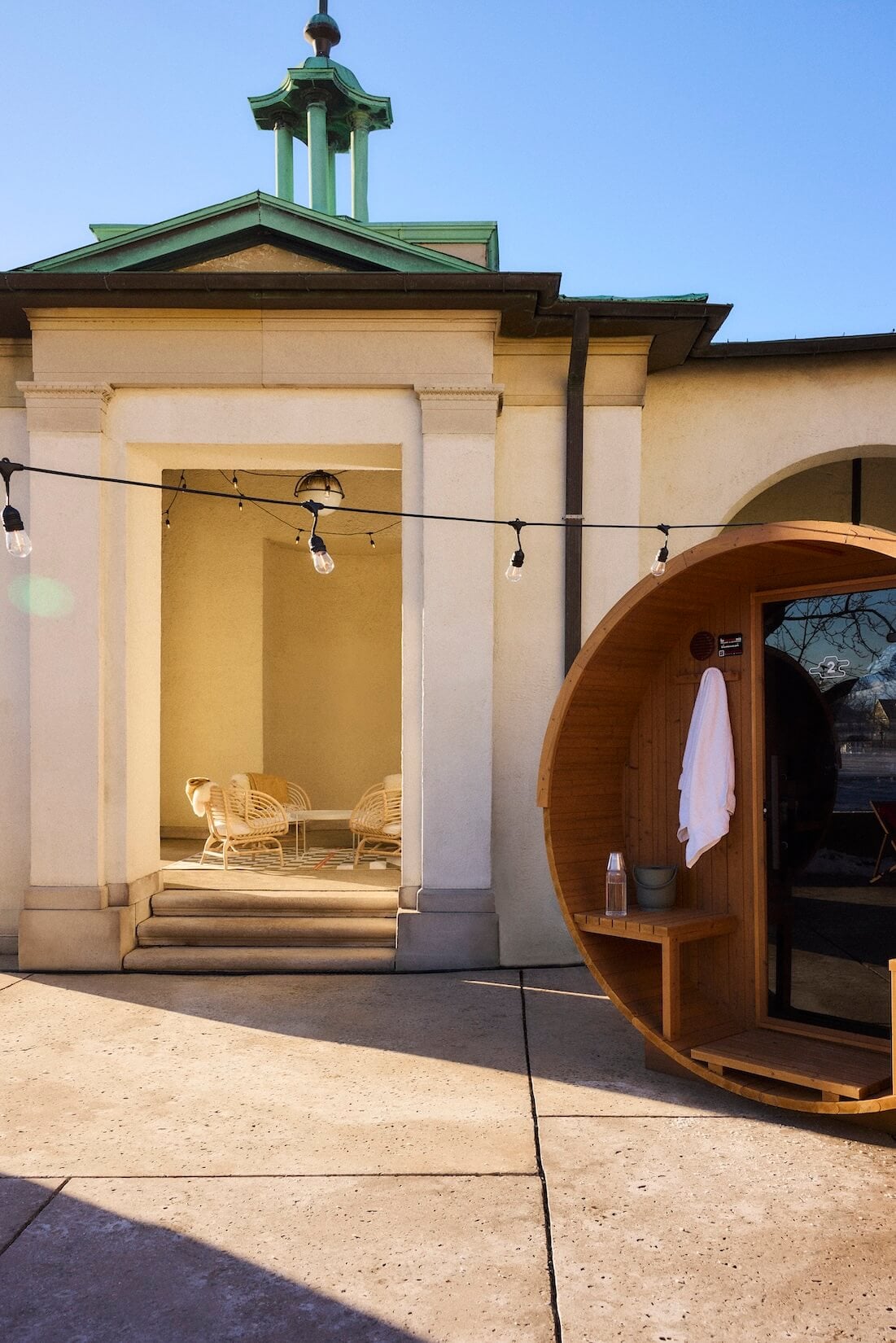
Wood is essential in a high-heat, high-humidity environment like a sauna. Softwoods such as spruce, pine, or heat-treated options like Thermory are hygroscopic, meaning they absorb and release moisture, helping to stabilize temperature and humidity. About 80 percent of the interior surface is wood to prevent the walls from becoming too hot to touch.
The project also embodies Scout’s broader philosophy that creativity is a civic tool, and that temporary structures can act as catalysts for community. Much like the firm’s adaptive reuse of the 340,000-square-foot Bok Building or its reimagining of 50 Sims in Providence, the Sauna Collective is meant to demonstrate how even small-scale, ephemeral environments can meaningfully shift how people interact with place.
The saunas will remain open through the winter season, offering visitors a chance to gather, warm up, and learn more about Swedish culture in FDR Park.
→ Continue reading at The Architect's Newspaper

