
By all accounts, the musical Shuffle Along should have never succeeded. An all Black production prospering in an era of sharp racial division seems unfathomable. Not to mention the fact that the show was deeply in debt and released post-1919 pandemic when many Broadway theaters still had their doors shuttered. It shouldn’t have worked, but it did. It was in a sense, undeniable.

This is the story of Shuffle Along, a groundbreaking musical both created and performed by people of color, a story so powerful, Langston Hughes credited it as the soundtrack that sparked the Harlem Renaissance.
The Creators Of Shuffle Along
What made Shuffle Along so unprecedented for the time was that it was truly an all Black production. And that started with the writers and composers. Shuffle Along was written by Flournoy Miller and Aubrey Lyles.
Miller and Lyles were a long-time duo who started out in Tennessee and wrote several plays in addition to acting and producing themselves. One of their first plays, The Mayor of Dixie would eventually be re-written and arranged for the narrative of Shuffle Along. In 1915, Miller and Lyles made a name for themselves starring in Darkydom, the first major black musical comedy.
When the duo then teamed up with the vaudeville team of Noble Sissle and Eubie Blake, magic happened. Blake, a pianist, served as the composer and Sissle was the lyricist. They first had success together with the 1915 hit, “It’s All Your Fault,” performed by vaudeville star Sophie Tucker.
The pair continued working together and struck gold on the nearly 20 songs included in the 2-act Shuffle Along, perking ears with their genre-blending mix of ragtime, jazz and vaudeville.
Opening Night
Shuffle Along debuted at the Sixty-Third Street Music Hall on May 23, 1921.
The play opened to around $20,000 in debt (approximately $350,000 in modern day terms). Needless to say there was initially little money left over to pay the cast after covering travel and production expenses.
The play was a labor of love and success was never guaranteed. But even before the play ever premiered Black performers from around the country flocked to New York for the casting call. Everyone involved knew the risks but marched on steadily.
Still, the show became an instant hit. The story itself centers around the story of a mayoral race in the fictional “Jimmytown” and was the first to feature a nuanced romantic plot between two Black characters. Nonetheless, the play was perceived as funny and lighthearted, full of vibrant dancing and song. In a post-pandemic society, Shuffle Along undoubtedly lent an air of escapism and joy to theatergoers.
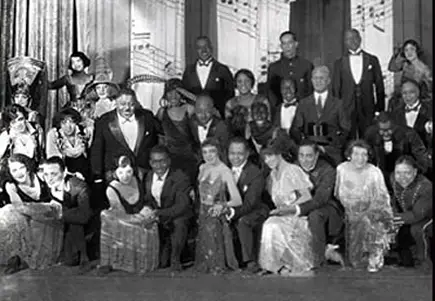
Famously, police had to re-route 63rd street into a one-way road to ease the congestion caused before and after the play. Notably, tickets were priced the same as any other Broadway show, with expensive orchestra seats going for as high as $2 to $3. In total, Shuffle Along ran for 504 performances at the Cort Theatre.
Meet the Cast
Not only were the creators of Shuffle Along African American, but so was the cast and the musical pit. Shuffle Along launched the careers of many of its actors including Josephine Baker, Adelaide Hall, Paul Robeson and more. Baker, for instance, would star in The Chocolate Dandies in 1924, also composed by Blake and Sissle. She also became the first Black woman to star in a major motion picture, Siren of the Tropics, in 1927.
The orchestral pit was famously headed by William Grant Still, known by many as the Dean of African American Composers. The pit also featured several famous zarzuela musicians from Puerto Rico, who previously were frequently prohibited from playing in white orchestras. Their presence added to the unique genre fusion of Shuffle Along’s songs and the syncopated rhythms of the music.
Who’s Watching
What made Shuffle Along so groundbreaking was also the audience. This wasn’t just a musical that appealed to fellow African Americans. In fact, the majority of theater patrons were white, many even famous celebrities and artists.

The musical attracted notable figures like W.E.B. Du Bois, Langston Hughes as well as white songwriters Irving Berlin, Al Jolson and Cole Porter. Importantly, Black attendees were not relegated to the balconies. This was crucially a completely non-segregated, racially-integrated audience.
It is worth noting however that despite the progressive nature of the play, the Black performers notably still used blackface, as was common at the time.
An Inspiration For All
Shuffle Along notably paved the way for a golden era of Black musicals on Broadway. Shuffle Along proved that both Black and white audiences would pay to see African American performers on stage. In short, it legitimized the African American musical.
In 1923, Miller and Lyle starred in Runnin’ Wild, yet again bringing a historically Black dance to the Broadway stage in the form of the Charleston. Ravella Hughes, another Shuffle Along alumni, choreographed the dances.
In total, nine African American musicals opened between 1921 and 1924. In 1929, the play Harlem introduced the Slow Drag to the state. Popularity of these shows continued all the way into the early years of the Great Depression.
Langston Hughes wrote in his 1940 memoir The Big Sea:
“The 1920s were the years of Manhattan’s Black Renaissance. It began with “Shuffle Along…a honey of a show,” “Swift, bright, funny, rollicking, and gay, with a dozen danceable, singable tunes…Everybody was in the audience—including me. People came back to see it innumerable times. It was always packed…It gave just the proper push—a pre-Charleston kick—to that Negro vogue of the ’20s, that spread to books, African sculpture, music, and dancing.”
A Lasting Legacy
Shuffle Along, although often overlooked considering its historical significance, has continually made its presence known, appearing back on Broadway a handful of times after its premiere, emerging again in 1933 and 1952, albeit to much less success. The song “I’m Crazy About Harry” also experienced a revitalization in 1948 when Harry Truman used it as his official campaign song.
Most recently the play was reimagined in a 2016 production starring Tony winners Billy Porter, Audra McDonald and Adrienne Warren.
It would be difficult to overstate the impact of the musical Shuffle Along. Simply put, it paved the way for a flourishing of creativity and expression among the Black community and also led to a level of exposure to new audiences that had never been seen before.
→ Continue reading at NYS Music

