
The National Capital Planning Commission (NCPC) met today to discuss the East Wing Modernization Project, the Trump administration’s proposal for a new ballroom designed by Shalom Baranes Associates.
The hearing happened after the project was presented to, and then subsequently approved by, the U.S. Commission of Fine Arts (CFA) on February 19.
Today, NCPC Chairman Will Scharf approved the ballroom project to move forward for deliberation, and said the NCPC will hold a final vote in April. The full set of drawings that were submitted to the NCPC can be accessed here.
Ahead of the hearing, Shalom Baranes Associates was asked by Scharf to prepare view shed studies from Lafayette Park, 16th Street, the south side of the White House executive mansion from E Street, and other corridors.
Shalom Baranes presented animations of the proposal at today’s hearing, to convey how the ballroom will not overshadow the executive mansion. Rick Parisi, the landscape architect Baranes is collaborating with on the project, also presented at the hearing. Parisi is principal-in-charge of MPFP.
Fisher Marantz Stone, the New York–based lighting design studio working with Baranes on the project, did not attend the hearing, however, Baranes presented its design scheme to the commission.
The west elevation was changed since the design was last presented to the public. Shalom Baranes Associates proposed a new arched window to “simplify the composition,” Baranes said.
In regard to the landscape design, South Lawn Drive will be reconfigured as part of the construction project. Parisi said the design team is considering southern magnolias for the East Wing garden.
The NCPC concluded that “critical views of the executive mansion will not be impacted,” because it would be mostly veiled by “large oaks and evergreen trees,” Parisi said.
As for the paving, the designers are considering Mount Vernon brick and large stone for the ground surfaces, Parisi said, before noting that a fountain will be relocated, and four topiary trees will be replanted.
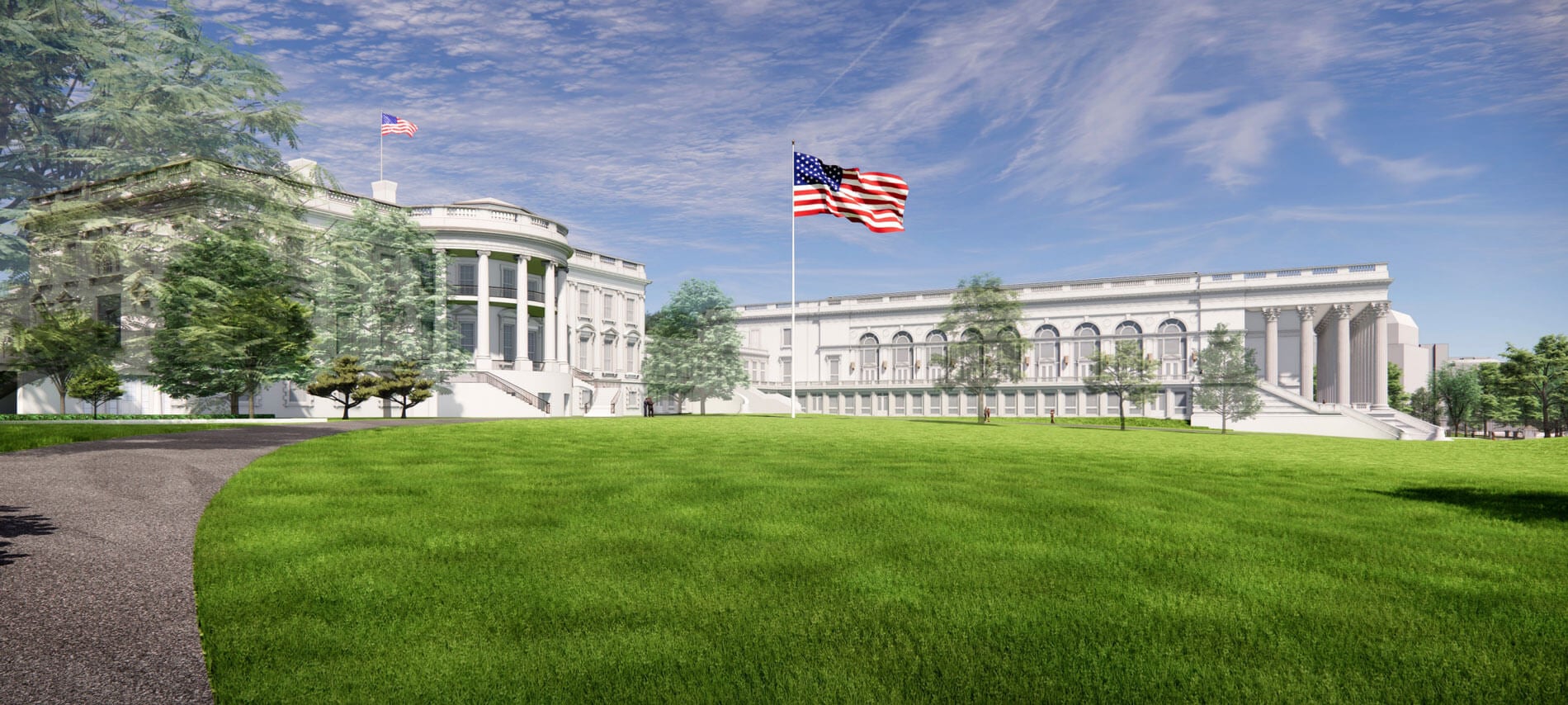
View corridors of the White House from the Washington and Jefferson Monuments would be altered by the East Wing ballroom, the NCPC said.
Arrington Dixon, a NCPC member, asked Baranes if the East Wing ballroom will have solar panels on the roof. Baranes told Dixon there will not be solar panels on the roof.
In the previous NCPC meeting, much of the conversation pertained to the height of the building, namely that the addition may be taller than the executive mansion. Today, NCPC stated the ballroom will not exceed the height of the executive mansion, which is approximately 60 feet.
Baranes said that a pediment that had been previously proposed was removed as part of the updated design in order to meet this height requirement.

Prior to the meeting, more than 38,000 comments about the project poured in from the public. By comparison, for the recent CFA meeting, over 2,000 messages were received from the public, and “over 99 percent” of them were in opposition to the project.
Carol Quillen, of the National Trust for Historic Preservation; Priya Jain, from the Society of Architectural Historians; Rebecca Miller, of the DC Preservation League; architect David Scott Parker and other opponents of the project gave testimonies today at the NCPC hearing.
Quillen asked for a smaller ballroom that’s lower in height in order to preserve the “symbolic connection between executive and legislative government,” she said. Parker had similar critiques of how view corridors will be altered.
Parker said the ballroom defies industry standards; he also said the south portico is “illogical” and that the floor is inaccessible, among other critiques. Jain likewise said the addition needs to maintain the “visual supremacy” of the executive mansion, and noted the ballroom “disrupts the harmony” of the grounds and “overwhelms everything.”
Jain emphasized that the project denotes the first major change to the White House’s exterior in 84 years, and therefore criticized the project’s “rushed timeline.” (Miller also criticized the project schedule and poor communication with the public.) Jain requested the design team to “remove unnecessary features” that overshadow the executive mansion.
The full statement issued March 3 by the Society of Architectural Historians outlining the organization’s position can be accessed here.
Jim Steitz, a citizen unassociated with architecture and preservation groups, spoke in his capacity as a U.S. citizen. Steitz called the ballroom “a gilded edifice to one man’s ego.”
→ Continue reading at The Architect's Newspaper

