
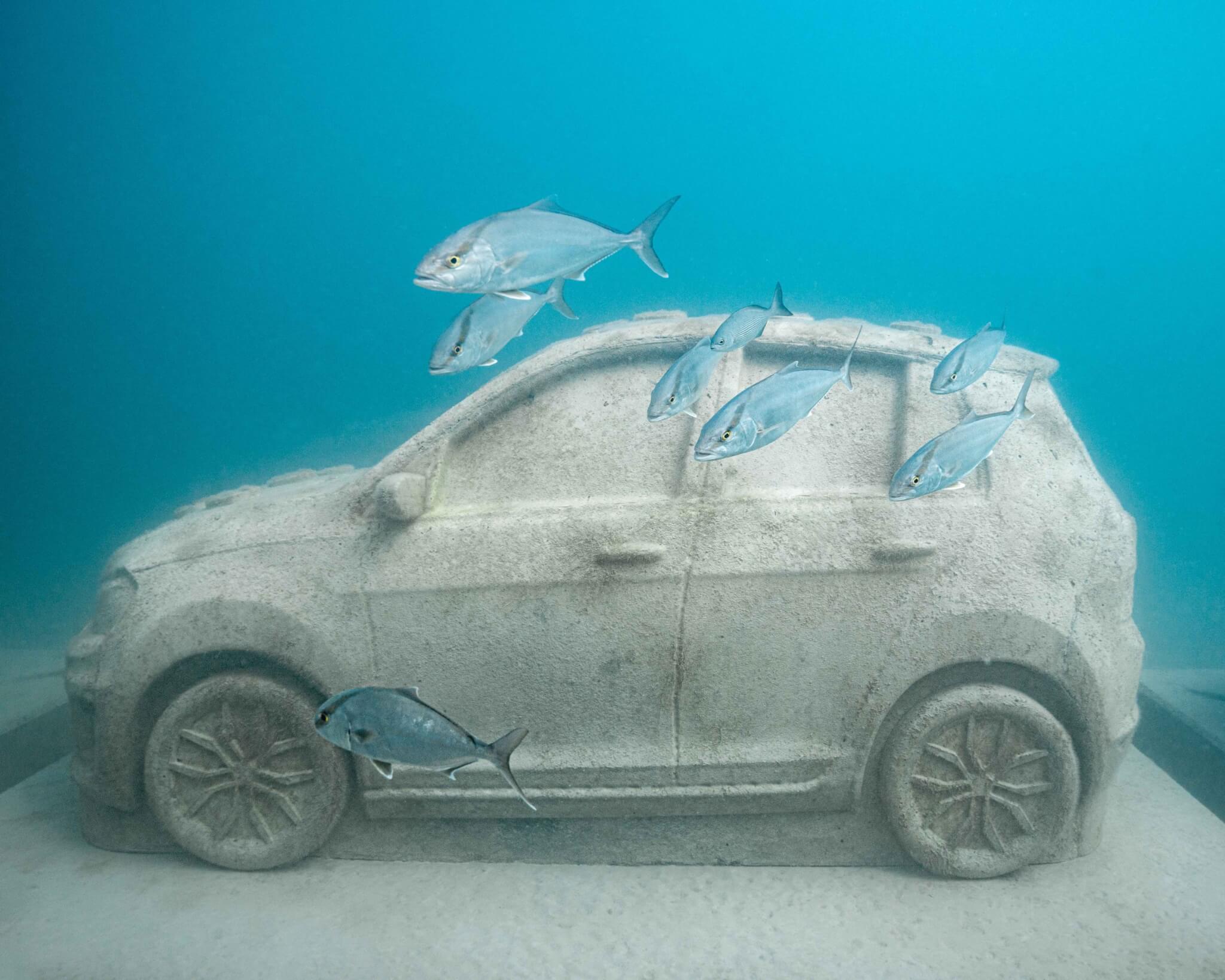
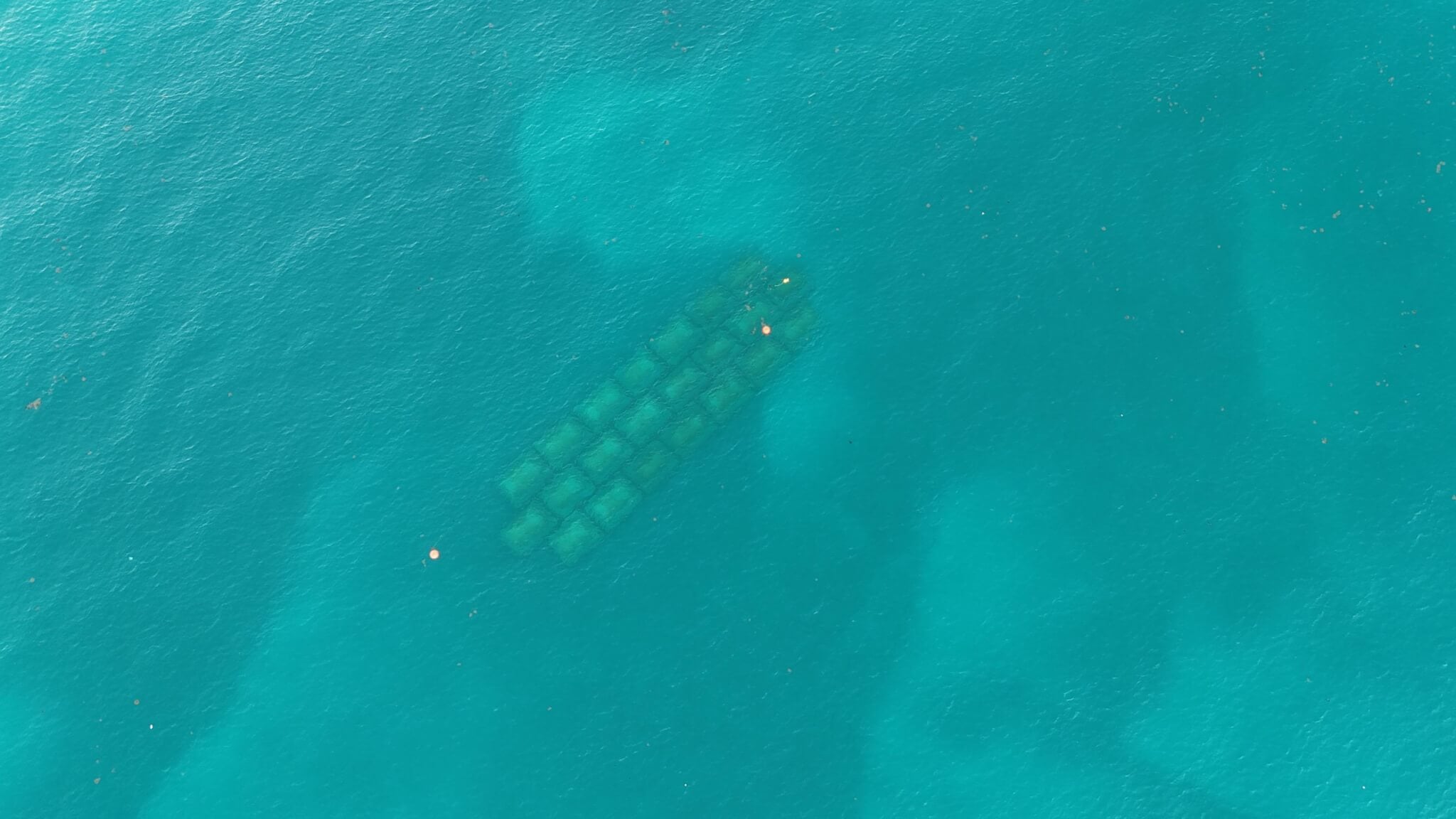
From above, Concrete Coral looks like a submerged parking lot lost to some ancient flood. Up close, amid the bright blue waters, fish weave through the hollow windows and circle hubcaps stippled with early-stage marine fuzz. The familiar weight of everyday urban clutter was dropped into the calm water just off Miami Beach.
Concrete Coral, by artist Leandro Erlich, is the first installation of REEFLINE, Miami Beach’s ambitious new underwater sculpture park and hybrid coral reef. For four days in October, beachgoers watched as a 159-foot construction barge hovered offshore, lowering 22 life-sized concrete cars, one by one, into the Atlantic. Each landed on its pad nearly 800 feet from the shore, completing a surreal table arranged 20 feet beneath the waves.
The cars were cast from marine-grade concrete, engineered to invite life. Soon, divers from REEFLINE’s Native Coral Lab will seed the installation with 2,200 corals using Coral Lok, a fast-bonding method meant to anchor living fragments securely to the sculptures. Over time, the traffic jam should bloom, turning an indictment of congestion into a deliberately built ecosystem for fish, invertebrates, and declining native corals.
REEFLINE was the idea of Ximena Caminos, working with a master plan by Shohei Shigematsu and OMA. Envisioned as an underwater corridor spanning the full seven-mile length of Miami Beach, the project intertwines sculpture, marine science, and coastal engineering. The city’s long, flat shoreline is a prime testing ground for hybrid reefs designed to absorb wave energy, slow erosion, and stabilize the seabed. The installation of Concrete Coral marks the first major step, backed by the 2022 Arts & Culture General Obligations Bond and supported by a wide cast of scientists, architects, environmental advocates, and public officials.
Out on the water during deployment, cranes swung each car overboard. From the beach, the cars are visible only as shifting dark shapes amid turquoise waves. Swimmers and paddleboarders were kept clear until everything was secured on the seafloor.
Erlich’s installation suggests a quiet reversal of Miami’s usual narrative. Instead of a city imagined as sinking beneath the weight of cars and rising seas, the cars sink first, settling on the ocean floor and becoming unlikely forms of refuge. His past installations include another eye-catching art stunt that gave the illusion that museum-goers were hanging off a building facade. The project was on view in the Liberty Science Center in Jersey City, New Jersey.
Already, schools of jack and spadefish weave through the cement chassis and slip between open windows, treating the scene not as spectacle but as habitat. The effect is a small preview of the ambition behind REEFLINE. Over the next decade, the project aims to nurture thousands of new coral outplants, create a chain of monumental underwater artworks, and build a living classroom for residents, students, and visitors who come to learn from the coastline’s shifting ecology.
“REEFLINE shows how creativity can drive real solutions for a changing planet,” said Caminos. “We’re transforming art into an engine for marine ecosystem enhancement and education. What begins in Miami Beach — once seen as ground zero for sea level rise — can become a model for cities around the world.”
→ Continue reading at The Architect's Newspaper

