
When a catastrophic fire broke out at Wang Fuk Court in Hong Kong’s Tai Po district in November, killing 160 people, the apartment complex had been undergoing renovations to repair the buildings’ exterior walls. Bamboo scaffoldings had been erected to the full height of the approximately 328-foot-tall towers.
Though it has since been confirmed by authorities that highly flammable materials, such as substandard green mesh netting and styrofoam boards covering the windows, were the main contributors for the speed and spread of the fire, bamboo scaffolding quickly came under scrutiny from officials in the fire’s aftermath.
Much of Hong Kong’s public reacted swiftly in its defense. Online and in the streets, people argued that the material had long been unfairly maligned and could not have driven the blaze. Yet with each day that has followed the fire, the regulatory noose for the craft has tightened, calling in to question the future of bamboo scaffolding in Hong Kong.
However, the shift away from bamboo had begun months earlier. On March 17, 2025, the Development Bureau issued a directive encouraging “the wider adoption of metal scaffolds in public works.” The statement acknowledged bamboo’s speed, flexibility, and low cost, but framed metal as more aligned with practices in China and in “advanced economies.” Scaffolders reacted stoically.
Some wondered whether China’s rising steel inventories played a role. The directive alone did not amount to a ban, yet it marked a turning point in how the government positioned bamboo—no longer as an unquestioned part of Hong Kong’s building logic, but as a system to be reconsidered. One that has served the city for well over a century and enabled the vertical expansion and unmatched urban density, and can be envisioned when Chan Siu Fan, a third generation master bamboo scaffolder tells me in an interview, which was conducted as a part of my research on bamboo scaffolding: “Anywhere a person can fit, I can build a bamboo scaffold.”
To understand what stands to be lost, one must look closely at the material itself—and at the people whose skill gives it form. Bamboo scaffolding resists neat classification under contemporary regulation because its intelligence is not industrial but material. A bamboo pole is light yet exceptionally strong: fibers run straight along its length, resisting bending, while its hollow cylindrical form carries compression efficiently. What appears as flexibility—the slight sway of a scaffold in the wind—is, structurally, one of bamboo’s greatest advantages. It absorbs movement instead of fighting it.
Where a metal scaffold must be braced and anchored to avoid deformation, a bamboo scaffold is meant to adjust, it can take up wind, vibration, and the everyday forces of construction by bending and resettling without losing integrity. This characteristic is especially important in a city that experiences strong winds during typhoons.
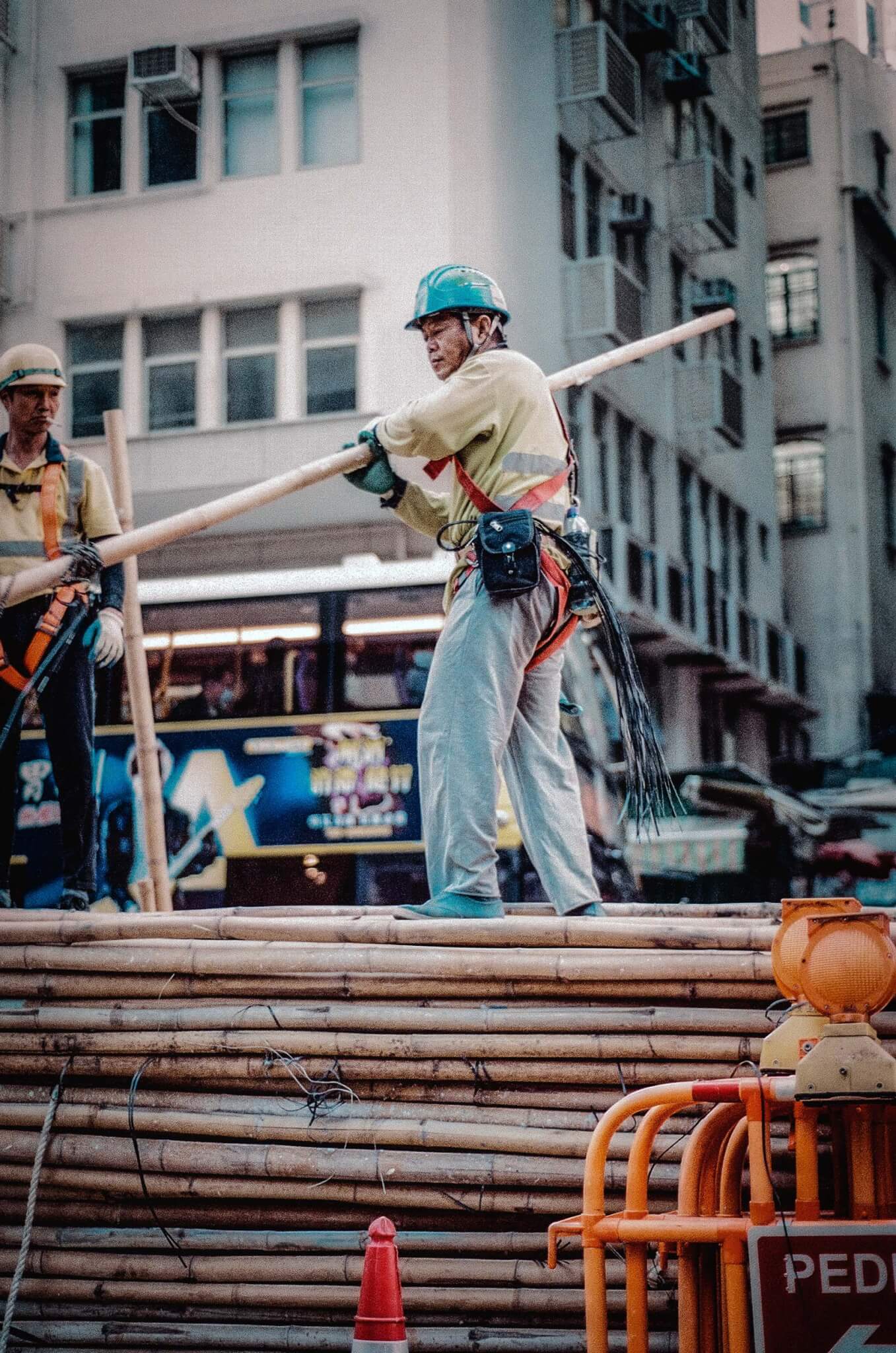
The scaffoldings in Hong Kong use two locally available bamboo species, called kao jue and mao jue, of which the external diameter at base are around 1.5 inch and 3.15 inch respectively. The poles are green when harvested, indicating a high amount of moisture and usually dried under the sun for around four weeks until they turn yellowish, before going on site.
While bamboo is a combustible material, its behavior in fire is shaped by its density, hollow structure, moisture, and silica content, which can make it relatively resistant to ignition. Though it remains flammable, its performance depends heavily on the materials and conditions with which it is combined.
Behind the material properties lies a craft system that is just as sophisticated. Every joint—bound today with standardized nylon in place of the historically used split bamboo—contains a tacit calculation: angle, tension, grain behavior. As engineer S. Ramanathan wrote, bamboo scaffolds are “self-verifying,” their stability tested continuously through the movement of the worker assembling them. The craft is embodied in each scaffolder and passed down from generation to generation.
When accompanying two scaffolders, Timmy So and his father So Sifu, on a job they told me about the importance of learning to work without gloves, noting “the body must feel the tension of the knot and the space that is left between the poles for movement.” This feeling is hard to translate into a user manual. “You have to practice to master it,” said So Sifu.
The technique dates back at least 2,000 years and in the more recent history has been used to build some of the city’s tallest skyscrapers, like Norman Foster’s HSBC headquarters in Hong Kong’s Central district. Aside from serving an essential use in the construction of new high-rise towers, bamboo scaffoldings are often also used in small-scale renovation projects, where space can be even more cramped in Hong Kong’s tight urban fabric.
Watching the 65-year-old master swing himself up across the structure as his son handed him 7-meter-long bamboo poles, the processes behind building a scaffolding structure began to feel like a theater piece. However, Timmy explained that building is only a small portion of what scaffolders do, and that before this three-hour job he had spent two days in the office filling out paperwork to meet the city’s stringent regulations.
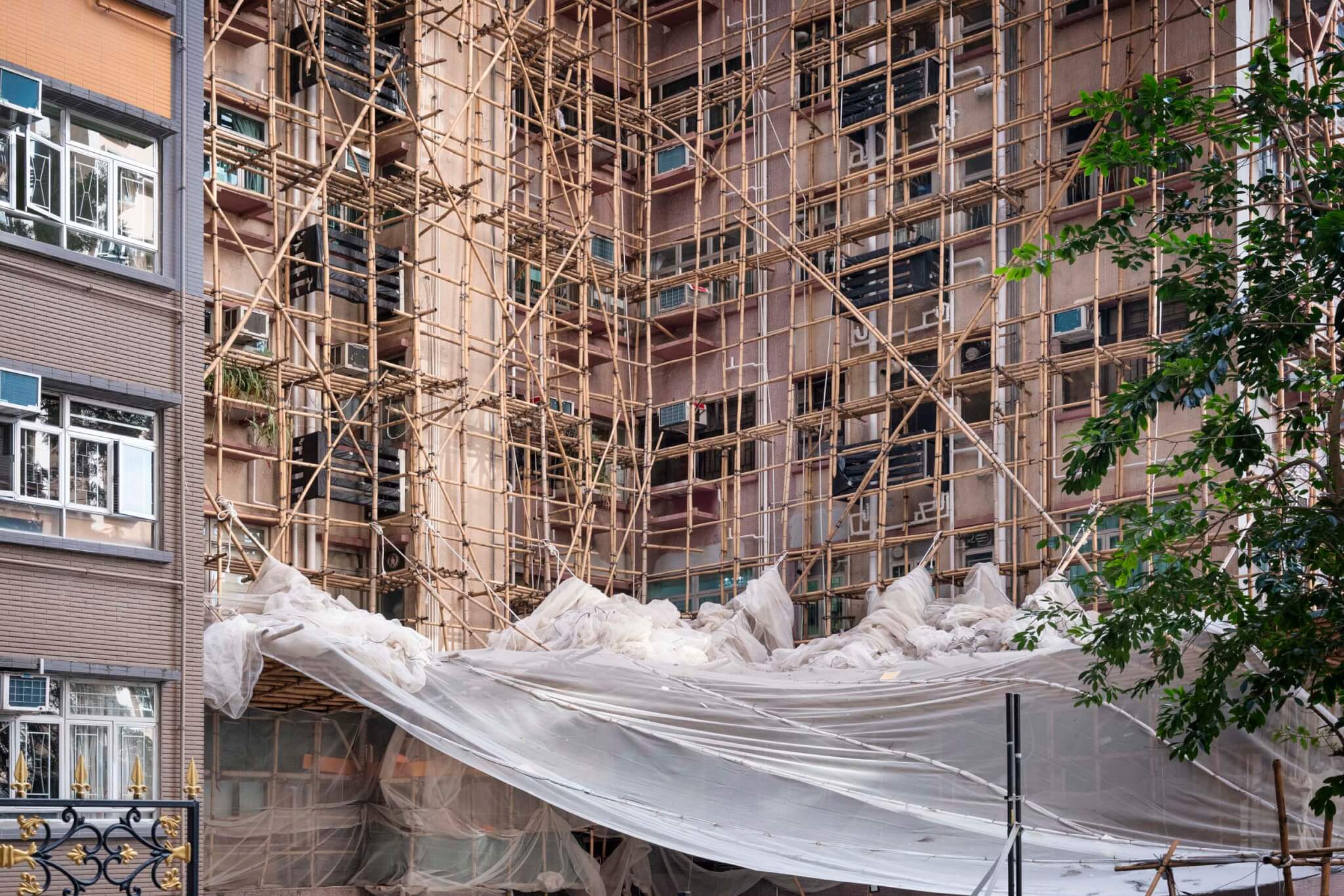
After an investigation of the fire, officials found that the green netting on the exterior layer of the scaffolding, which serves as protection from debris and dust during construction, was below fire-retardant standards in the case of Tai Po. The upper parts of the towers had been wrapped in a cheaper and highly inflammable netting. This led the government to establish a new regulation in the weeks following the fire requiring the removal of all protective meshes from scaffoldings across the city, leaving them in their naked, skeleton-like form.
However, also in the week following the Tai Po tragedy, the Hong Kong Construction Industry Council (CIC) has suspended the 122-day training and assessments for bamboo scaffolders. This suspension marks another obstacle for an industry with an already aging labor force—the majority of the 3,000 licensed scaffolders are in their fifties or early sixties. These changes risk the acceleration of bamboo scaffolding’s decline, and if further action isn’t taken, the craft may disappear within the next generation.
What remains is a question not simply of regulation but of value. What does Hong Kong choose to honor as part of its architectural identity? What forms of knowledge does it allow to persist?
Bamboo scaffolding is not nostalgia; it is a living, adaptive system that has enabled the city’s architectural ambitions for more than a century. To lose it now—through policy, misconception, or neglect—would be to sever a way of making that is inseparable from Hong Kong’s spatial and cultural intelligence.
Raffaella Endrizzi is a Swiss architect and photographer, living in Hong Kong since 2020 and currently working on an archive/research project on bamboo scaffoldings.
→ Continue reading at The Architect's Newspaper


_at_26_Nov_1745.jpg)

.jpg)