
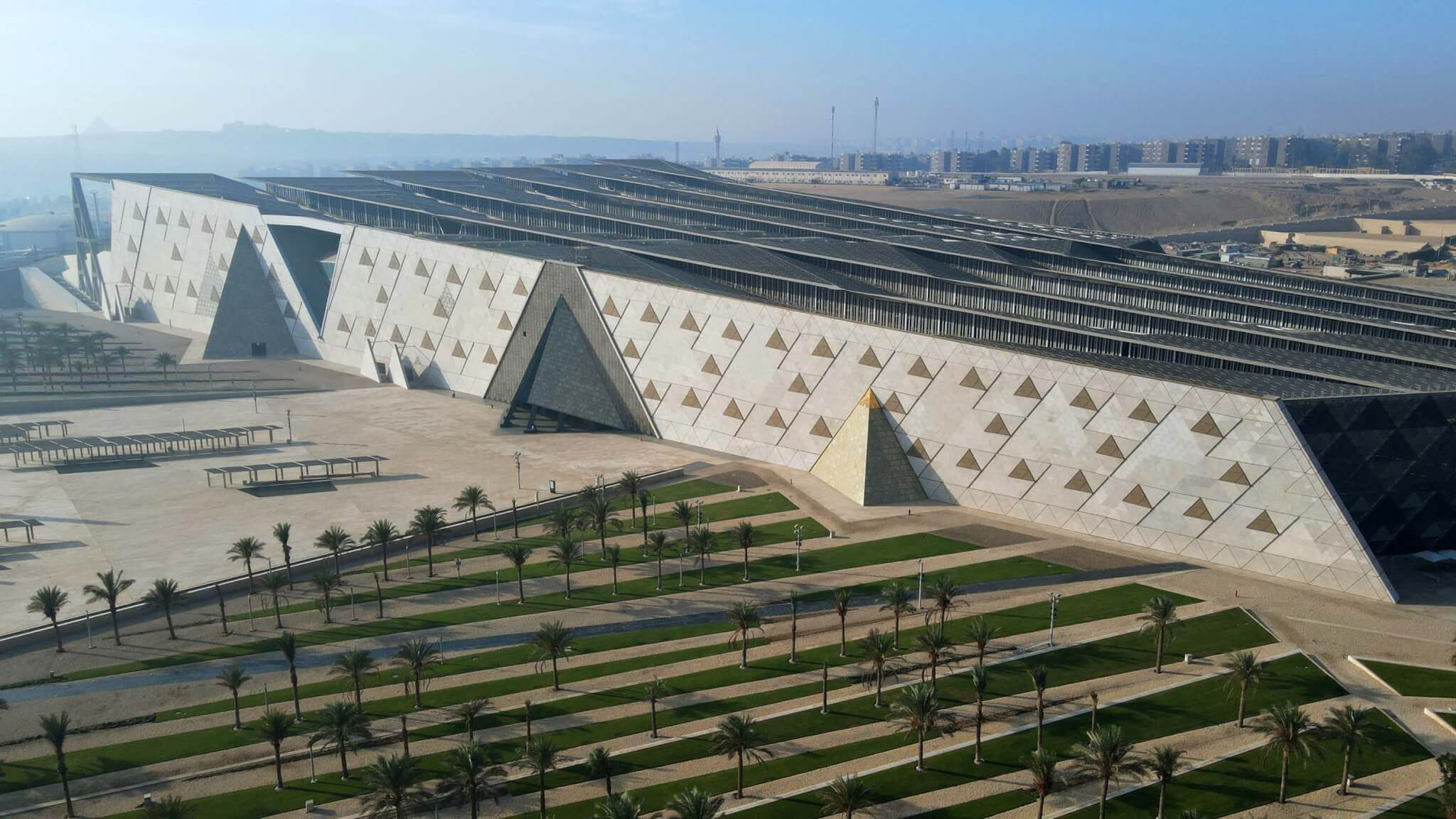
The Grand Egyptian Museum (GEM) is built on a diagram: a fan of perspectival lines drawn from the state’s arbitrarily selected site toward the pyramids. In the competition renderings, this gesture felt decisive, with rays of lines arrayed outward toward the only surviving wonders of the ancient world, organizing a building that would literally orient itself toward antiquity. But diagrams behave differently in reality. The vanishing point of the scheme does not fall on the plateau; it falls in a highway interchange. What should have been the architectural home of one of the world’s most important collections instead became a building governed by an abstract, geometric impulse inscribed into the massive site by what was then a young architecture office in Dublin.
Ancient Egyptians aligned stone to stars with exacting accuracy. GEM, armed with laser scanning and computational modeling, could not even align the incline of the decorative “pyramids” affixed to its facade with the real pyramids rising in full view. That misalignment explains the entire building’s shortcomings. One civilization used geometry to construct meaning; the other is more concerned with branding.
From the inception of the project, the official narrative insisted on grandness: the largest archaeological museum in the world, the grand staircase, the grand atrium, the grand plaza, the grand views, and on. Such bigness is not an architectural idea but a marketing gimmick. Architecture needs proportion, intention, hierarchy, and material logic; GEM substitutes all of these with scale. It is conceived not around the objects it houses; rather, the building is designed as an object in the landscape. Seen from the air, the parti holds. Seen from inside, it evaporates.
There are two primary problems with this project: scale and authorship. The main challenge of a museum like this, given its location, is whether to design for the grand scale of the nearby pyramids or for the intimate scale of the museum’s highlight objects like the mask of Tutankhamun, whose collection is being comprehensively displayed for the first time. The conceptualization of the design could have reconciled these two radically different scales in a cohesive architectural language. Instead, the scale of the site became the engine of the gesture that shapes the design; the collections to be housed within were not considered. The result is a series of massive halls that resemble an airport terminal in their proportions. Upon completion of construction, other consultants had to be brought in to design the actual exhibits, retrofitted into the building after the fact. This raises the second issue, that of multiple authors.
The 2003 competition was won by heneghan peng, whose proposal bore the marks of early-career ambition—namely, a diagram too elegant on paper to survive construction. After the selection, responsibility became diffused. Arup handled structure and facade engineering, West 8 the landscape, Metaphor the exhibition master planning, Cultural Innovations the museology, and Atelier Brückner the displays in the galleries. Then came Orascom and the Egyptian military contractors, whose finishing decisions determined most what visitors actually see.
From Perspectival Diagram to Grand Caricature
The exterior illustrates the collapse of the architecture from diagrammatic scheme to built form. The competition imagery implied a monolithic stone facade—alabaster planes folding in response to light and geometry. The built reality is a field of cladding triangles, a pseudo-Sierpinski raster spread across surfaces with no structural, symbolic, or spatial necessity. The triangles exist because the pyramids are triangular. This is not concept; it is approximation.
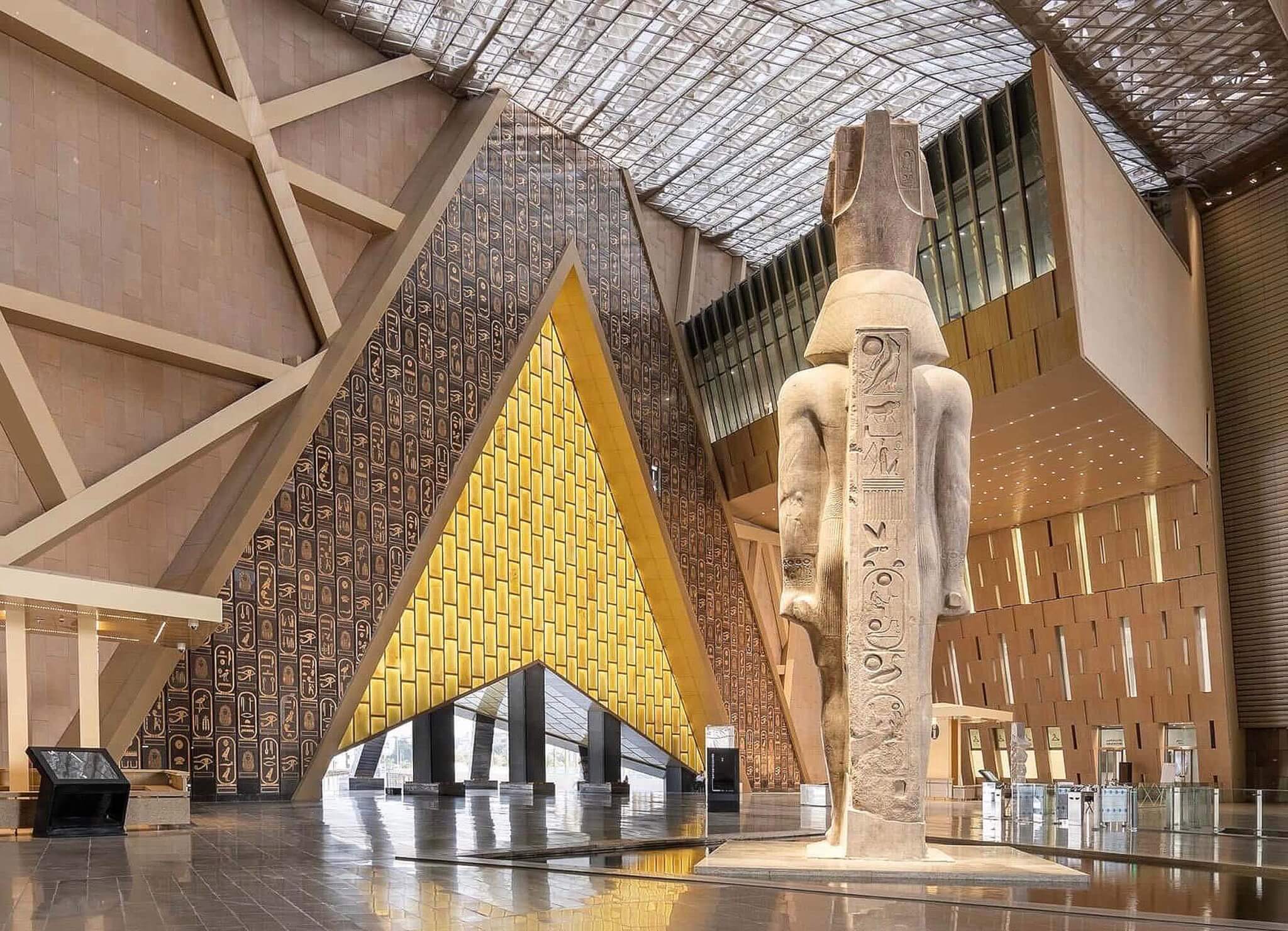
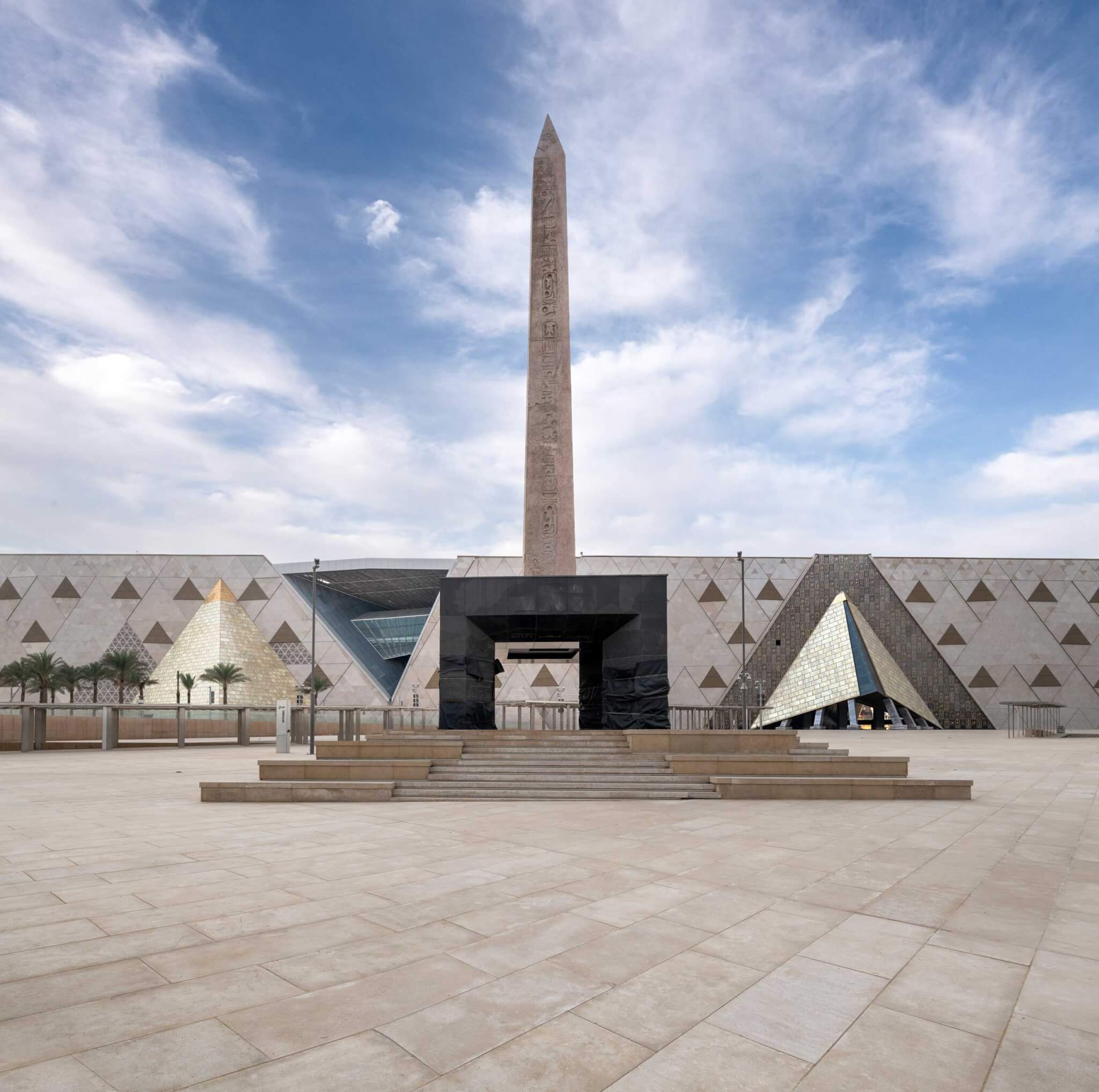
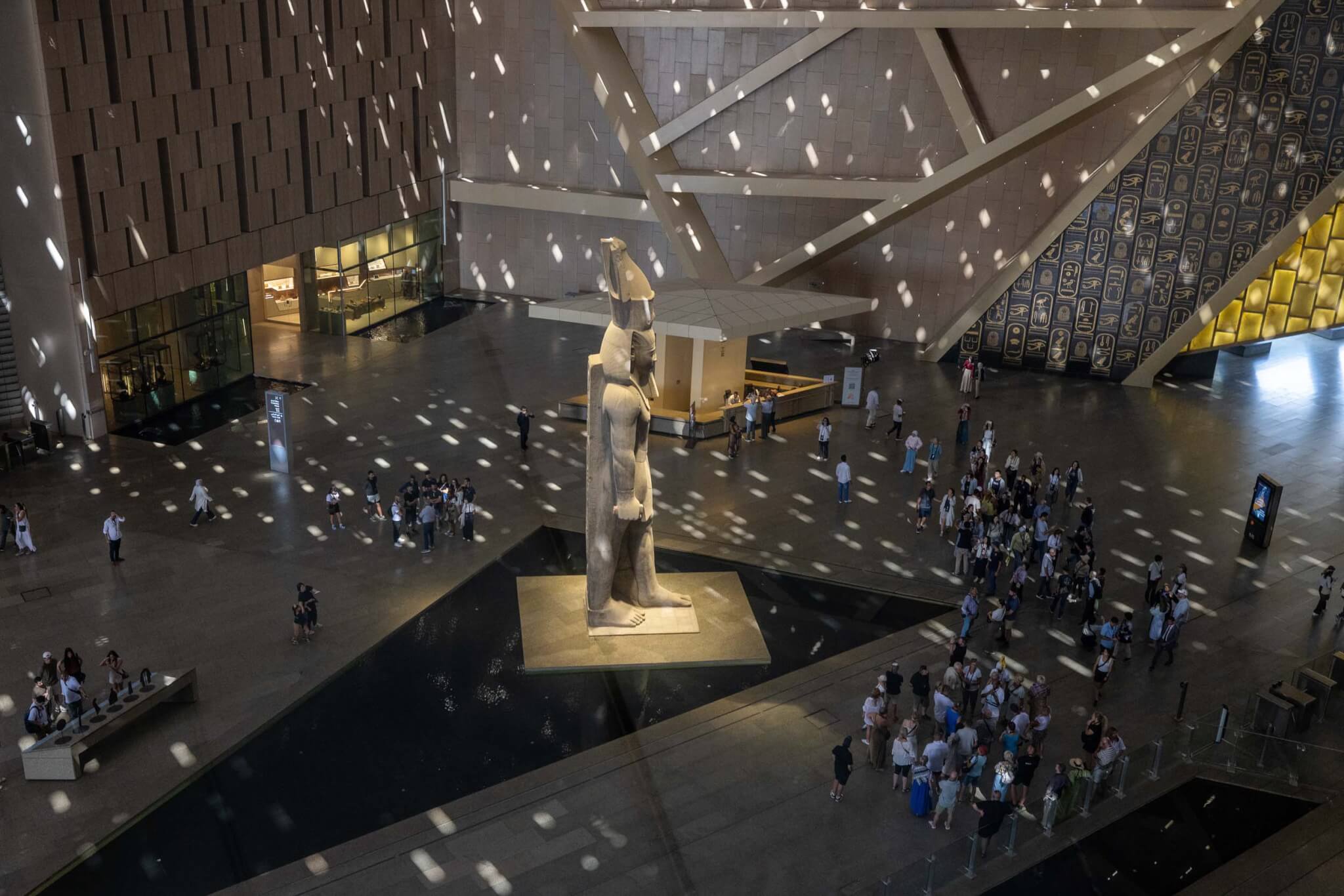
Worse, the facade includes hieroglyphic cartouches said to be the names of ancient kings and queens—including a stylized rendering of the Tutankhamun mask—deployed as graphic noise framing the entrance pyramid. The result is an oddly anthropomorphic form: The folded cladding reads like a lifted skirt propped on splayed legs under which visitors enter. It is difficult to imagine a clearer illustration of concept collapsing into caricature. A museum devoted to a civilization whose writing system was deciphered over 200 years ago chooses to engrave nonsense on its walls, framing an entrance that reads less as intentional architecture than as a late-stage bolt-on, absent altogether from the original competition elevations. The meeting of facade materials is crudely resolved, as it relies on graphic rather than architectural solutions.
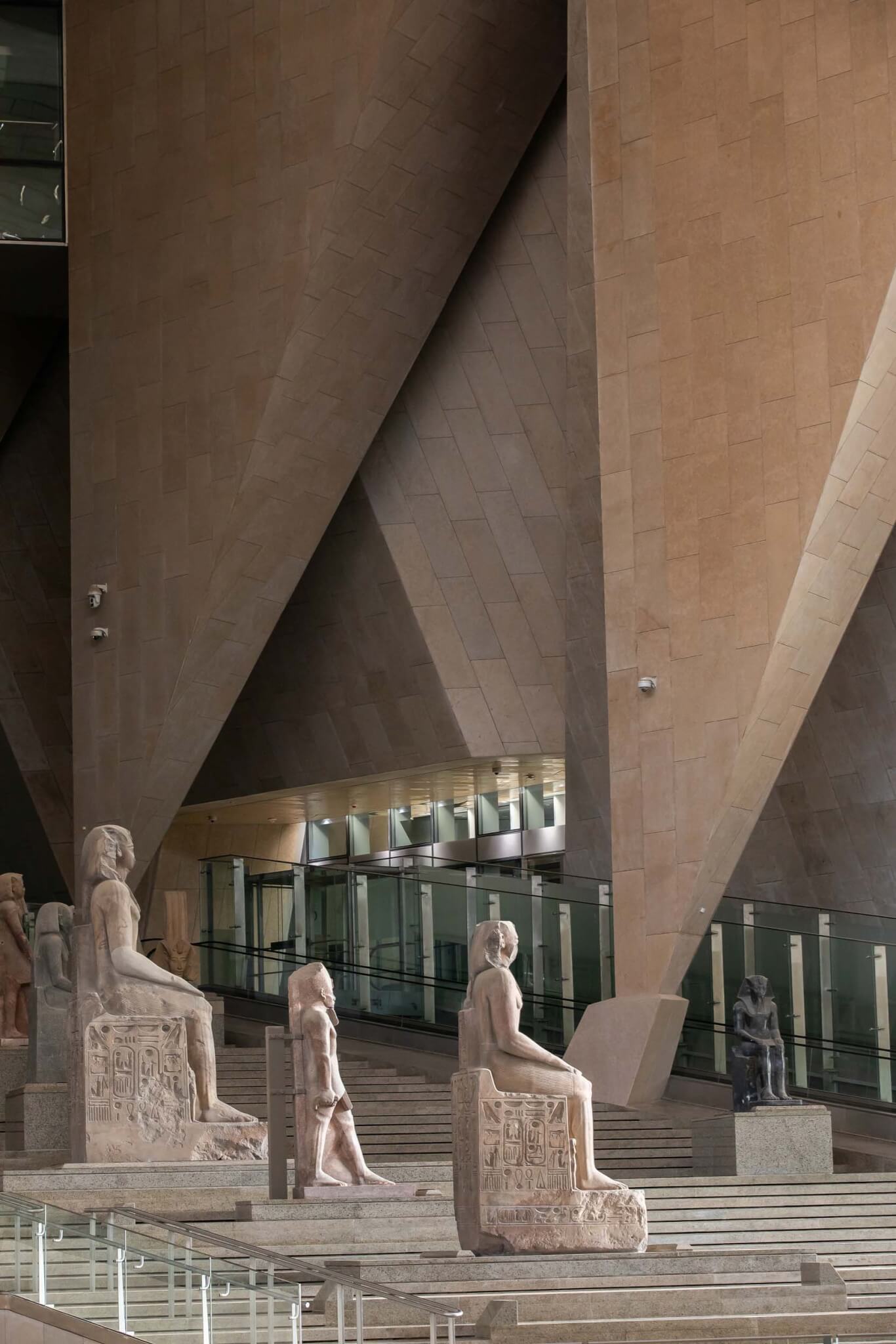
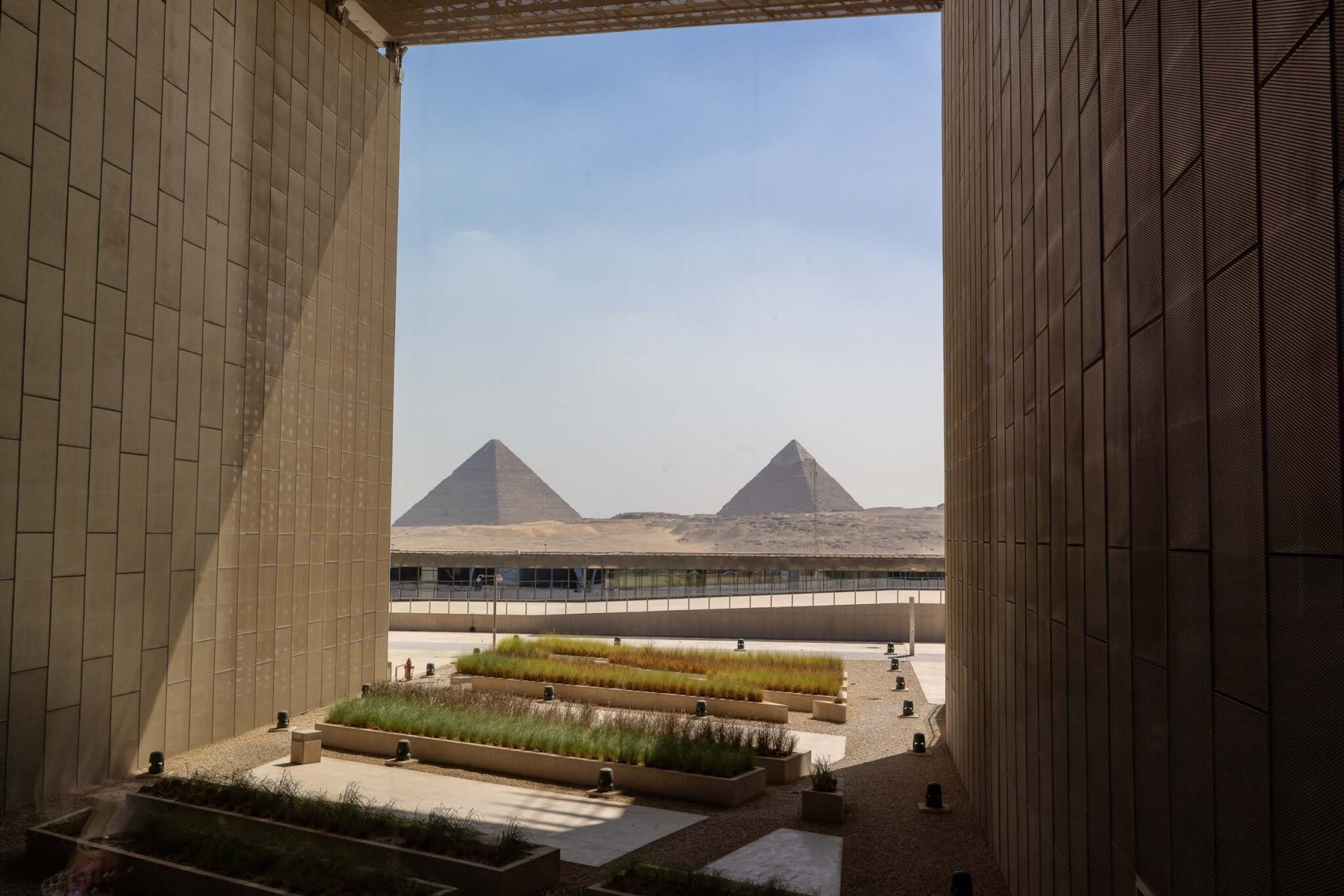
Inside, the facade is bracketed with diagonal structure and mismatched angles. Although massed as one monumental structure, the Grand Egyptian Museum is effectively two buildings stitched together: a museum wing separated by a vast atrium from an events/commercial/administrative one. The atrium is grand in scale but lacks a cohesive vision; instead, it is the meeting point of fragments. The monumental stair dotted with statues of kings and queens is photogenic but dwarfs the displayed objects; they are reduced to props to entertain the visitor on the long climb. The climax is a framed view to the pyramids, the very site the entire building is oriented toward in plan, but it falls flat as the foreground is dominated by the cladding of the structure’s jutting walls, diminishing the pyramids in the distance.
Museography After the Fact
The most damning architectural failure of this museum is that the spaces do not feel designed for the objects on view. Instead, it has been retrofitted for display. Atelier Brückner’s vitrines float in volumes whose proportions were determined long before a single artifact was considered. Micro-environments sit inside macro-volumes like retail concessions in a transit hub. Walls tilt arbitrarily, lighting grids flatten surfaces, and nothing in the architecture anticipates the scale, presence, or requirements of the objects it houses. The Sun Boat, an object that survived 4,500 years and had a purpose-built museum next to the place it was found, now sits under an undulating ceiling that is far too low; it would have been better displayed in the large atrium, since no space was tailored to it from the start. That option would not be possible since the atrium is not a weather-controlled space, it is semi-open with a porous ceiling. Ancient Egyptian builders designed around their objects; GEM did not.
Tutankhamun is the museum’s anchor, its narrative and symbolic center. If any object—or rather, any assemblage of objects—should have driven the building’s spatial logic, it is this one. But the design of the galleries occurred after the architectural shell was fixed. The result is museography as adaptive reuse: cases calibrated to available bays, suspended panels inserted to create intimacy within the architecture, circulation paths shaped by the building’s angles, and object relationships dictated by what fits where. The famous mask, the star of the collection, does not occupy a bespoke chamber proportioned to its scale and significance. It sits in a glass case surrounded by crowds in a corridor-like space of otherwise identical galleries.
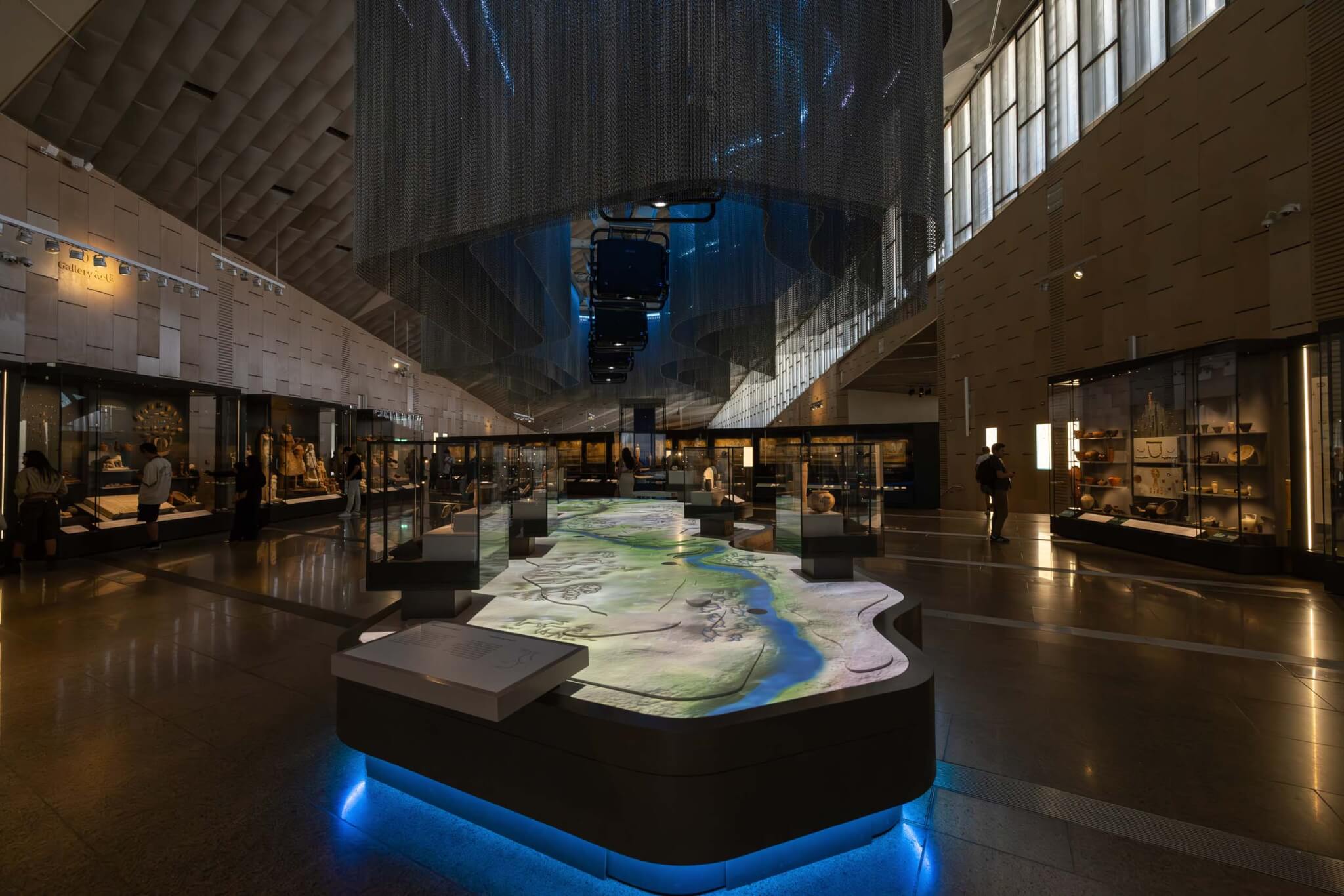
The comparison to Berlin’s display of the Nefertiti Bust is instructive: David Chipperfield’s reconstruction of the Neues Museum preserved the original domed hall for Nefertiti; it is entered in a way that architecturally stages the encounter. The space is both grand in proportion and intimate in atmosphere. The architecture withdraws just enough for the object to command the room—a clarity GEM’s architects never attempted for the Tutankhamun mask.
The landscape extends the diagrammatic obsession. Vast forecourts, security perimeters, and the requirement to “clear the view” led to the demolition of surrounding urban housing. The resulting landscape is a desert of triangular hardscape fields, dotted with palm trees, with little shade and no microclimate modulation. Raised up on a four-legged plinth, the obelisk is crudely conceptualized and oddly placed. Again, it is frustrating that a museum devoted to a civilization that mastered axial procession produces a forecourt with no sequential spatial power.
One must also situate GEM within Egypt’s contemporary architectural genealogy. In 1997, two years before GEM’s competition was announced, Egypt completed the Bibliotheca Alexandrina—also large, also symbolic, also state-led. But Snøhetta’s project has a single concept, a single author, and a coherent tectonic language. Its grandness emerges from proportion and clarity of spatial organization, not from scale alone. GEM, by contrast, is a reminder that grandness, when used as a design brief, almost guarantees architectural incoherence.
From Object-Centered Precedents to Grand Indifference
The history of housing Egyptian antiquities in museums has always had blurred vision and involved foreign hands. The 1902 Egyptian Museum in Tahrir, designed by Marcel Dourgnon, was also the result of an international competition, held in 1895. For all its colonial stiffness, it was designed from the inside out: Its coherent, hierarchical, and purpose-built architecture consists of a clear neoclassical plan organized around a central atrium, a legible entrance axis, and a rational structural rhythm that calibrates ceiling heights, daylight, and circulation to the actual scale of artifacts. The dome marks the intersection of its major axes, anchoring a spatial order that cascades into modular galleries on two floors, each proportioned for statuary, sarcophagi, and suitable for cases housing small objects.
This is not a call for a return to neoclassicism in the 21st century, but a recognition of why that museum worked for more than a hundred years. The unbuilt 1926 Breasted–Rockefeller proposal, planned with a grand riverside entry next to the existing museum, was another expression of the period’s neoclassical museum culture—larger, heavier, academically Egyptianizing in its aesthetics, but still fundamentally an object-centered institution.
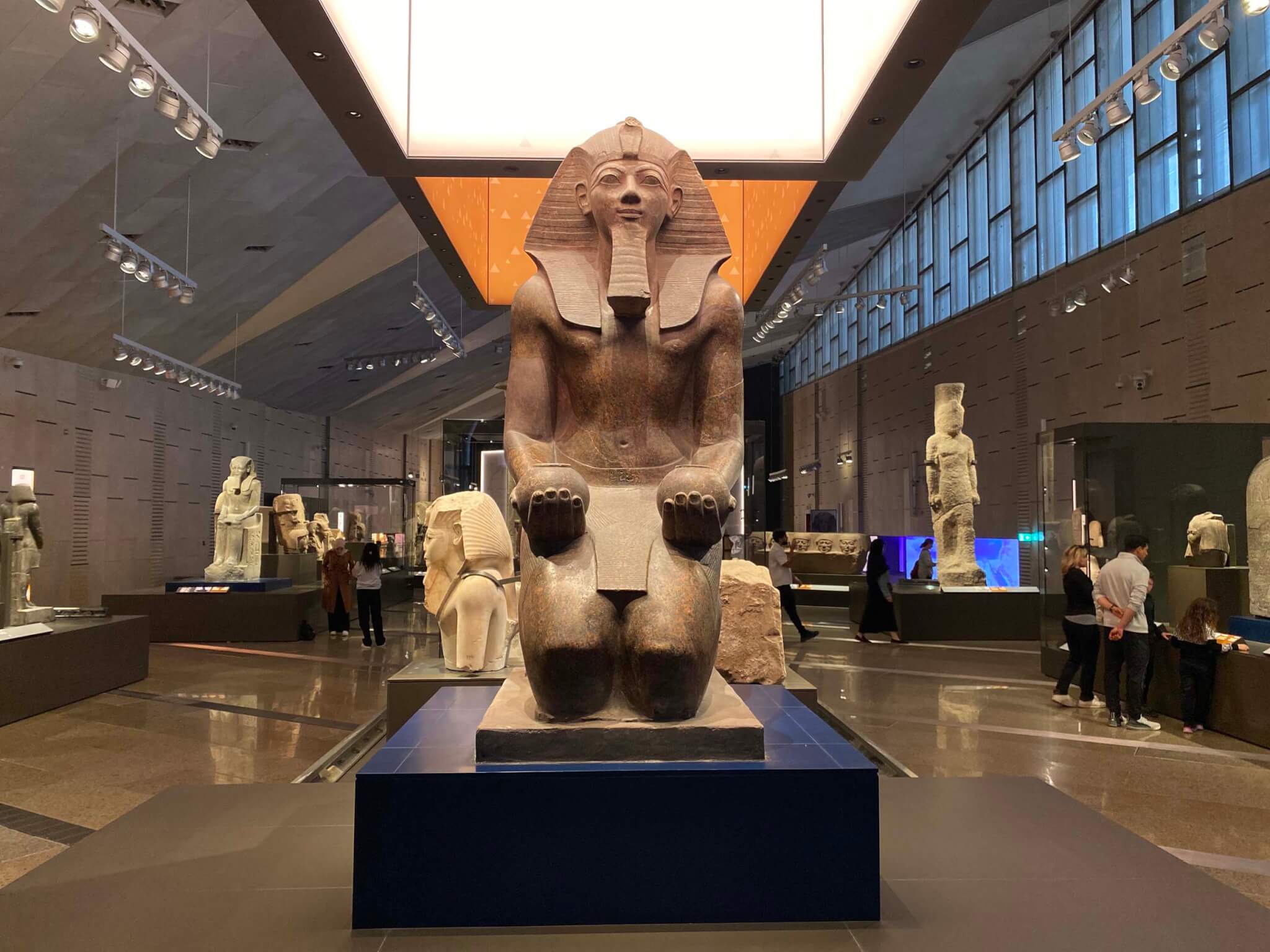
Since the 1902 museum was built, tens of thousands of Egyptian antiquities have been excavated and stored in its basement and other storehouses across the country. A new museum was needed for the Tutankhamun collection to be properly displayed in its entirety, plus a consolidated home for conservation labs, archives, training spaces, and research departments. That new institution could have been architecturally rigorous and designed for the material it houses. What emerged instead is a building whose primary architectural intelligence remains its competition site diagram. The rest is a concatenation of triangles, claddings, unexplained diagonals, shapes and forms, misaligned volumes, climate-control boxes, and celebration spaces stitched together by multiple teams over two decades into an incoherent building grand in scale but otherwise fragmented.
Compared to the rest of heneghan peng’s built portfolio—largely small- and medium-scale projects where a clear geometric idea can be fully controlled from concept to detail—the Grand Egyptian Museum stands as an outlier. Nothing in their work before or since approaches its scale, complexity, or institutional politics. The firm’s approach, effective in modestly sized buildings, was never given the chance to mature here, and their role became increasingly marginal within a state-driven machine that prioritized delivery over coherence.
A museum for a civilization defined by precision should embody precision. A museum that relies on grandness should have a theory of scale that works not only for the site and its perspective lines but also for the objects it was commissioned to exhibit. GEM has mass, spectacle, and impressive statistics, but not architectural clarity. The tragedy is not that the building is bad; the tragedy is that it is indifferent. It stands as a museum to the world’s most sophisticated architectural past executed with no architectural conviction of its own.
Mohamed Elshahed is a writer, curator, and critic of architecture, and his work extends to design and material culture. He is the author of Cairo Since 1900: An Architectural Guide (AUC Press, 2020) and of Rebellious Things: A History of Modern Egypt in Objects (forthcoming). Mohamed was a 2023 Paul Mellon Visiting Senior Fellow at the Center for Advanced Study in Visual Arts at the National Gallery in Washington, D.C. In 2023–24 he was a fellow at Columbia University’s Institute for Ideas & Imagination in Paris. Follow Mohamed on Instagram: @rebellious_things_book.
→ Continue reading at The Architect's Newspaper

