
As the year comes to a close, AN looks back on the dynamic facades projects covered online, in print, and on screen at our conferences in 2025. The list spans projects from around the world, featuring a range of formal and material expressions—angled BIPV panels, monolithic travertine, towers shaped like biophilic figures, aluminum made to look like stone, tilted stripes of ceramic, and more.
Stay up to date on developments in facade design, technology, and the broader AEC industry with our Friday Facades+ Newsletter!
The Ragon Institute
Payette
Boston
Boston’s new biomedical research center features an eye-catching facade of tapered aluminum fins that create variation and depth while enhancing energy performance. Integrated with a high-efficiency, unitized curtain wall system, the fins filter light, shape views, and hide mechanical equipment. Their variation in spacing and profile, driven by internal programs and solar exposure, brings a shifting sense of enclosure to the uniform glass between them; depending on the angle, the building appears as solid, transparent, or somewhere between.
Cadence House
Moto Designshop
Philadelphia
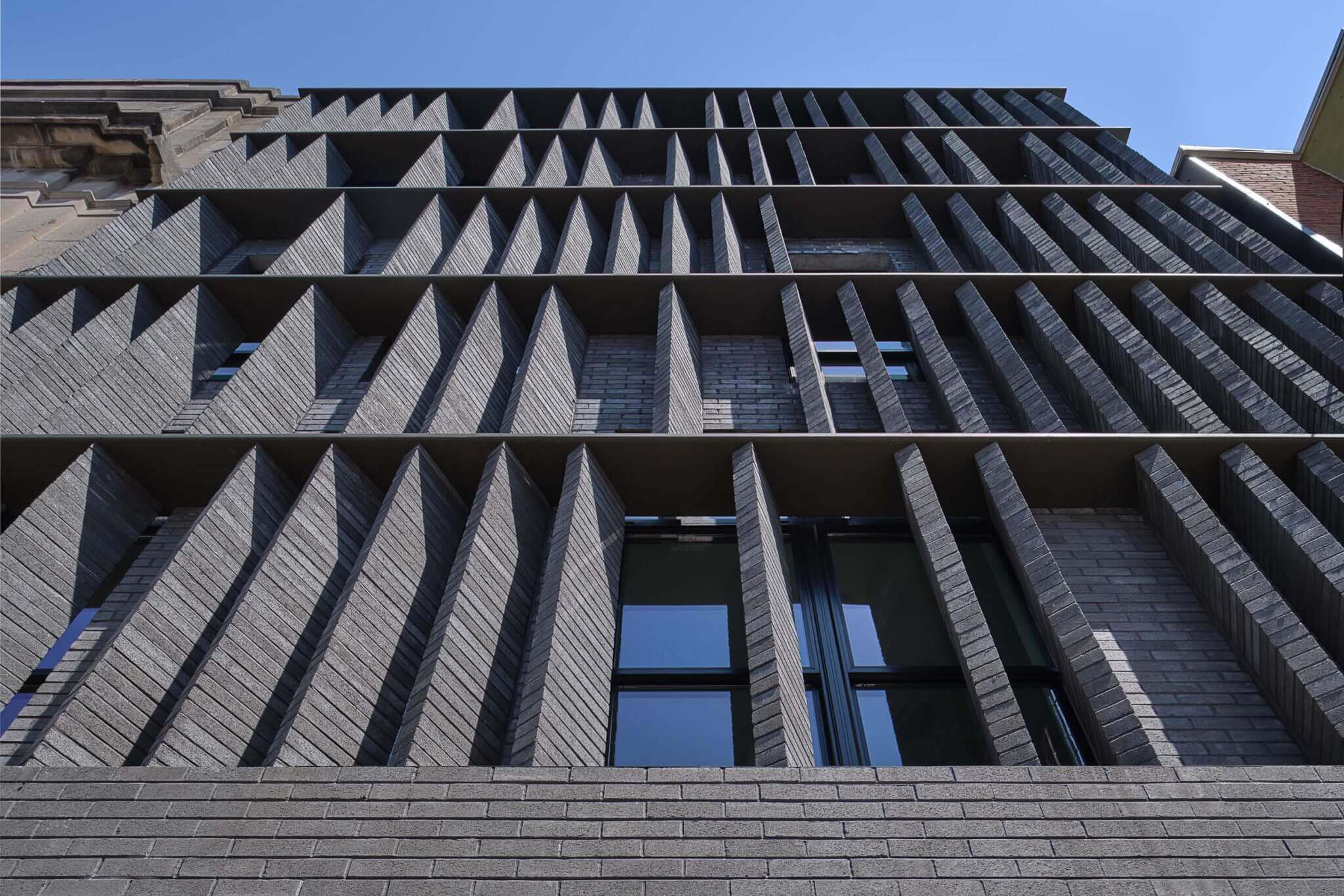
In a dense city like Philadelphia, residential architecture maintains a precarious relationship with privacy, which is often difficult to achieve. Moto Designshop faced this challenge head on, designing a new row house across the street from a busy and unsightly gas station. To conceal the home and obscure the eyesore from the interior, the firm added a screen of angled brick pilasters to the building’s street-facing facade, a feature that led to the project’s name: Cadence House. The firm notes that Cadence House avoids the “flat brick facades and punched double-hung window openings” of a conventional Philly row house, seeking to elaborate on the typology.
Vanvitelli
ebpc
Milan, Italy
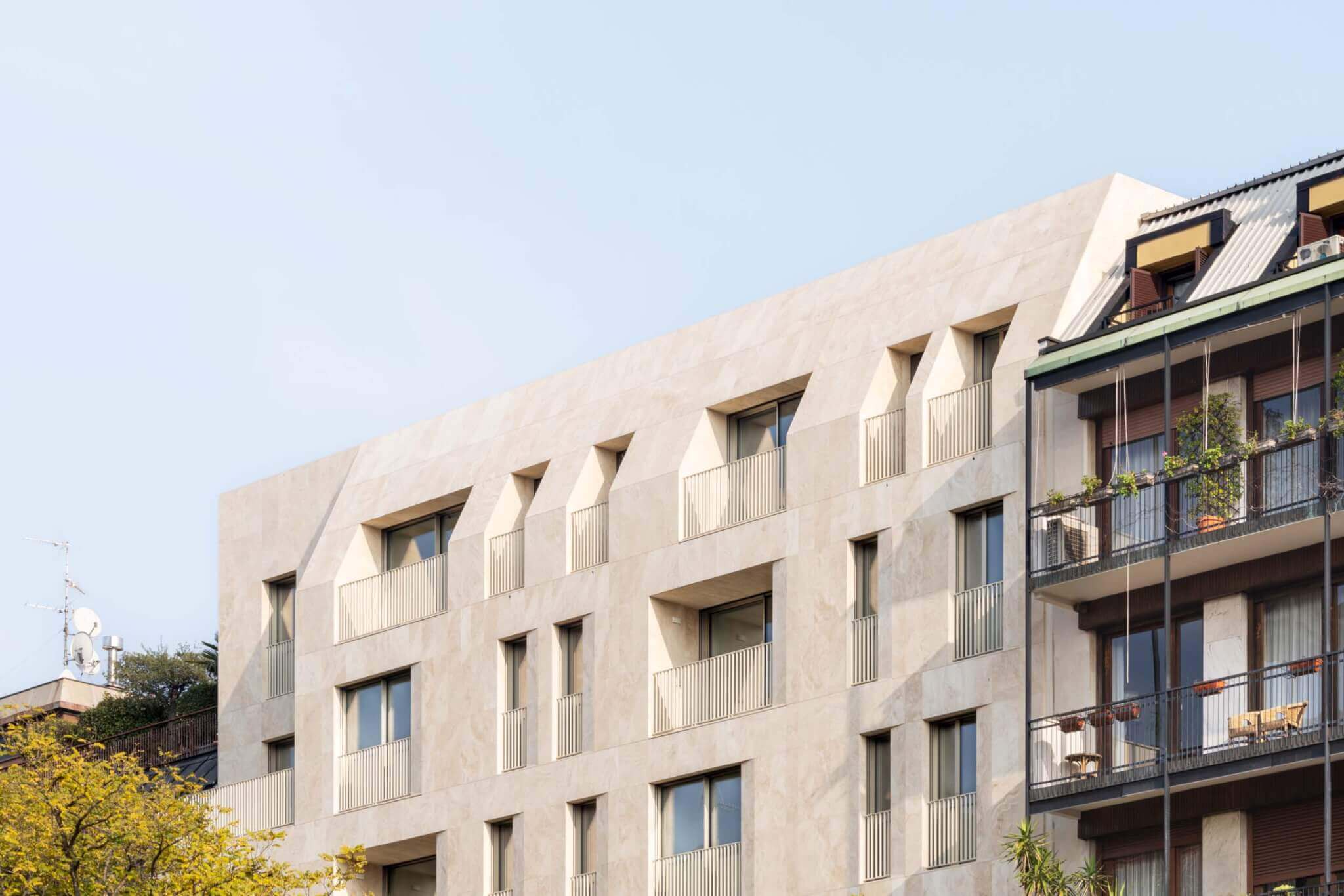
Near the Viale dei Mille in the eastern part of the city, an opening in the street wall along Via Luigi Vanvitelli became the site for a handsome 16-unit apartment building designed by the Milan-based architecture practice ebpc. The building is massed to be a good neighbor: Its volume, faced in travertine from Siena, aligns with the structures on either side, and its flat frontage is cut back at the top, perhaps a nod to the roof on the right. Inset windows are given a slight relief and shadow with a panel set at a slight breaking angle. The stone jointing is fully aligned horizontally and vertically, and the patterning translates to the champagne-colored metal panels that are recessed along the main entrance.
JOMOO Headquarters
OMA
Xiamen, China
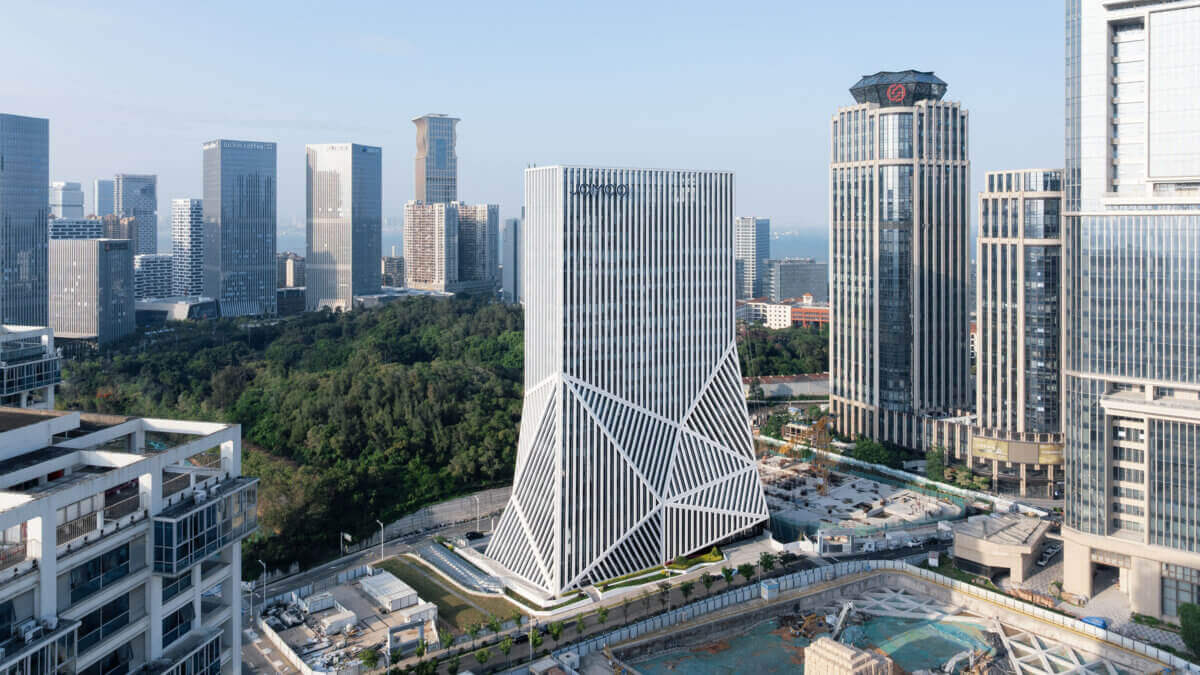
Seen from a distance, the JOMOO Headquarters possesses a bright, unwavering presence on the skyline. An army of vertical stripes, evenly spaced and clad in white ceramic panels, climbs an orderly facade to a stark, flat top. Keeping with its corporate lineage, the tower’s minimal aesthetic with soaring verticals on the skyline recalls 20th-century classics like the Daily News Building by Raymond Hood and Edward Durell Stone’s General Motors Building in New York. Yet at its mid and lower sections, the building takes on a more contemporary (and curious) demeanor: the facade buckles into hefty triangular segments, while the ceramic-paneled stripes get displaced and tilted.
Arklow Wastewater Treatment Plant
Clancy Moore
Arklow, Ireland
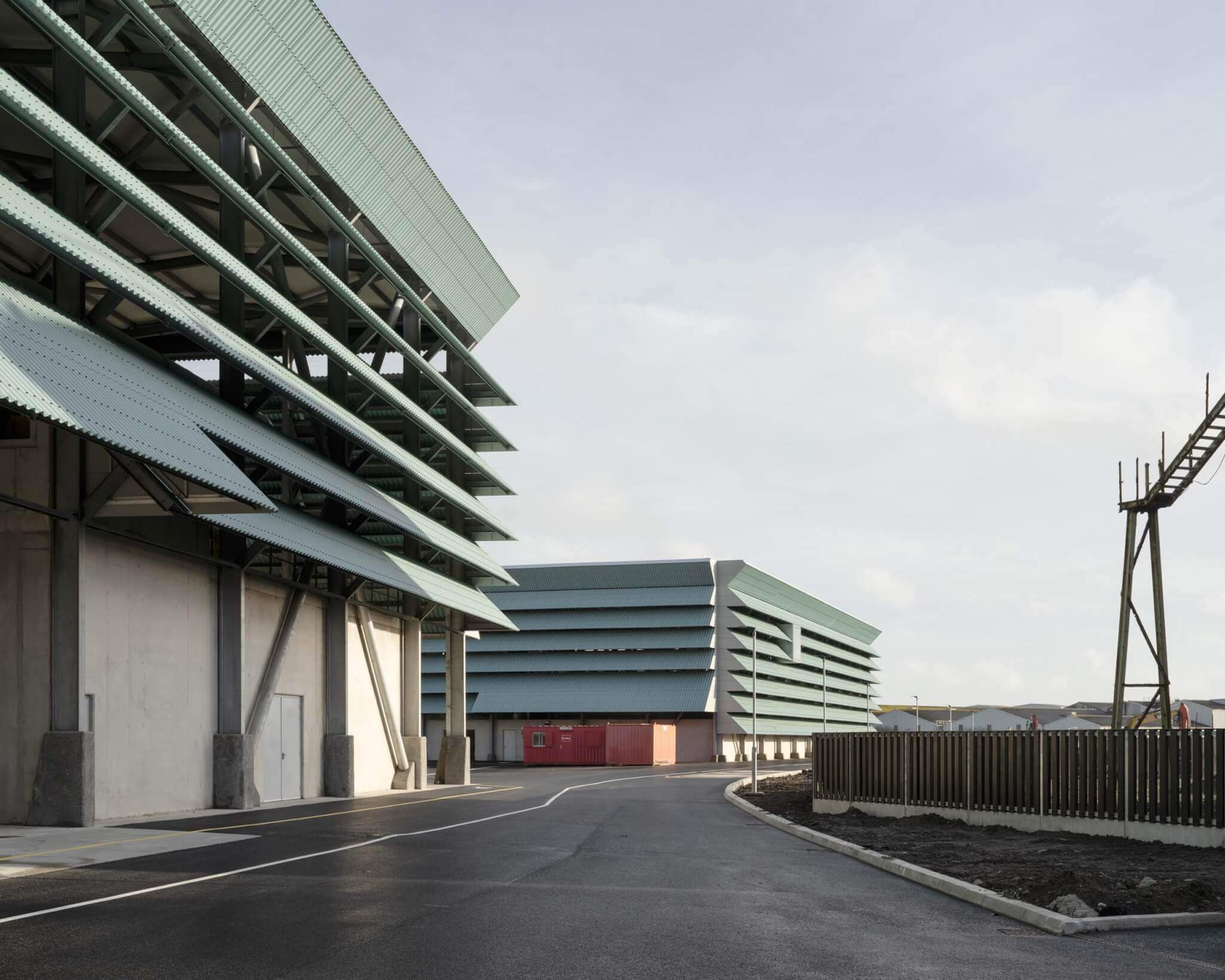
An existing wastewater treatment plant in Arklow has been reclad in flat fiber cement panels by Clancy Moore. High density fiber cement panels from Switzerland were used to clad all three buildings because of the material’s long lifespan and need for little maintenance. The cladding’s green color was selected for a variety of reasons related to Ireland’s cultural history and ecology. The exact shade of green was tested through a series of panel mock-ups, which led the architects to choose a variation of sea green that was bright enough to be seen from a distance.
Kaktus Towers
BIG
Copenhagen
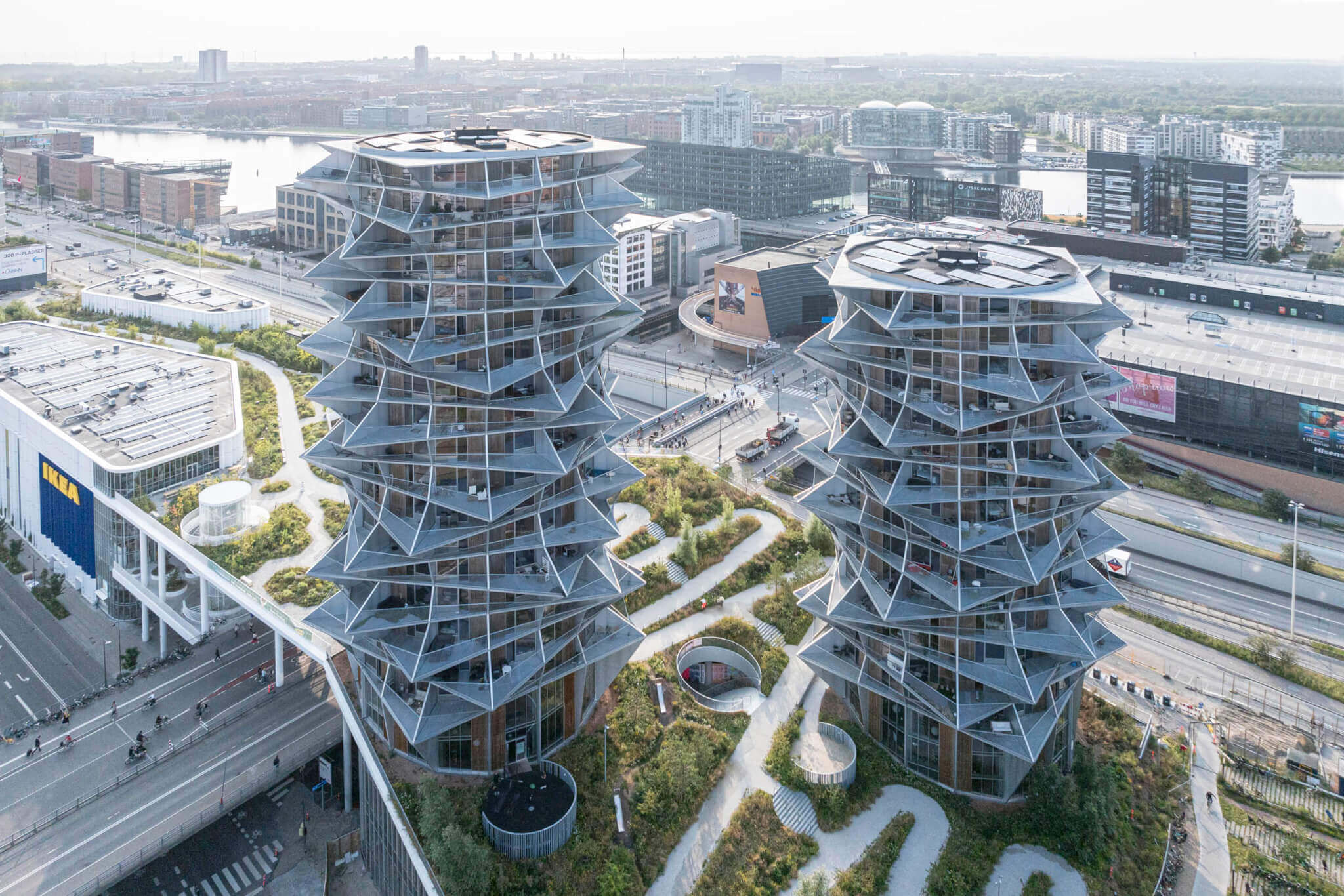
Rising from an elevated green plateau at the edge of Vesterbro—a former industrial zone now undergoing a new wave of development—the twin, jagged facades of Kaktus Towers are both amusing and difficult to track. Just two balcony types are mirrored into four variations and repeated across the entire project. The towers were conceived as a series of square floor plates, systematically rotated relative to each other. A typical floor plan shows a square perimeter that rotates 22.5 degrees per level, producing the effect of varied, cantilevered triangles along the towers’ edges.
The Butterfly
Revery Architecture
Vancouver
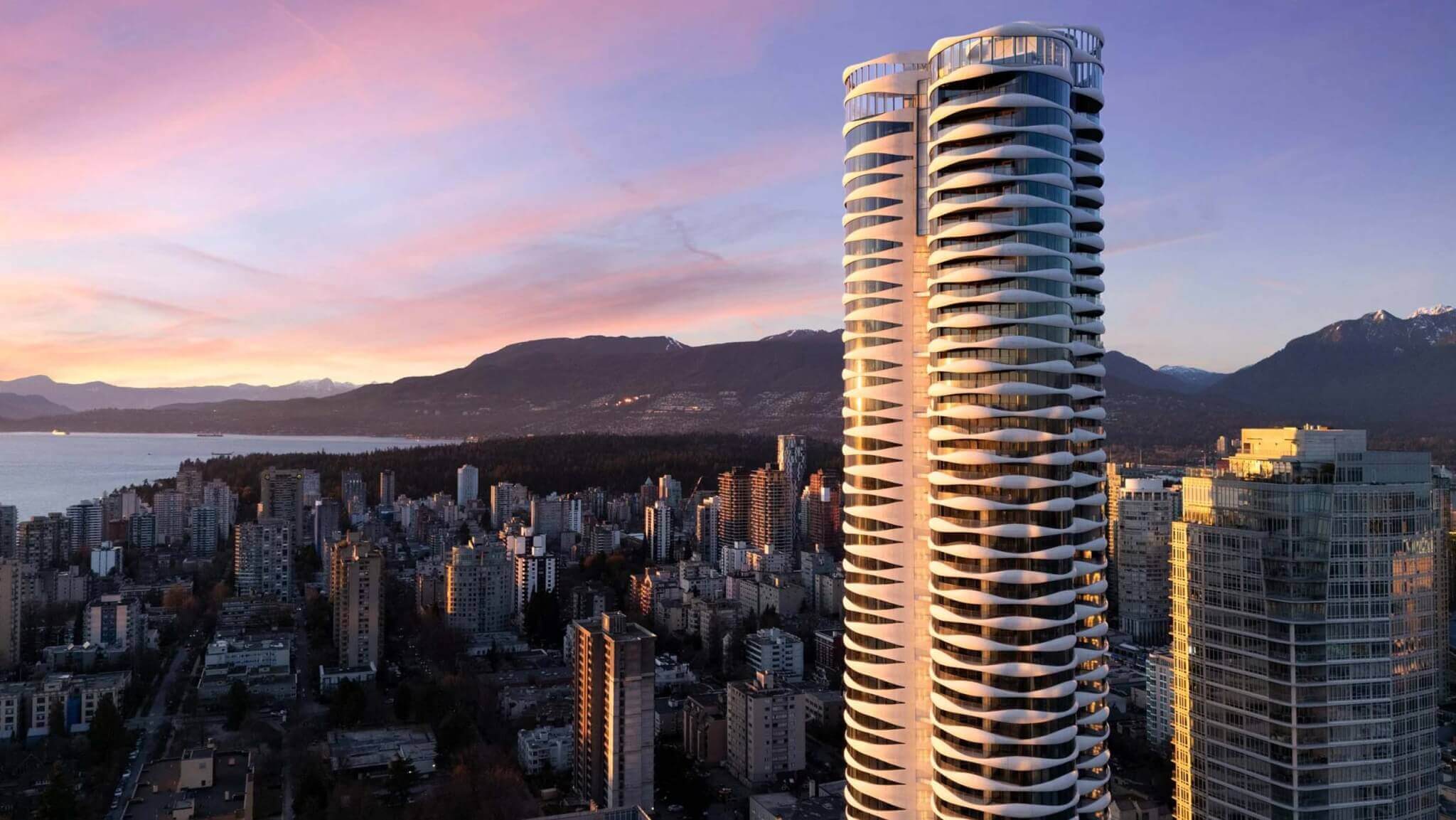
The new 57-story residential tower is composed of four cylindrical volumes joined at the center by an elevator core, forming a plan that reads like a butterfly. Circular floor plates are subdivided so units sit diagonally to Vancouver’s street grid, opening longer sight lines through neighboring towers and toward the city and mountains beyond. Its facade consists of slightly undulating horizontal bands that repeat all the way up, and the project’s most unconventional move is its use of open-air corridors on every floor.
Fanshawe College Innovation Village
Diamond Schmitt
London, Ontario
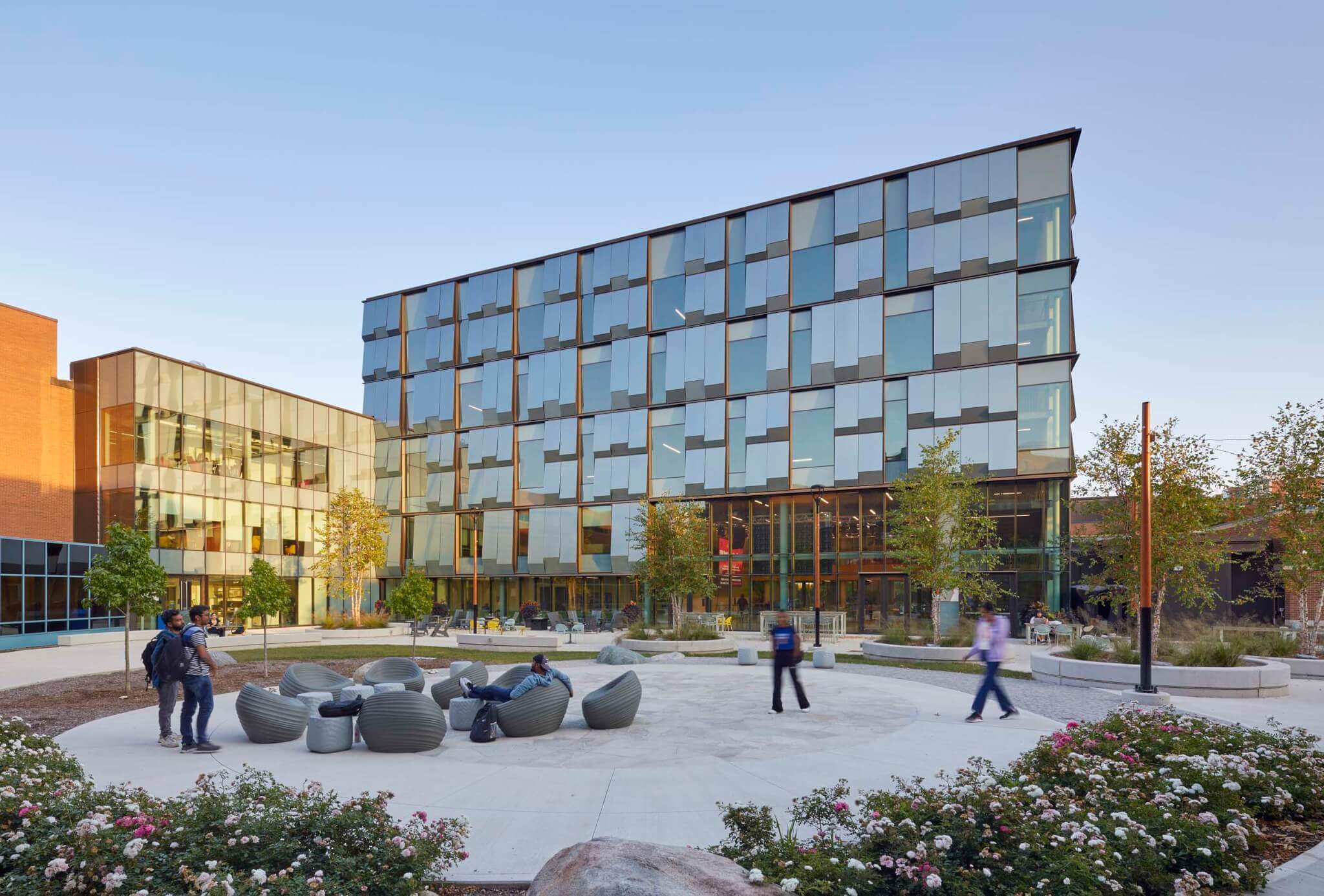
At Fanshawe College—one of Ontario’s largest public institutions of higher education—Diamond Schmitt has situated a new building, known as the Innovation Village, into the center of the campus. Surrounded by the school’s existing brick buildings, the new structure is distinguished by its size and bold blue color. Diamond Schmitt’s intervention also boasts a number of high-performance features, including the use of building integrated photovoltaic (BIPV) panels and an exposed mass timber portico.
→ Continue reading at The Architect's Newspaper

