
In his 2007 review of the New Museum’s new, SANAA-designed building, Paul Goldberger called it a “a thunderbolt from another world,” before going on to say that “as the spread of condos and boutique hotels across New York’s Lower East Side continues, it is at risk of becoming a victim of its own success.” Almost two decades later, the prescience of this statement is undeniable.
On March 21, after two years of closure for construction, the New Museum reopens with an angular, OMA-designed expansion that rises up alongside the 19-year-old SANAA building. The new building emerges in a markedly different context to its predecessor.
New York City’s museums are in the midst of a building boom to fuel their structural mission of constant growth. Artists and art museums in the U.S. are confronting censorship and public funding cuts while museum attendance still has not returned to pre-pandemic levels. The current incarnation of the museum’s Bowery neighborhood is losing the grungy radicalism and architectural eclecticism of its past. And the SANAA building itself has been blamed as a catalyst for the neighborhood’s gentrification. There’s also the impending retirement of Lisa Phillips, the museum’s current Toby Devan Lewis Director, who has led the institution for 26 years. The “new” New Museum—as the media have been calling it—has to coexist with all these tensions, as it carries the weight of the institution’s future on its oblique shoulders.
In a statement during this month’s press preview for the reopening, Phillips described the building as “not a new wing, not an extension, not an annex…it’s a second building in an expanded campus.” Designed by OMA in collaboration with Cooper Robertson (now Corgan) and Arup, the new seven-story addition at 231 Bowery, occupies the lot adjacent to the museum’s existing premises at 235 Bowery. From a distance, the new $82 million structure looks like a wedge of cool-toned laminated glass, with dramatically beveled edges at the top and bottom. Its upper half gently brushes against the museum’s original SANAA-designed building: a Jenga tower-esque pile of blocks sheathed in a fine white metal mesh. Together, they resemble a pair of minimalist sculptures towering over the terminus of Prince Street. On the SANAA building’s facade is a 13-foot-tall sculpture by artist Tschabalala Self, which was commissioned for the reopening . The sculpture, titled Art Lovers, features a couple, mid-embrace.
Blurring Boundaries
This version of the New Museum dissolves the boundary between the museum and the street. On the lower floors, the OMA building’s bottom half pulls away from the SANAA building at a sharp angle and leaves a triangular space on the pavement, which will be used for public programs and installations. OMA’s partner-in-charge for the project, Shohei Shigematsu, told AN that the firm’s aim was to “provide a public domain and create a ground level that is much more open than before. It activates the street in a different way.”
Unlike the SANAA building’s facade, which is almost entirely opaque apart from the ground and fifth floors, there are multiple diagonal ribbon windows which slash across the OMA building’s facade and frame views of the Bowery and Prince Street for visitors inside. Shigematsu said that he wanted both buildings to have “a kind of seamless connectivity, but with a distinct identity. Because the SANAA building was a bit hermetic, inward looking, introverted, we also wanted to connect the whole institution back to the city.” But for a private institution, coexistence means filtering what (or who) comes in as much as regulating what goes out. As soon as the press preview concluded, the museum immediately placed traffic barricades to cordon off the plaza.
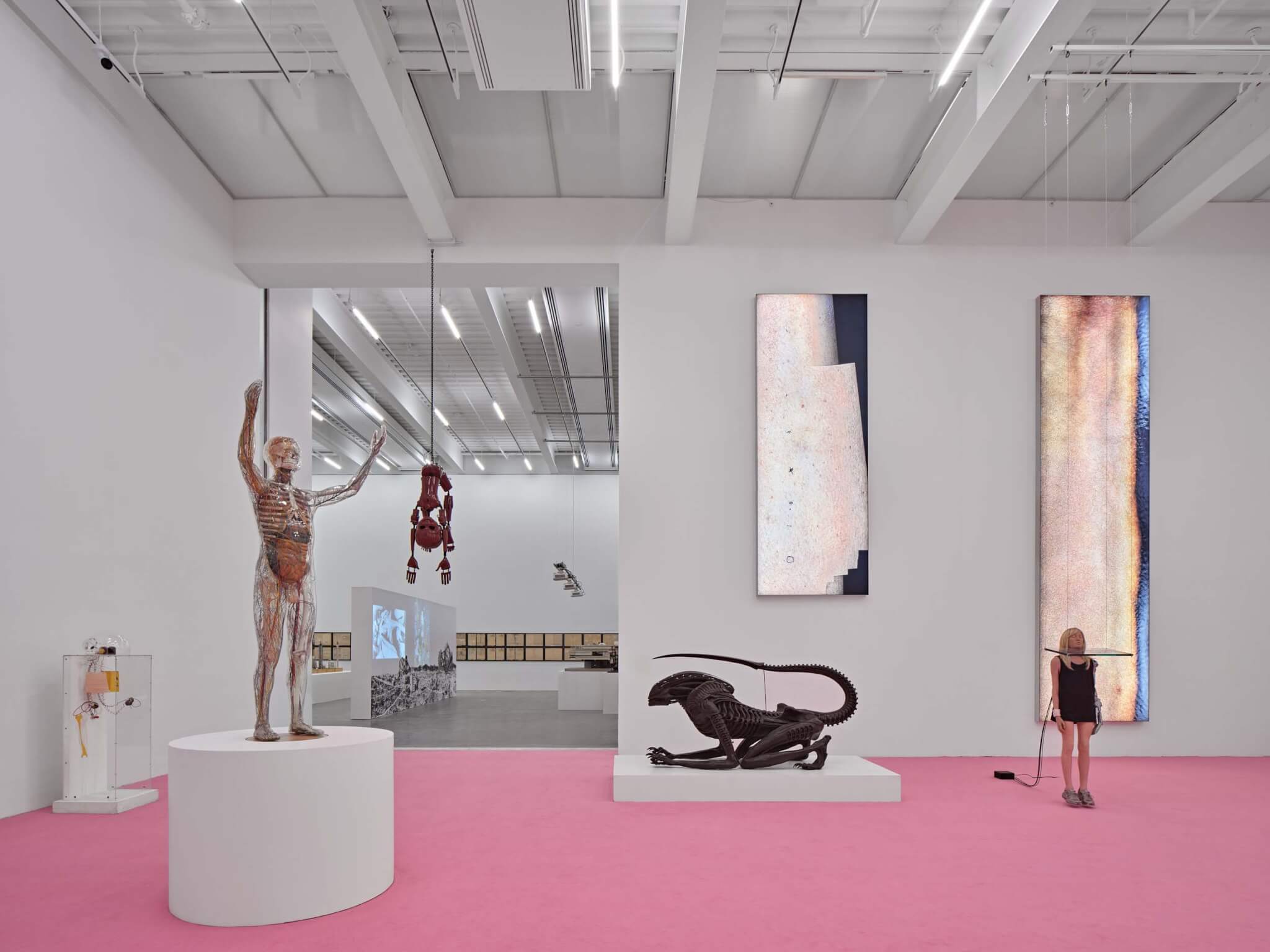
The space’s inaugural themed exhibition, titled New Humans: Memories of the Future, brings together the work of over 150 artists from around the world, who are investigating what it means to be human amid breakneck technological change. It includes commissions by leading contemporary artists like Camille Henrot and Wangechi Mutu, alongside work by major figures from the past like H.R. Giger and Francis Picabia, among others.
Together But Separate
The new building doubles the museum’s total floor area, adding 60,000 square feet of usable space. The ground levels of both buildings combine in a single interconnected lobby equipped with a ticket counter, a massive open hall, a bookstore at the far end, and a restaurant that is yet to open.
Although the New Museum’s leadership initially favored preserving the building that once stood at 231 Bowery—which the museum purchased for $16.6 million in 2008—OMA’s winning 2017 design proposal for the New Museum expansion suggested tearing it down and replacing it with a new addition. In an interview I conducted during my academic research on the New Museum at Columbia University’s Graduate School of Journalism, Jake Forster, an associate at OMA who co-led the project, said that the design team conducted several feasibility studies about preserving 231 Bowery, but they determined that since the floor levels of the two buildings didn’t align, any merger between them would result in “mediocre gallery spaces.”
Forster and his colleagues also looked at methods to surgically remove and store the facade, while they replaced most of 231 Bowery’s internal structure. He recalled that the consensus among OMA’s team was that they “had to do so much work to the inside of the existing building, that there really wouldn’t be anything left of it.” With this understanding the team sought to create an addition that would be complimentary to its context. They considered configurations where the new building was either balanced, supplementary, or subservient to the SANAA building and eventually settled on a scheme that was contemporary in style, but distinct in character.
In the OMA building’s atrium, an angular winding staircase connects each section of the inaugural exhibition across three floors. With railings covered in a metal mesh that’s lit up in fluorescent green tones, the stairs wrap around Shelter, an installation by Czech artist Klára Hosnedlová, composed of a skeletal metal structure wrapped in a pelt of flax-based textiles, with a paw-like glass and sandstone sculpture at its center. The metal railing also embraces the inside of the glass facade, leaving subtle imprints of its perforations on the exterior. Wallpapers featuring artwork by Tishan Hsu, Ayé A. Aton, and Emma Talbot, decorate the walls of the atrium, and bring the space alive, introducing an element of surprise at every zig-zagging corner of the staircase.
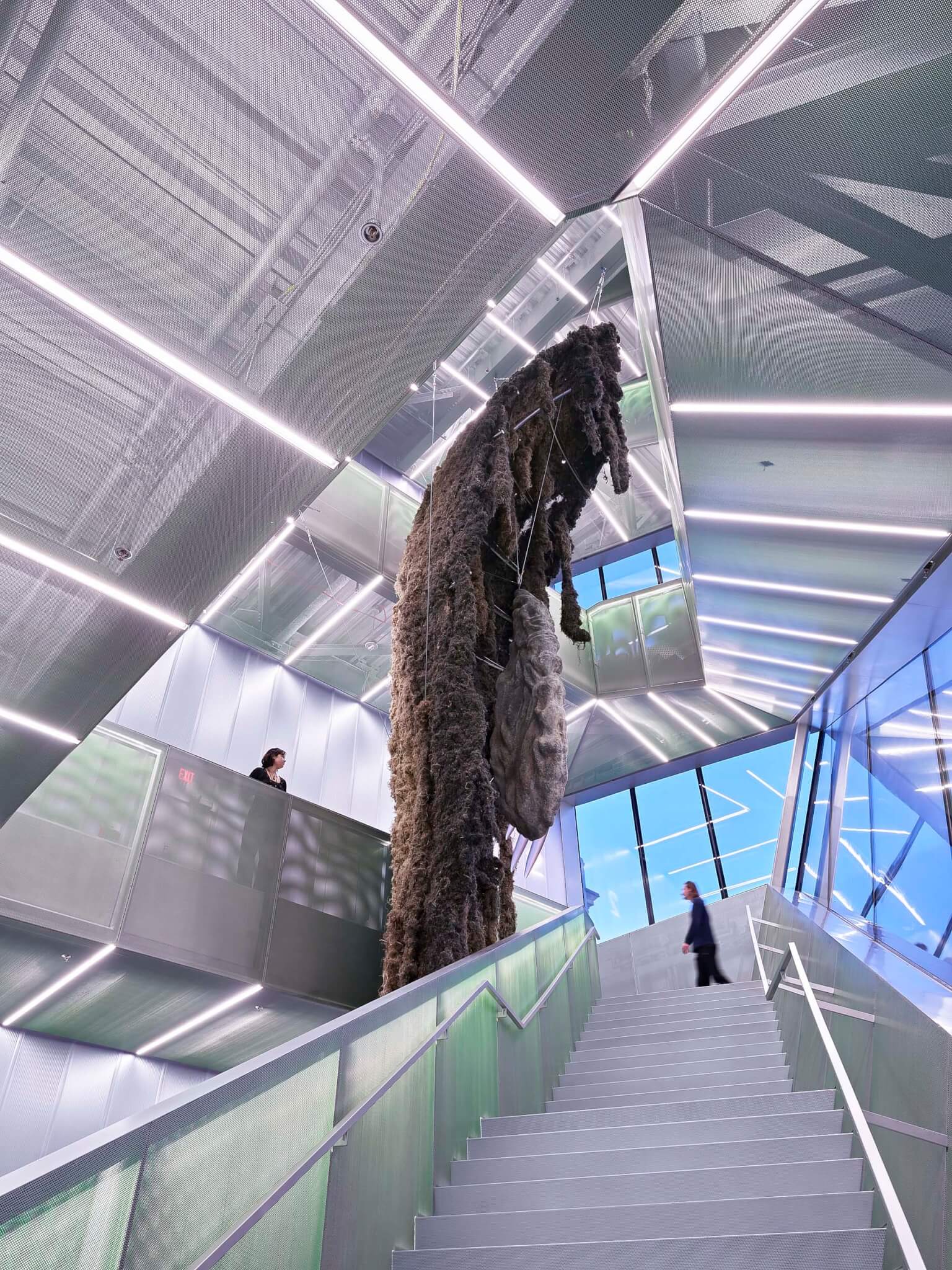
Inside the galleries, the floor levels of both buildings now align seamlessly. In an interview for my academic research, Andrew Barwick, a senior associate at Cooper Robertson, said that “the expansion comes up and kisses the existing building at the fifth floor floor plate level. And then it cants backwards sharply from that point.” The upper floor plates in the OMA building are wider than the lower floors, whereas the inverse was true for the SANAA building. This scheme balances out the area of each floor, opening up the rigid verticality of the SANAA building. The integration of the two structures also increases the flexibility of the galleries, and the expanded space makes it easier to put up and take down one exhibition while others remain on view. As a result, the gallery spaces in the old and new buildings flow into one another like two halves of a whole, with corrugated metal ceilings and polished concrete floors.
Some sections of the exhibition harness this continuity well. For instance, the fourth floor of the exhibition makes full use of the museum’s high ceilings by having Anicka Yi’s tentacled balloon-like aerobes float above Bodys Isek Kingelez’s fantastical city sculpture Ville Fantôme like a tongue-in-cheek re-enactment of H.G. Wells’s War of the Worlds. Others either feel too narrow or too overburdended with objects for crowds to pause and engage with the art on display. These areas represent the pitfalls of expansion, which according to OMA’s cofounder, Rem Koolhaas, occurs when museums get bigger and bigger, and eventually turn into “circulation devices” such that “the particular experience that is the essence of the museum, a quiet contemplation with space,” is lost.
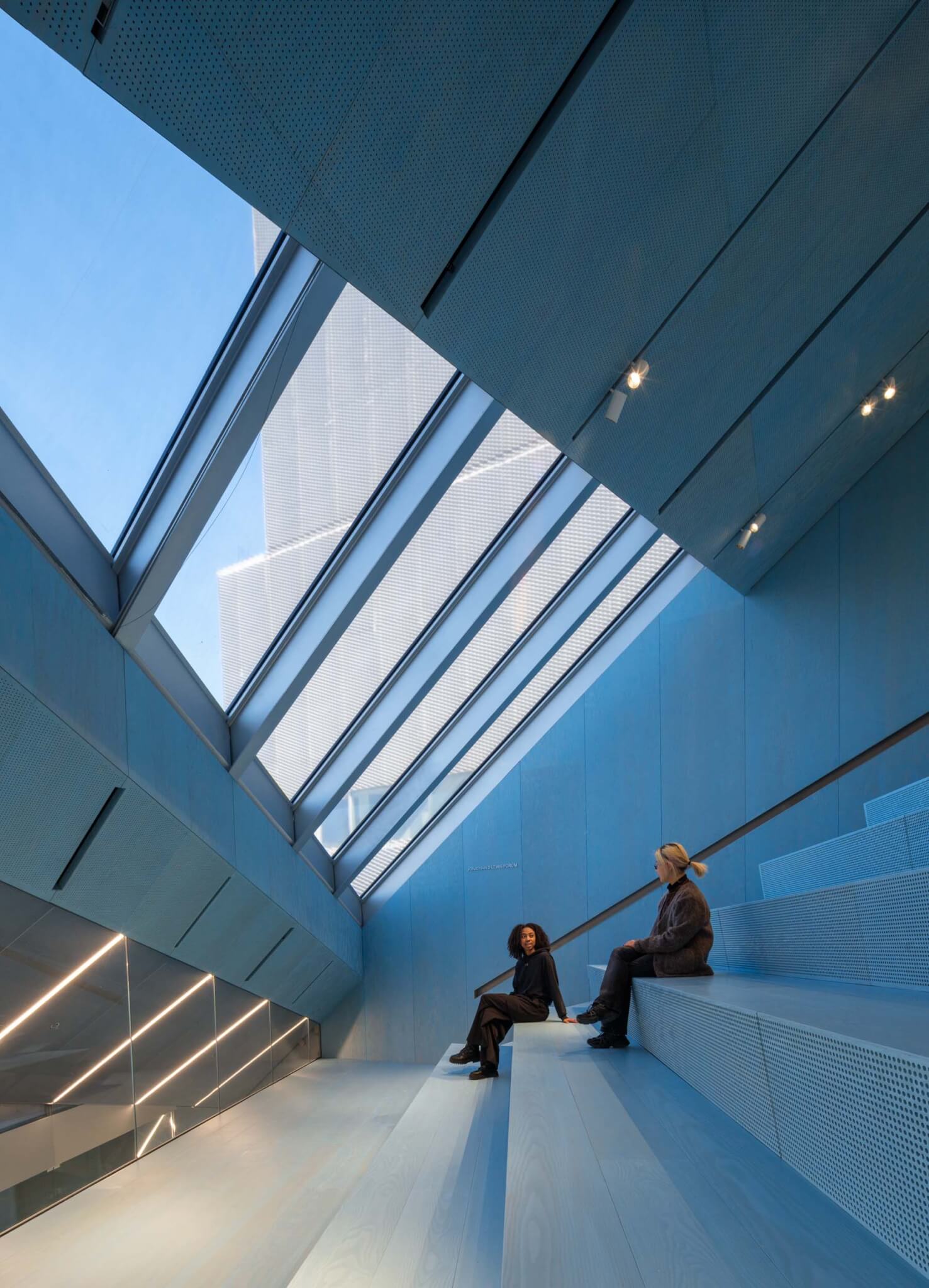
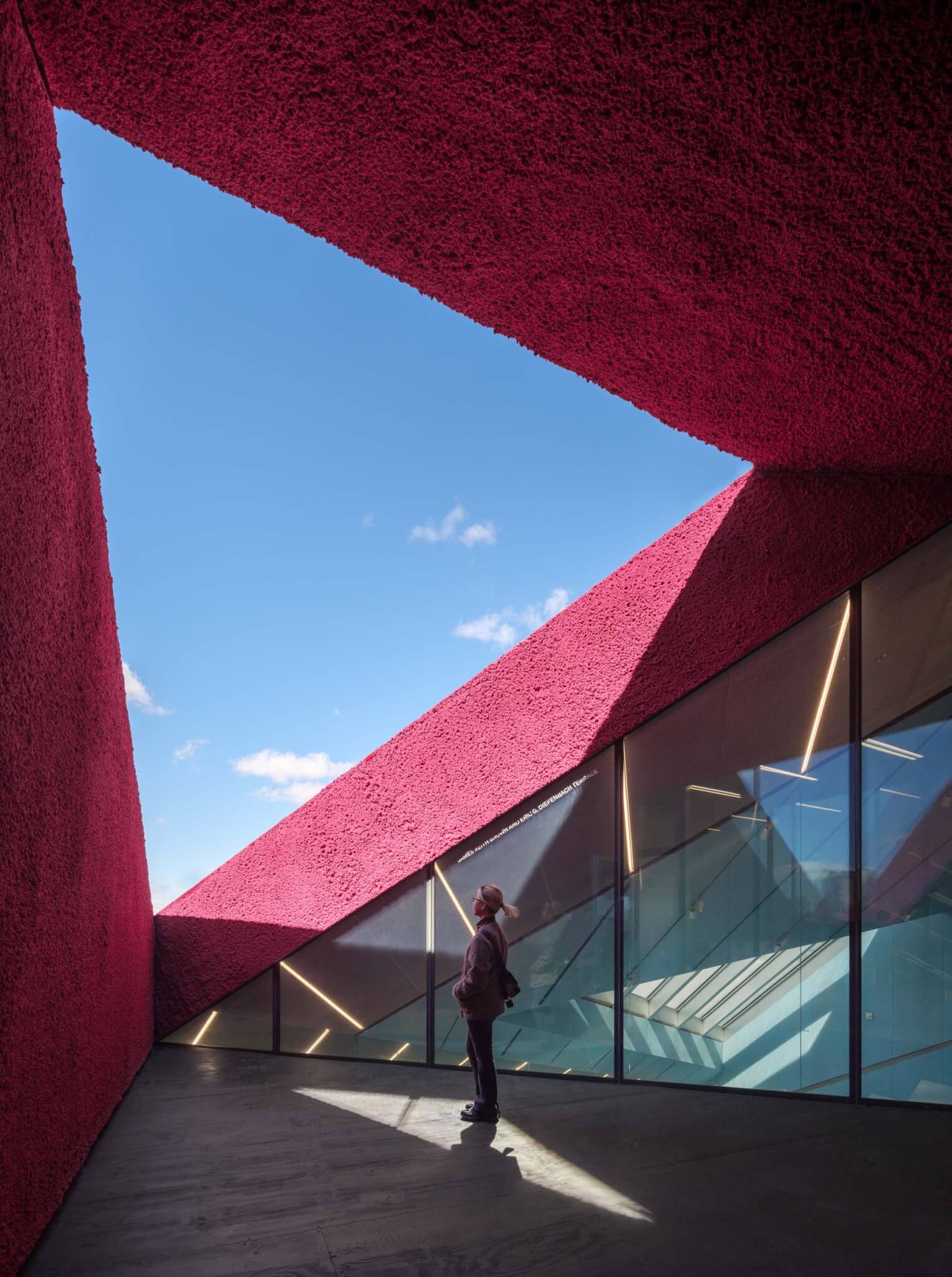
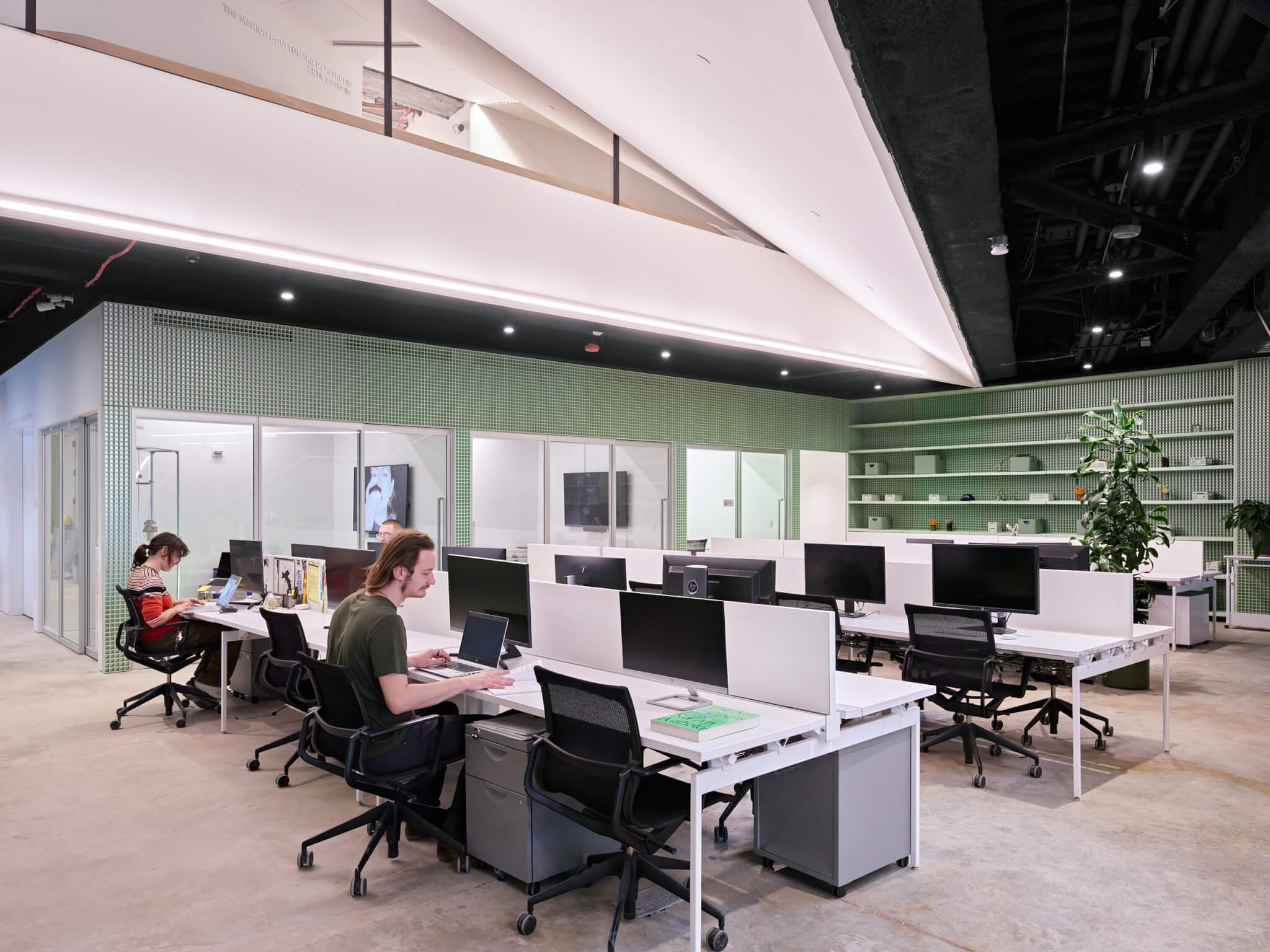
The highest occupied floors of the museum have bridges between the two buildings which offer views of Lower Manhattan. Another angular staircase slices between a forum with stepped seating made of pastel-blue toned wood and perforated metal, a glaringly empty sky room, offices for the museum’s cultural incubator NEW INC, and triangular terraces carved into the building’s steeply sloped roof to introduce pops of color on the facade. There’s also an artist’s studio, spaces for events and educational programming. Whereas the galleries have a polished industrial feel, the upper floors replicate the vibe of a tech-startup office, albeit, infused with a touch of whimsy and a lot of diagonal lines.
A Legacy of Radical Approach
From top to bottom, the OMA building’s version of connecting the museum to the city is architecturally outward-looking rather than inward-welcoming. These gestures reflect the museum’s own radical origins as a “museum without a venue” that was “curatorially driven,” as Massimiliano Gioni, the New Museum’s current Edlis Neeson Artistic Director told AN in an interview. Curator and art historian Marcia Tucker founded the New Museum of Contemporary Art in 1977, and conceptualized it as a non-collecting, non-hierarchical, artist-driven institution.
This stemmed from Tucker’s critical stance towards New York City’s art institutions, and what she saw as their failure to engage with contemporary art and artists on an international scale and across different mediums. “The New Museum was one of the first institutions to put on shows about the HIV crisis. It was a place for discovery, where you saw the future greats. We also developed projects where the artist was invited to show their work and think of the exhibition as a site to test out ideas of what a museum could be,” said Gioni. Over time, the museum’s programming has grown to include conducting educational programs with New York City schools, partnered events with local organizations like the Bowery Mission, a triennial exhibition, and new media installations. Even if its ties to the Bowery were once negligible, the museum has made concerted efforts to give back to its community and evolve from a museum without a venue into an institution of the Bowery.
With this expansion, the museum seeks to expand both its radical legacy and its footprint in the Bowery. However, some of its recent years have been mired in controversy. Days before OMA released the first renderings of the new building in June 2019, members of the museum’s newly-formed employee union and their supporters protested and demanded better pay, benefits, and working conditions outside an exhibition opening at the SANAA building. In an interview last year, writer, editor, and former New Museum union member Dana Kopel told me that although the museum foregrounded its progressive radical politics, “the harshness with which they fought the union made it overwhelmingly clear that those radical politics were for display only.” She added, “We knew that they had or were prepared to come up with $82 million for a building and couldn’t come up with the fraction of that to ensure all of their staff got paid a living wage in New York City.”
The negotiators eventually reached an agreement for better working conditions by September 2019, and the protests catalyzed similar unionizing movements across cultural institutions in New York City. This event exposed an issue in the way contemporary museums operate, and the problem with how the coffers of billionaire art collectors and philanthropists provide the primary fuel for starchitect-driven experimentation in museum design.
And then there’s the question of how the shiny new building will impact its surrounding built environment on Bowery. It has arrived at a time of metamorphosis for the neighborhood. Today, as a consequence of rezonings and private development, glass towers with luxury housing and expensive retail spaces have risen over the ashes of tenement buildings and historic structures. During an interview I conducted for my academic research, Mitchell Grubler, a community organizer and resident of the Bowery, who cofounded the Bowery Alliance of Neighbors, said he felt that the New Museum “played a role in furthering gentrification on the Bowery.” Shigematsu acknowledged that “this area is tricky because it experienced gentrification” but continued, “having a cultural institution that people can visit, ultimately, for me, is not necessarily gentrification per se. It just gives more opportunity for anyone to see culture.”
The new OMA building might not resolve existing tensions among the art world, community organizers, and the forces of development. And the building itself is in some ways, still incomplete. Some bathroom faucets don’t work, the atrium landings and stairs are slippery, the corners are hazardously sharp, spaces remain unfinished, and there are telltale signs (unpolished floors and scuff marks) that the exhibitions were put up at the very last minute.
However with time, the museum may yet rectify these shortcomings, just as they have been trying to rectify the impact of their expanding presence on the Bowery. And even in a climate where museums are confronting economic challenges, censorship, and a slow return to pre-pandemic attendance levels, Gioni still sees value in the kind of space the New Museum embodies. “I think museums are one of the last places where you consume images with others and that also trains us to be with others as we experience images, as we experience ideas, emotions,” he said. Ultimately, coexistence requires mutual recognition and active participation. It is a constant negotiation.
→ Continue reading at The Architect's Newspaper

