
As the population hub of Teton County, Jackson, Wyoming’s picturesque downtown anchors a community of residents, tourists, and outdoor enthusiasts. Despite its modest size and charming rustic feel, Teton County is consistently ranked as one of the country’s wealthiest places. But not every resident is tucked behind a fat bank account. According to the Economic Policy Institute, this county is the most economically unequal in the country, with its top 1 percent making 142 times more than the average income of the rest of the population.
Housing in the Mountain West is a study in disparities. The ultra-wealthy have flocked to these mountain towns because of the pristine wildernesses—and generous tax haven—resulting in skyrocketing rents and home prices. COVID-19 brought waves of remote workers, which strained the existing housing supply, while new construction in the region is restricted by zoning, land use, and NIMBYism. From Montana to Colorado, the working class is grappling with a major housing crunch. But some towns are punching back, prioritizing workforce housing through a combination of novel construction technologies, zoning reforms, and public partnerships, bringing much-needed new housing to the region’s 99 percent.
Ruben Caldwell, a Jackson resident and partner at architecture firm Post Company, described this housing situation as dire: “Something that needs to be clear is that the housing values we’re talking about within these towns are astronomical,” he said, pointing out that even someone making 300 percent of the inflated area median income (AMI) wouldn’t be able to afford a home. Zillow reports that the average listing in Jackson is approaching $2 million, meaning that healthcare workers, teachers, public servants, and others are excluded from homeownership. On the rental side, real estate sites like Zillow and RentCafe cite average monthly rents of $5,000 and $3,453, respectively. In his book Billionaire Wilderness, Yale Professor Justin Farrell notes that the majority of wealth in Teton County comes from outside investment income, and this ever-growing wealth has had little impact on salaries in ordinary jobs. From 1970 to 2015, wages grew from $39,943 to $41,052, “making it difficult to survive amid inflation and now untouchable home prices,” he writes.
While most might imagine that demand for affordable housing comes largely from working-class populations, Caldwell says that interest extends well into the professional class because of current home values. “Workforce housing” then takes on an expanded meaning in the Mountain West; in resort areas it’s not just cooks, servers, or lift operators who lack access to housing; here, doctors and lawyers struggle, too. To meet these needs, architects and developers are building homes to meet diverse incomes and worker statuses. Elizabeth Whittaker, a partner at Boston-based Merge Architects, previously worked with a Jackson developer on a single-family home, and the developer later brought Whittaker’s team a big idea: Transform three conjoined land parcels in a modest single-family neighborhood into a dense, multi-family building affordable to workers who want to rent.
The developer, said Whittaker, “realized that there was such a need for workforce housing… All those people that work there, so many of them in the restaurants and a lot of the industry, can’t afford to live there.” Located at the base of the popular Snow King Mountain resort, the 20-unit development, completed in 2023, boasts light-filled one- and two-bedroom apartments with private balconies and shared courtyards. Rents aren’t subsidized, requiring construction to adhere to a very tight budget to achieve affordability. “We maxed out every square inch that we were allowed to build per floor area ratio (FAR).” she added.
Similarly, in Big Sky, Montana, Peter Rose + Partners (PRP) saw an opportunity to increase the area’s affordable housing supply without using subsidies. As Big Sky has grown from a mountain town to a ski resort and destination for the wealthy, the need for temporary workers, especially in construction and service, has grown, says founding principal Peter Rose. The town’s population is less than 3,000, and most of these workers commute from Bozeman, 40 miles away.
To meet the needs of Big Sky’s evolving labor landscape, PRP worked with developer Lone Mountain Land Company to construct the nation’s first modular mass-timber structure, a 32,000-square-foot building for temporary workers. The architects at PRP had spent years studying modular, cross-laminated timber construction in places like Germany and Austria. In collaboration with designers, fabricators, and contractors, they formed IDCUBED to bring this technology to North America. Big Sky became an opportunity to execute. The project was completed in only 11 months and houses 96 people in a dormitory-style arrangement that provides a private bedroom for each resident, with shared kitchens, living rooms, and bathrooms.
While ideal in their ability to meet residents’ budgets and idyllic in their designs, the developments did not happen without their own share of hiccups. In mountain towns where the need for affordable housing is a priority, construction is restricted due to difficult terrain and protected land. Billionaire Wilderness points out that the ultra-wealthy influx didn’t just inflate costs but also contributed to a type of NIMBYism rooted in ecological conservation. As such, the key to building affordable housing often comes down to public buy-in.
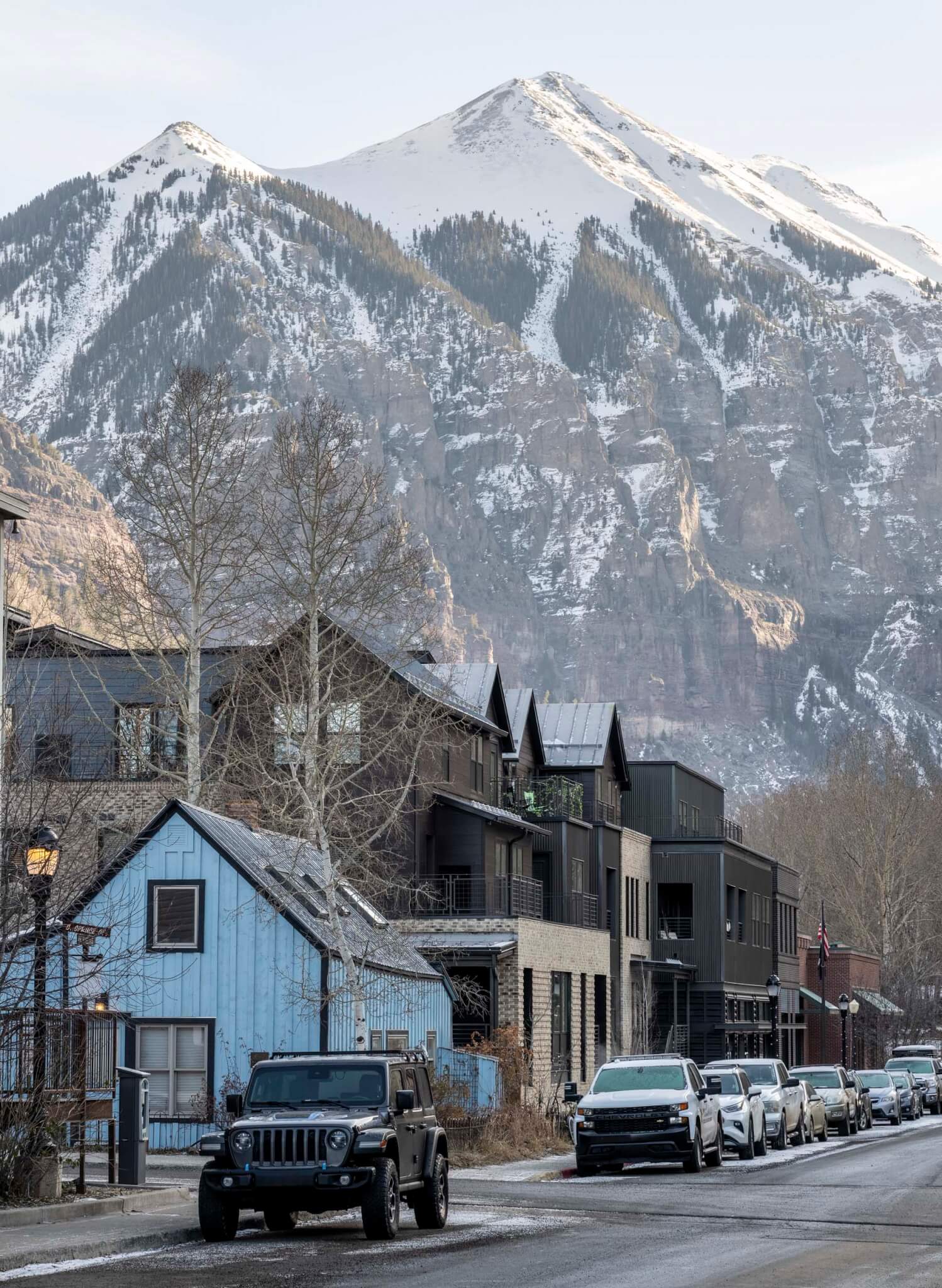
In Telluride, Colorado, a town boxed in by steep canyons, where local workers have been priced out by an influx of pandemic-era remote workers, Colorado-based CCY Architects worked with the town to construct VooDoo Lounge, a 27-unit mixed-use rental housing development targeted to those making 110 to 170 percent of AMI. The property is located in the town’s historic district, which required that they work diligently to gain public approval, said CCY partner Maura Trumble. It wasn’t easy.
“There’s a very engaged community within Telluride that tends to lean more antidevelopment,” said Trumble. “In this part of town, there’s a lot of high-value, free-market condos with people who enjoy their views and are of the mindset of ‘We love affordable housing, but don’t build it by me.’” This is a common attitude that CCY has encountered in its work across small mountain towns, where it has built its niche over 50 years; as such, the firm is accustomed to working closely with civic volunteers and city officials to tailor developments to town desires.
Named after the artist studios that once inhabited the site, VooDoo avoids the extruded box typical of multifamily developments. Instead, the designers prioritized adhering to the neighborhood’s existing low-rise character by spreading units across three floors. Frontal units have individual entries via walk-ups or an exterior circulation path; units in the rear have elevator access and interior entryways and include extra bedrooms inserted into an oversize dormer. CCY employed repetitive roof gables as a nod to surrounding historic buildings, creating “playful relationships to help break down the streetscape facade so that it didn’t feel big,” said Trumble.
Merge was also conscious of avoiding hulking residential boxes that might make neighbors nervous. Its Jackson project fit units in three volumes connected by a central plinth, ensuring that the final structure wouldn’t tower over the surrounding single-family homes. Rooflines are sloped to address the snowpack and speak to the mountain behind it. Residents who attended town hall meetings appreciated “the simplicity of it,” Whittaker said.
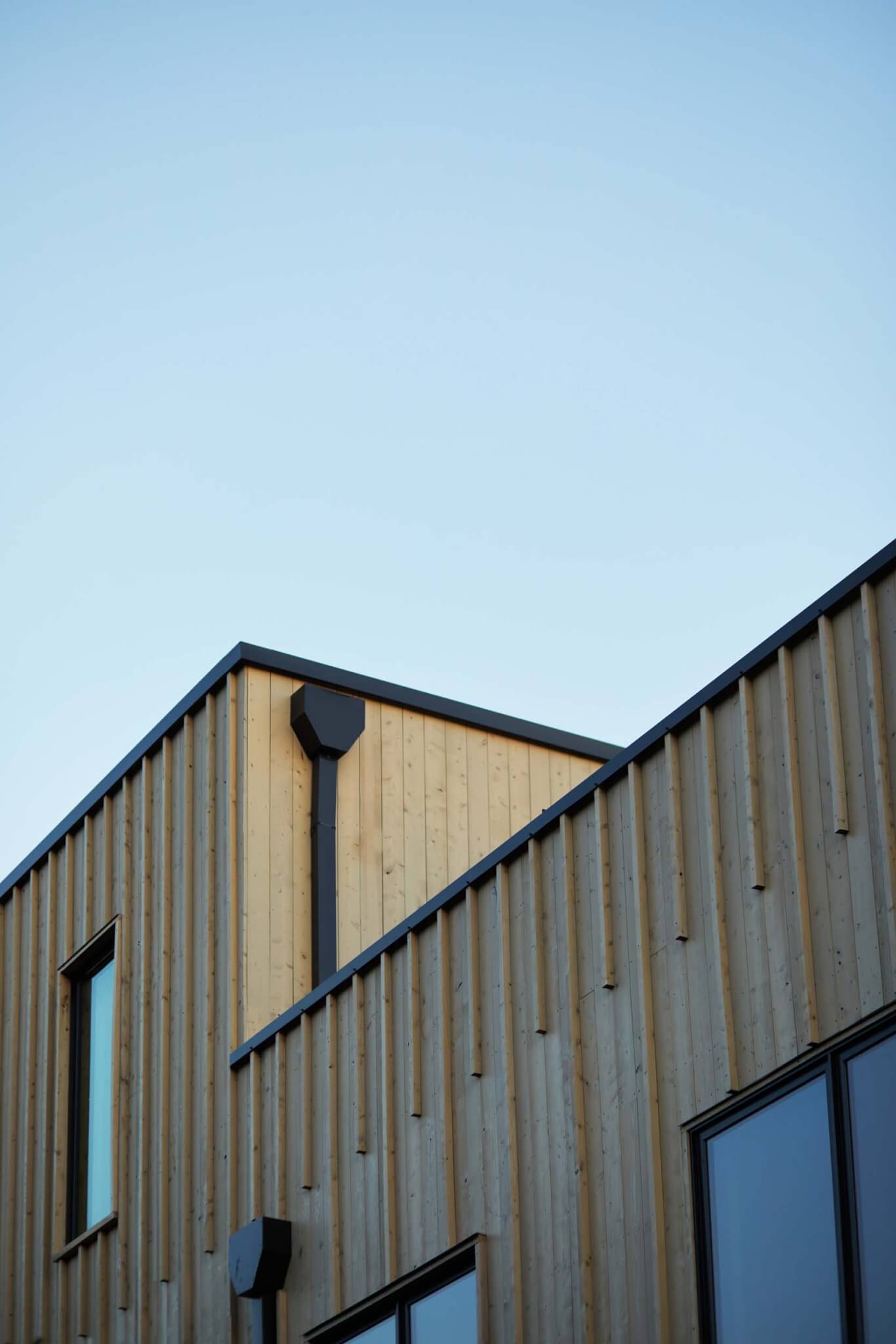
But it’s not just aesthetics that made these homes possible—some municipalities have also taken the wheel in creating policy to protect their community members. In Telluride, the town proactively land-banks developable parcels for housing, explained Trumble; for the firm’s VooDoo homes, the local housing authority was the developer. In Teton County, a zoning reform with new mitigation requirements was implemented in 2018. It included allowances to encourage workforce housing to be developed in town. Post Company was able to construct a 12-unit condominium project in Jackson under these changes, but Caldwell said it was scaled back from its original proposed 16 units “to make this a little bit more politically tenable…to the people who were loudly objecting to this change in density that had occurred a few years previously.”
Still, Post Company was able to provide 12 deed-restricted one- and two-bedroom condos that sold starting around $400,000—affordable to the professional class that has been affected by the housing crunch. “The point here is not to create housing so that somebody can come in and build a giant hotel and have workers for it. It’s to sustain what we have,” said Caldwell. As a Jackson resident, he understands the importance of providing housing at all levels. Mobile home communities, dormitories, multifamily rentals, owner-occupied condos, and more help maintain what is most desirable about living in a mountain town.
“The pressures that are being put on the community are challenging what we value, which is a closeness and accessibility [to] each other and the outdoors,” said Caldwell. “All of that stuff is in some ways being directly attacked by the market conditions that are driving the housing crisis.”
Anjulie Rao is a Chicago-based journalist and critic covering the built environment. She is a lecturer at the School of the Art Institute of Chicago and a columnist at ARCHITECT magazine.
→ Continue reading at The Architect's Newspaper

