
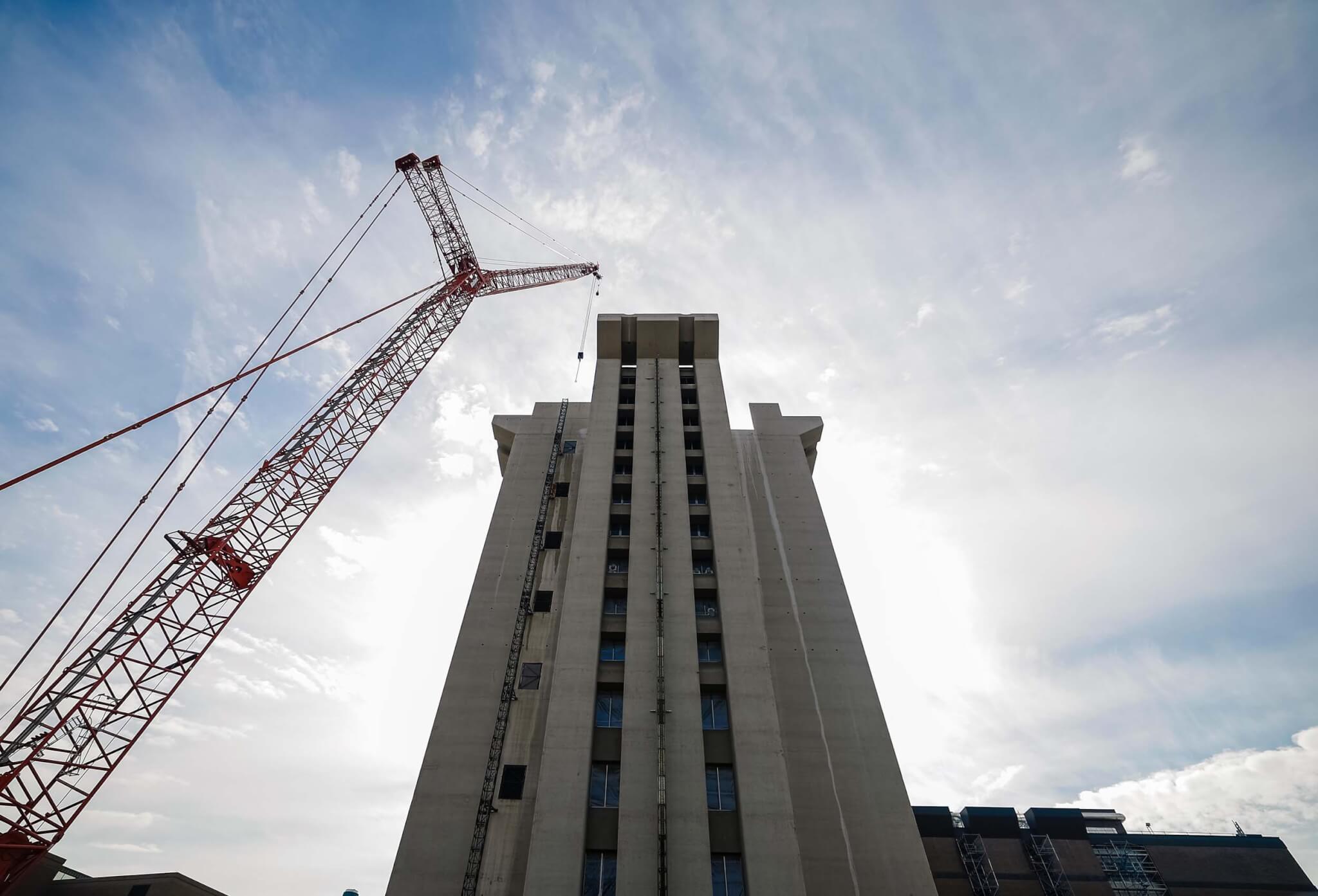
On January 27, 2026, demolition crews began taking apart Crosley Tower, the 16-story Brutalist monolith that has loomed over the University of Cincinnati’s Uptown campus for 57 years. The tower takes its name from Powel Crosley Jr., a UC alumnus whose ventures spanned radio manufacturing, automobile production, and ownership of the Cincinnati Reds. Some have called the building a totem, others an eyesore. It has topped lists of the ugliest university buildings in the country. And yet, by the time the cranes arrived, over 500 students had joined a campus appreciation club devoted to it. That contradiction—the building everyone claims to hate but can’t quite let go of—is the real story of Crosley Tower.
Crosley Tower was designed by the Cincinnati firm A. M. Kinney Associates. It was completed in 1969 using a slip-form, continuous-pour technique in which wet concrete was fed into rising molds around the clock for 18 consecutive days. It is the second-largest continuously poured concrete structure in the country, behind only the Hoover Dam. The result is a square, fluted pylon whose massive corners rise 16 stories and flare outward at the crown in what architectural historian Paul Bennett described as “abstracted Corinthian fashion”—though the flaring forms are not merely decorative; they house ventilation shafts for the chemistry labs within. Bennett also called the Crosley “a totem of the 1970s,” when universities used tall buildings to project worldliness and sophistication. With its twin circular windows gazing out from each wing, the building has struck observers as everything from a giant chess rook to a medieval watchtower to, on gray days, a dystopian movie set.
Love It or Raze It
The Crosley Tower’s lead architect, Charles Burchard studied at Harvard under Walter Gropius and worked in Marcel Breuer’s office before arriving in Ohio, where his career proved turbulent—his licensure was challenged in a bitter dispute between architects and engineers over professional boundaries, and he eventually left Cincinnati for academia.
As founding dean of Virginia Tech’s School of Architecture, Burchard built a program rooted in Bauhaus principles. His design for Crosley, initially called Building A2 of the Science and Engineering Complex, was Brutalist in the fullest sense: raw concrete as both structure and finish, form dictated by mechanical systems and construction method, no applied ornament—very Brueur-esque.The ethos was honesty: no veneers, no plastering, no unnecessary decorative finishes. Yet Bennett observed that the tower and its companion Rieveschl Hall carried “visually powerful stylizations along their rooflines, perhaps innovative at the time but now considered by most at UC as garish.”
UC announced plans to demolish Crosley in 2018, citing a crumbling facade, a sinking foundation, and persistent leaks. The rapid pace of the original pour, which over decades compromised the concrete’s integrity, left the building beyond practical renovation. The $47.3 million demolition, approved by the Board of Trustees in April 2025, is being led by Skanska, with O’Rourke Wrecking Company handling the top-down, floor-by-floor removal—both firms have employees on the project who attended UC and once took classes in the tower.

The Modernnati blog has questioned whether any preservation specialists were consulted, and noted that at over 50 years old, the tower was eligible for nomination to the National Register of Historic Places—a possibility that was apparently never pursued. Architect Jeanne Gang of Studio Gang has argued that demolishing Brutalist structures is environmentally reckless, since the carbon from curing cement has already been spent—adaptive reuse, she says, is almost always the greener path. Cincinnati was never a Brutalist city; it favored art deco and midcentury modern, and had little appetite for raw concrete. Crosley was one of the few exceptions. But UC’s position is that Crosley’s structural decline put it past saving. Whether or not the decision was inevitable, the building’s impending loss galvanized a community that had been quietly forming for years.
Reverence Required
The Crosley Tower Appreciation Club, founded in 2021 by communication design students Sophie Lietz and Emma Unangst, grew from a GroupMe link into one of the largest student organizations on campus, with trivia nights, photography competitions, and movies projected onto the building’s flanks. Students have posted Minecraft replicas, made ceramic mugs with its image imprinted, and at least one person got a tattoo. This past summer, the club’s Instagram announced a “black mass” in memory of the tower—black clothing optional, reverence required.
“It’s kind of a meme,” said Anna Hargan, a UC graduate and architectural designer at Cincinnati firm Drawing Dept. Who devoted her Master’s thesis to the building. “It’s considered ugly and unadaptable. But I see it more as monolithic or monumental.” Clara Weber, a student in UC’s College of Design, Architecture, Art, and Planning (DAAP), was more direct: “the ugliest building on campus, but everyone kind of loves it.”
Juju Stojanovic, a DAAP student who grew up blocks from campus, channeled her attachment into a typeface called Crosley Display and a capstone book documenting the tower’s history and its community of fans and detractors. Doctoral graduate Deirdre Piedmonte urged people to remember the building for the science conducted within—work by figures like George Rieveschl, inventor of Benadryl; and Edward Deutsch, a pioneer of nuclear medicine. Hargan, in her thesis, wrote that Crosley’s “infamous identity has nurtured an unexpected level of appreciation.” Unangst, the appreciation club’s cofounder, said the plan was to hold the club’s final meeting as a viewing party for the demolition. “We’re very much at peace with the fact that it’s going to eventually come down,” she told The News Record. “All good things must come to an end.”
→ Continue reading at The Architect's Newspaper

