
Bruce Goff: Material Worlds
Art Institute of Chicago
Through
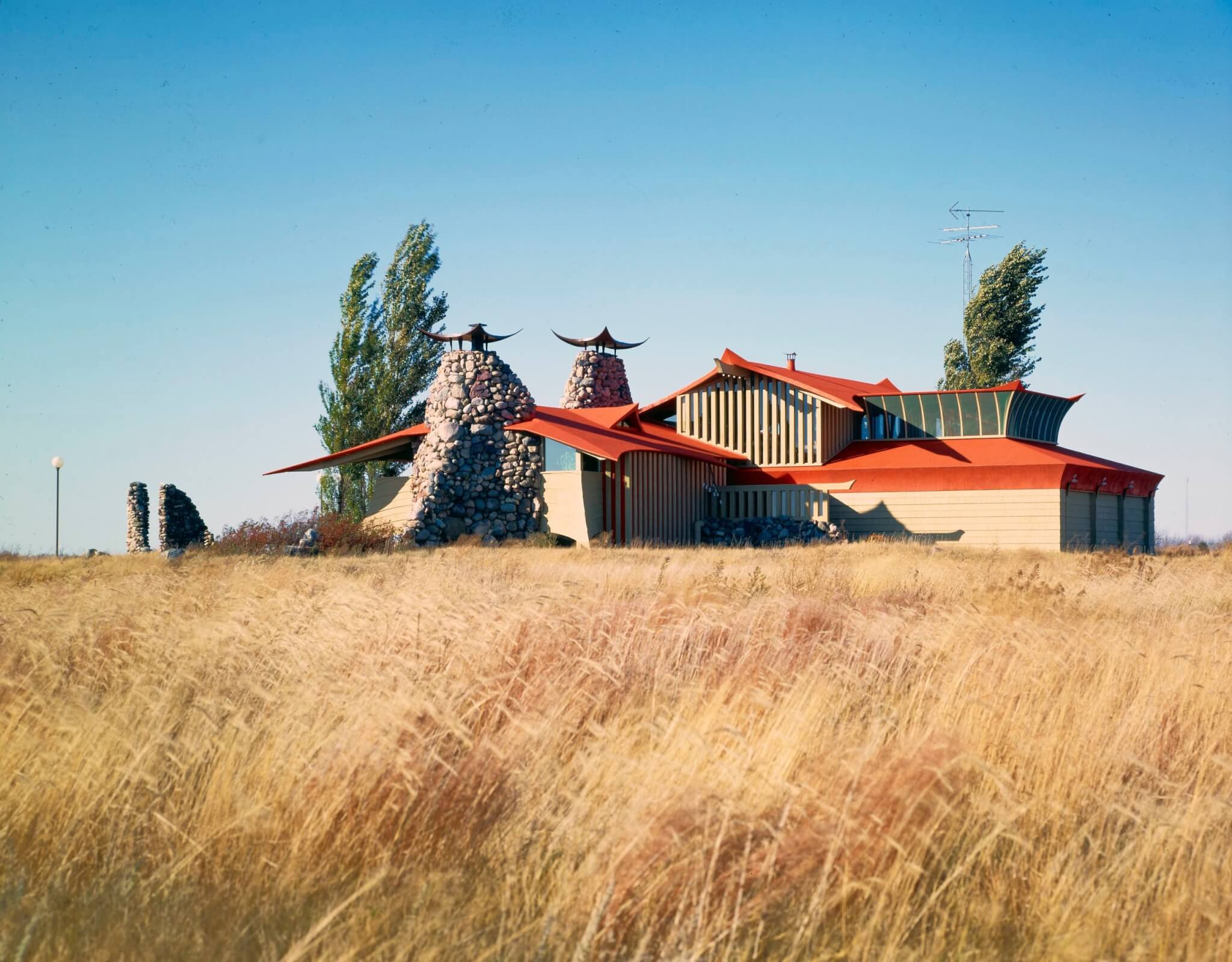
The most important aspects of the Art Institute of Chicago’s retrospective exhibition Bruce Goff: Material Worlds are not the buildings designed by the late architect (1904–1982), but the collection of mementos from his personal archive. With over 200 works on display, the exhibition is fairly large, but a strict path of circulation guides you through a biography of Goff’s life: the geography, people, cultures, and artifacts that deeply and directly influenced his striking architectural style. Goff is, perhaps, an obscure architect when compared to his mentor Frank Lloyd Wright and contemporary Mies van der Rohe. Nonetheless, he has made his mark in Chicago, the broader Great Plains region, and the discipline of architecture through his use of esoteric materials, unexpected geometries, and juxtaposing cultural touchstones, especially within his distinctive, residential single-family home projects.
Central to the exhibition’s examination of Goff’s life as an architect is what curators Alison Fisher and Craig Lee refer to as realia: the quotidian material samples, conspicuous art objects, space-age aesthetics, and Indigenous artifacts that fused to generate Goff’s style outside of the predominant modernist architecture of his time. Instead, the exhibition positions issues of Omni magazine, Native American watercolor paintings, miniature disco balls, custom dress shirts, artificial turf samples, and Japanese prints as equal and paramount to the architectural designs themselves. The architecture is there, too: there are dreamy watercolor renderings, studious site sketches, and intricate models. But as James Rondeau, the president and director of the Art Institute writes in the foreword to the retrospective’s accompanying book, the exhibition’s aim is to “explore the many facets of Goff’s expansive career to establish his role as a unique chronicler of twentieth-century America.”
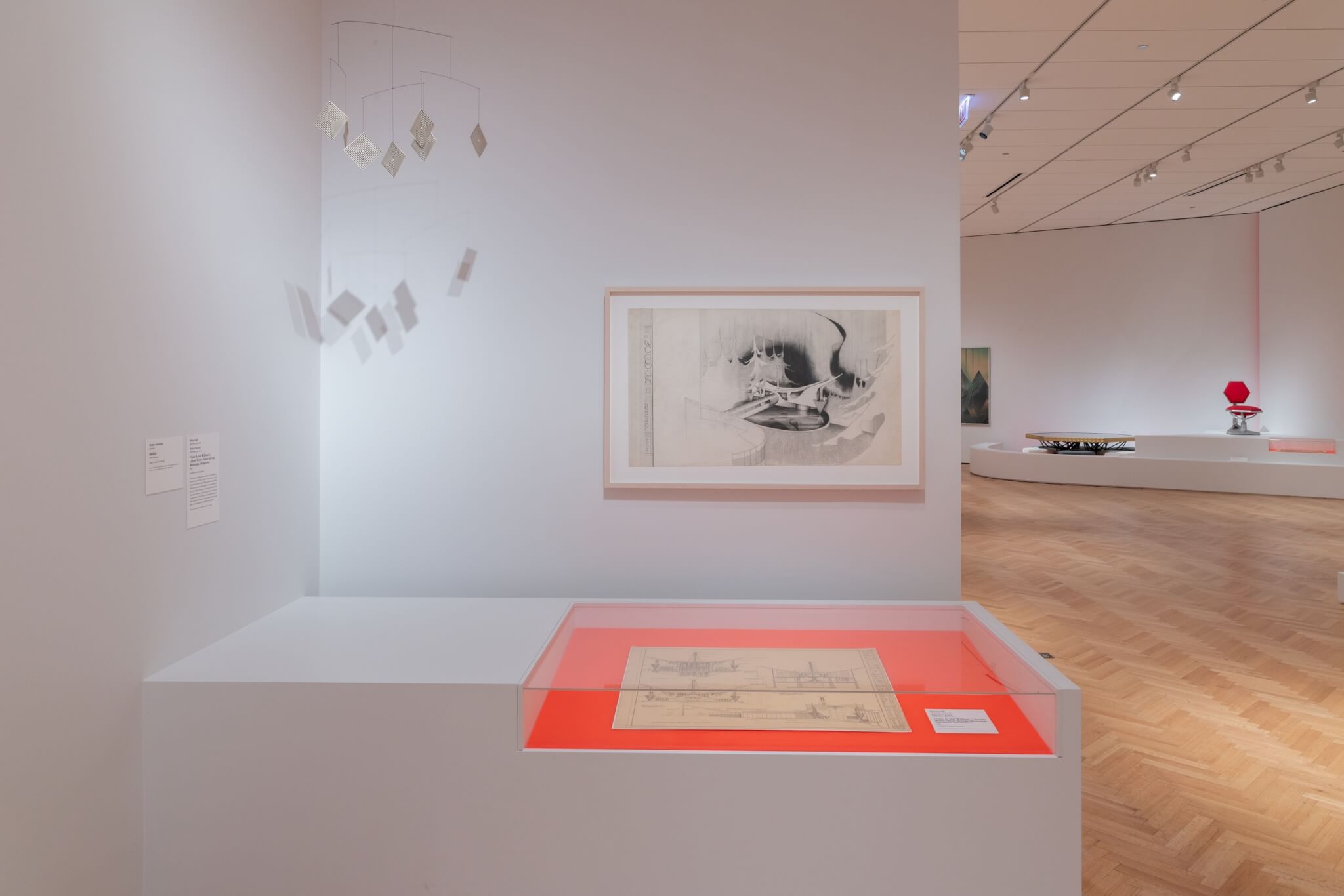
Material Worlds puts forth the argument that the architect operates in a field of existing work, often exclusionary of buildings, rather than in a disciplinary bubble as a singular genius, and that how the architect selects, exposes, and ingests that work can define their career. To illustrate this accumulative process, the exhibition is divided into ten sections, arranged chronologically, that follow a fairly consistent formula: a wall text that titles and frames that narrative portion of Goff’s life, two to three buildings associated with that time represented by drawings hung on the wall and the occasional model, and a nearby glass case in which the aforementioned realia is displayed against a neon coral background. The sections, titled “Realia: Goff’s Collections,” “Learning by Doing,”, “Avante Garde: On the Plains,” “Chicago Blues,” “The American School,” “Pride of the Prairie,” “Roadside Spectacle,” “Artificial Nature,” “Plastic Futures,” and “A Final Gathering,” explain what Goff was exploring at different times in his life and why. For example, the section “Plastic Futures” connects popular space-age aesthetics of the 1950’s with Goff’s use of plexiglass tubes, parabolic curves, and deep conversation pits in speculative domestic spaces, and displays copies of the futuristic magazine Omni from his own collection. Other connections are more localized: the 1948 Hopewell Baptist Church in Edmond, Oklahoma, described in the section “Roadside Spectacle” was designed in response to the congregation, which was largely comprised of oil-field workers, and typological forms built by Native Americans of the Great Plains region.
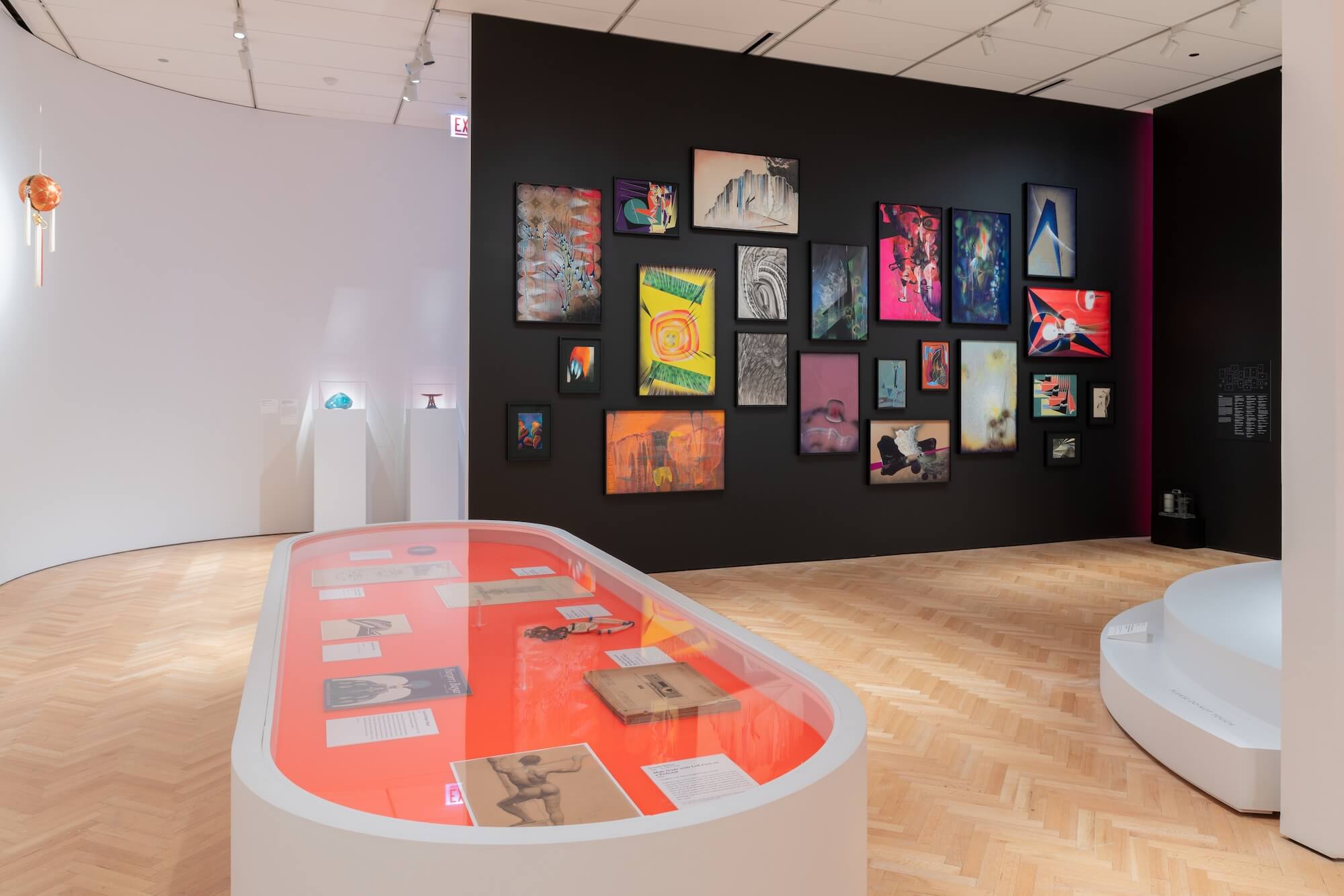
These displays are punctuated by a few moments of extracurricular production and activity authored by Goff. Near the start of the exhibit is a tall black wall filled with abstract paintings, then a player’s piano plinks out a repeating tune in the “Chicago Blues” section. The disparate interests of painting and music are not unusual for an architect practicing at that time (Corbusier even invented his own style of painting, and Wright is said to have visualized Beethoven’s music while designing), but they do contribute to the exhibition’s broader narrative of Goff as a multi-faceted chronicler of modern life, rather than a designer of it. The abstract compositions of his paintings and the jazzy arrangement of his music are as much a reflection of the midcentury moment as his buildings.
The realia-based architecture exhibition is not necessarily new, although it has never been called as such. It was prescient in 1953 when architects Peter and Alison Smithson launched their London exhibit Parallels of Life and Art, which showed biological specimens, archeological documentation, geological patterns, and anatomical x-rays among other images as a way to plasticize typical disciplinary categories (not to be excluded is that they referred to themselves as “editors” rather than curators, or worse, architects). Similarly, although more directly related to architecture, Rem Koolhaas’s 2014 Venice Biennale titled Elements walked viewers through the individual components like windows, walls, ceilings, and plumbing that add up buildings.
Like prior exhibitions that have surveyed the discipline of architecture, this retrospective of Goff’s work holds significance for the commentary it offers on a profession currently in flux. With looming de-professionalization, environmental crises, and a rumored recession, there is pressure on the discipline (deserved or not) to reconsider the role of The Architect as much as the role of Architecture. The directive for the contemporary architect inferred from the exhibition is simple: to be a collector of material worlds, not a creator of material worlds—despite what the title and entire history of architecture may imply. Goff clearly took care of the disparate possessions he found valuable, whether rare, old artifacts or commonplace minutiae, and this is part of what makes their display possible and valuable. Likewise, the contemporary architect’s custodianship of influential objects, places, culture, and environments is, in some ways, more important than the buildings they output. It’s no doubt that the discipline has become, antithetical to the word “discipline,” more inter-disciplinary as more holistic perceptions of the built environment and its impact on the public who occupies it has created the demand for a more expansive and analytical design process. But what a generous interpretation of Material Worlds may advocate for is a future for the discipline where architects concern themselves with extraneous material before any building project is underway; that by sifting through the material of what has come before and what may come after and creating their own canonical realia, architects may circumvent hollow remedies for our contemporary quandaries and arrive at an architecture that is forward-thinking, critically responsive, and radically independent.
Alaina Griffin is a professor of architecture design and history in Chicago.
→ Continue reading at The Architect's Newspaper

