
The Abundant Housing LA Education Fund, a California advocacy group, has announced the winners of the 2025 National Single Stair Architectural Design Competition.
The design competition was meant to showcase innovative single-stair residential building design, a burgeoning housing typology in cities around the country. Scholar Coby Lefkowitz, architect Gerhard Mayer, and design critic Frances Anderton juried the competition.
Single-stair, multifamily residences have been legal since the 1970s in Seattle, where buildings up to six stories need just one stairwell. Other cities like Austin, Baltimore, and Memphis are now starting to follow suit with single-stair reforms.
This approach allows for more apartments, better natural ventilation and daylighting, and quicker and more economical construction, the American Planning Association contends. It’s particularly advantageous for infill and small lots zoned for single-family construction, where square footage is precious.
Per the competition rules there were three project award categories: Sites were in Austin; San Francisco; and Portland, Oregon. First prize winners were announced in each city. Single-stair construction is today legal in Austin and Portland, but not San Francisco, where affordable housing advocates are now pushing for single-stair reform.
David Baker Architects (DBA) won first prize in the San Francisco category for its submission, Steplight. The project is located on an infill lot and is defined from the exterior by cascading balconies and terraces. Mayer the juror commended the unit layout ideated by DBA for prioritizing “access to natural daylight and cross-ventilation, and the unit mix offers a balanced range of apartment sizes to accommodate diverse urban households.”
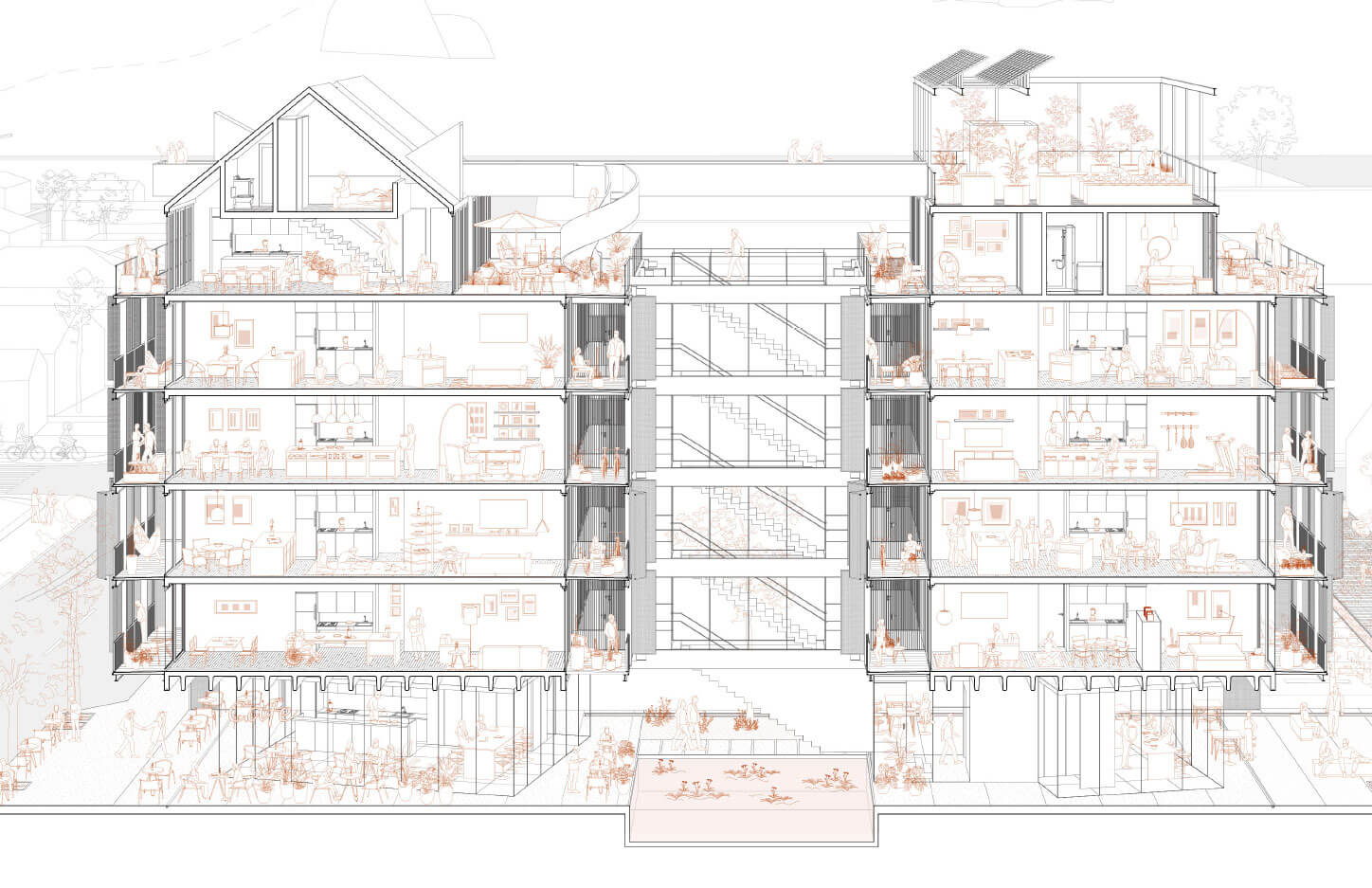
The winning team in Austin was comprised of Christian Calle Figueroa and Alexis Schulma. Their project, titled Cadavre Exquis, was sited in a low-rise residential neighborhood. It posits a solution for building much higher-density, naturally-ventilated, courtyard housing. In describing the project’s merits, Lefkowitz said Cadavre Exquis is “equal parts a pleasant vision for community and radical experimentation.”
“With rainwater collection systems, central gardens, brise soleil,” Lefkowitz added, “it asserts that buildings take a firmer role in shaping more sustainable neighborhoods without compromising on the most important mandate of the program: that a building be fundamentally desirable to live in on its own terms without yielding to the uncertainty of passionately felt aspiration.”
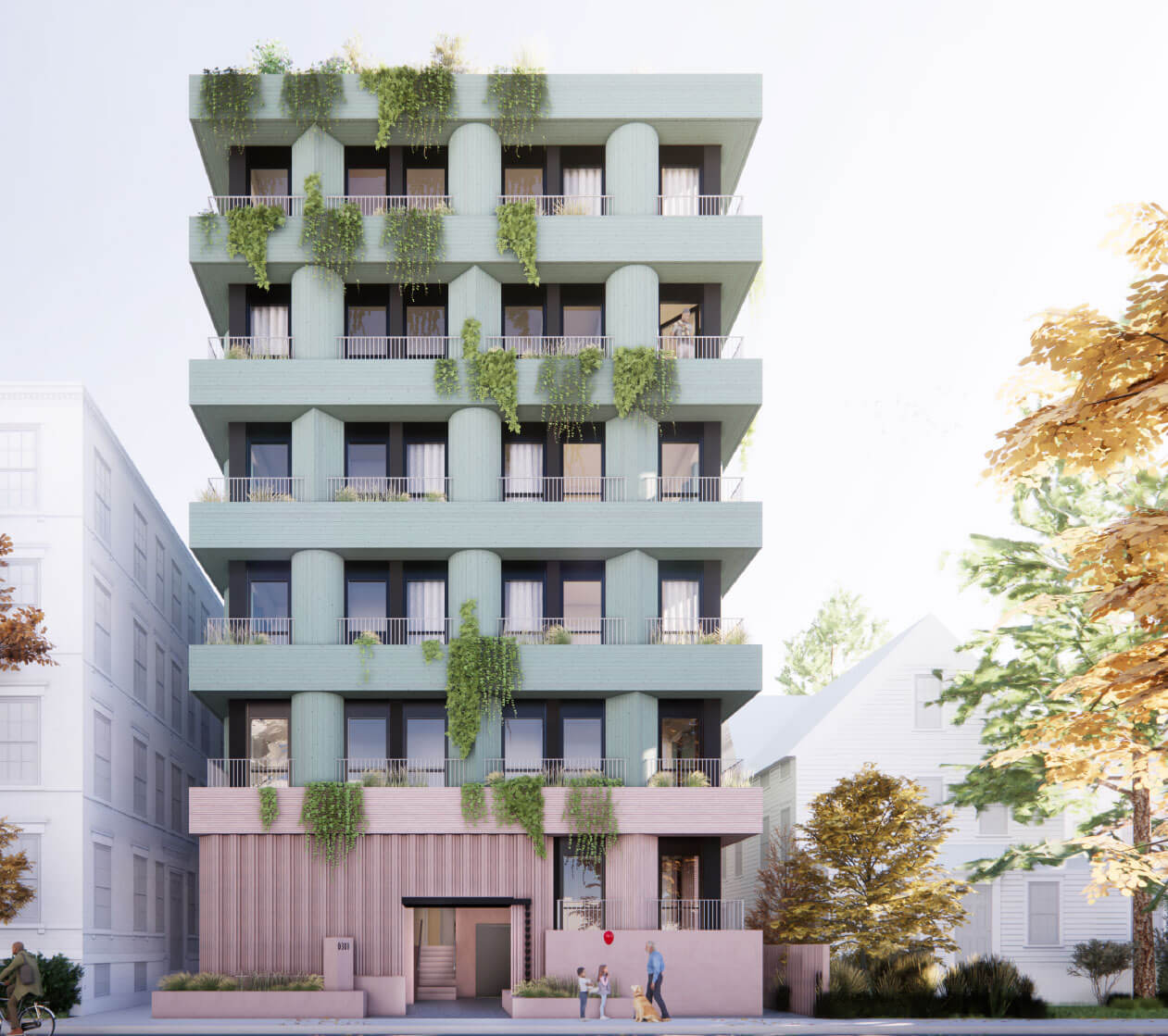
Inner Garden by architect Norbert Schlotter took home first prize in the Portland category. That project is a single-stair courtyard building defined by thick pilasters and horizontal planes. The building is lacquered in powder pink and green paint, and is stacked like a vertical garden, Schlotter said in the design statement.
“This project had me at the pink and green, a color combination I love. Together with the cylindrical and triangular columns and chunky delineation of the floor plates, the result is a bold and original facade,” Anderton said in describing Inner Garden. Anderton commended the project for its “Babylonian hanging greenery on the inside court, dripping from the single stair, transform the circulation at the heart of the concept into a delightful secret garden.”
Second and third place winners in the 2025 National Single Stair Architectural Design Competition were: James Donaldson, Sidell Pakravan Architects, Jonah Coe-Scharff, Kyle Barker and Mark Rukamathu, Story Dimson Studio, and Su In Kim and Seyun Kwon.
→ Continue reading at The Architect's Newspaper

