
On a Friday night at Berlin’s famed Metropol, the two surviving members of David Bowie’s Black American three-man backing rhythm section take the stage. Guitarist Carlos Alomar and bass player George Murray are missing their old percussionist comrade, the late, great Dennis Davis, but are tonight rounded out by a full band. It’s November 7 and they’re kicking off a 16-city, month-long European tour bringing the music of Bowie’s Berlin Trilogy (1977’s Low and “Heroes”, and 1979’s Lodger), that they helped create, back where it was born.
As the lights dim, the band is introduced by its leader, Carlos Alomar, and then kicks into a powerful, spot-on rendition of “Joe the Lion” from “Heroes”. This song was written in this city 48 years ago, less than two miles away at Hansa Studios, itself only a couple of blocks from the Wall and Checkpoint Charlie.
Cold War Berlin was the stuff of spy movies in the late ’70s — a wild west borderland with agents and operatives from both sides, and nonpartisan schemers making a buck, mark, or ruble in between. West Berlin was an island in a hostile East German sea, connected by train to West Germany, to which it belonged. A symbolic reality lived amidst a walled line between East and West, Warsaw Pact versus NATO. The Cold War raged hot in other parts of the globe, but here the simmering tension echoed the inter-war, expressionist, Weimar years, in this same old city.
It was all of this, particularly the themes alluding to that early 20th century German Expressionism and the work of Christopher Isherwood (author of Berlin Stories, the novel from which the musical Cabaret is based) that drew David Bowie and close friend Iggy Pop — both looking to reinvent their careers and creativity while getting clean from heroin (Pop) and cocaine (Bowie and Pop) and the dark decadence of fame they felt in Los Angeles. 1975 was a real breaking point for Bowie; in later interviews he said he barely remembered recording Station to Station in LA that year, as he was so out of his mind. The tour for that album took Bowie and Pop to Europe and thus began a period of healing and artistic rebirth.

The Berlin of now, almost 50 years later, is a very different place, a place of green spaces, surrounded by wind turbines and covered in solar panels. A long-since-reunited global metropolis, Berlin has commercialized and contextualized its dark 20th Century pasts with Holocaust museums, war memorials, a Checkpoint Charlie gift shop, and sections of the Wall on display. Bowie referred to the albums that came from his time there as the Berlin Triptych, while music historians often call them the Berlin Trilogy. This set of discs came from Bowie exploring a new world, ready to embrace whatever aesthetic development and unfolding it would bring. Ever sensible when it came to music and business, even while coming out of a cocaine haze, Bowie needed a trusted foundation of musicians to have his back in chasing a new horizon. Luckily, he had the D.A.M. Trio.
The D.A.M. Trio — Dennis Davis, Carlos Alomar, and George Murray — first came together in Los Angeles 50 years ago to record Station to Station in sessions from September to November 1975. Released the next year, Station to Station was Bowie’s 10th album and his second with Alomar, who had guitared on Young Americans (1975). Dennis Davis drummed on two of that LP’s tracks, “Fame” and “Across the Universe”, while bassist George Murray was a new player for Bowie on Station to Station. The D.A.M. Trio continued as the rhythm section for the next four of Bowie’s studio albums: Low (1977), “Heroes” (1977), Lodger (1979), and Scary Monsters (and Super Freaks) (1980).
The set list on that opening night in Berlin hits the most rocking points of the D.A.M.-powered albums. “None of the slow stuff,” Alomar tells me ahead of time, when planning the tour. By slow stuff he’s referring to the ballads on Station to Station (1976), but also, more specifically, the experimental, ambient tracks on the second side of Low and interspersed throughout “Heroes”, songs often attributed as much to producer Brian Eno as to Bowie himself. “Heroes” was the only album entirely recorded in Berlin. Low was mostly recorded outside of Paris at Château d’Hérouville, and Lodger was recorded entirely in Montreux, Switzerland at Mountain Studios. But as Alomar and this tour point out, the Berlin Trilogy is only the middle three of a five-album run with this powerhouse rhythm section. So it’s kind of a… five album trilogy.
Starting with the Station to Station tour in 1976, Alomar served as Bowie’s band leader and was responsible for the arrangements adapting studio recordings to the stage. He worked in this capacity all the way up through the Let’s Dance tour (an album on which he didn’t play). In reply to a question that I asked at lunch in Harlem a few years ago involving the musical notation-reading ability of rock musicians, Alomar said, “Well, it is a very delicate situation because I don’t like to intimidate the musicians. I have to kind of look at every musician and treat them like, ‘Hey man, I want you to play it like you wrote it, not play it like that guy wrote it. I don’t want you to be Bowie, I want you to be you.’” This is indicative of the patience, intellect, and versatility that made him perfect for this role under Bowie, and now the D.A.M. Trilogy Tour is not just a return to Berlin and this period’s music, but a return to his position as the band leader for this music. Bowie trusted him for many reasons, but an important one was that Alomar intimately knew his whole catalog.
Before the start of the show, the Metropol bar attached to the main dance floor teems with people in VIP passes who all seem to know each other. They tell me that they are members of the Facebook group, Bowie Fascination, and most of them attended the David Bowie World Fan Convention in Liverpool, England in July last year. It was there that Alomar publicly announced this tour. The duly gathered then felt they had to be part of this history.

In assembling the band, Alomar called in singer Michael Cunio, known for belting out vocals with Brass Against. While most of the covers he sings with that big band are from Led Zeppelin, here his Bowie is smooth and controlled, embracing the interstellar chameleon’s crooner aspects.
Filling in for Davis on drums is Tal Bergman, an accomplished percussionist for such acts as Chaka Khan, De La Soul, and Roger Daltrey. When I ask if he feels pressure to live up to Davis’s legacy, Berman says, “I met Dennis a few times when I used to live in New York, and he was a great guy, and a great drummer. There is no pressure for me. Only fun. The way I honor him is by playing what’s best for the music and keep some of his parts that I think are hooks — besides that just do the best job I can do.”
On backing vocals is three-time Grammy nominated Lea-Lorien, who is also Alomar’s daughter. Her husband Axel Tosca is on keyboards. The intricate, wild, and soulful lead guitar work is by Kevin Armstrong, a music producer and Bowie veteran having been in the band at the 1985 Live Aid gig as well as supporting Bowie in Tin Machine and on the 1995 album Outside.
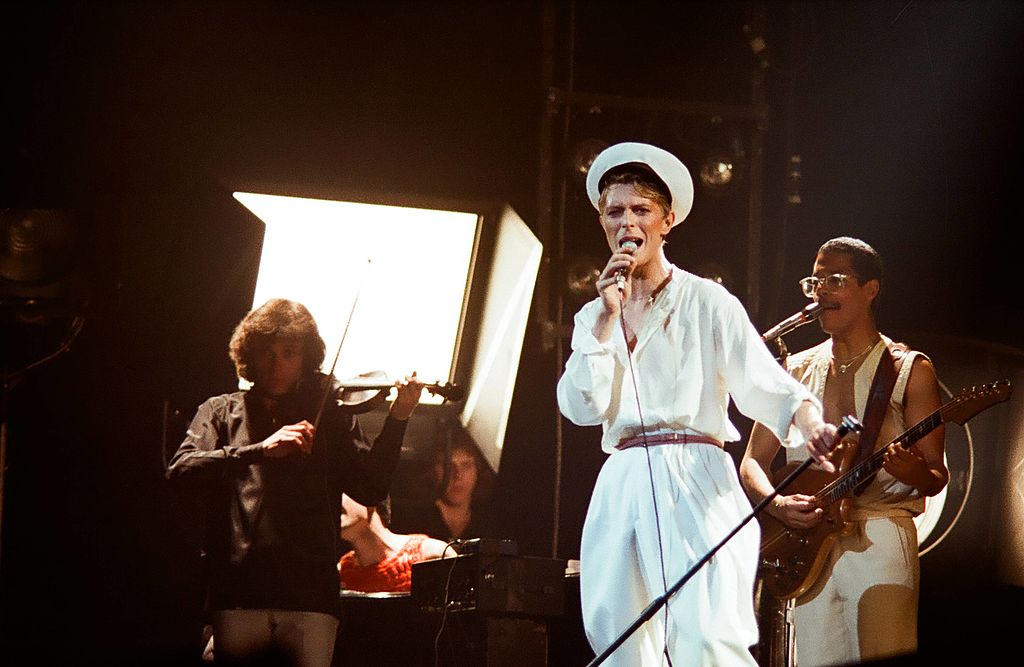
After four songs, (“Joe the Lion”, “Blackout”, “Beauty and the Beast,” and “Look Back in Anger”), Alomar takes a moment to address the audience about why we are all here. He reads a tribute to his “two brothers,” Dennis Davis — “who could make a drum breathe” — and David Bowie, and before kicking into the next song, “Breaking Glass” from Low, he tells their memories, or ghosts, “this is for you Dennis, and David, we are still holding the line.”
The setlist weaves together the different albums, a few from one, then one from another, then a few more from another, creating an inter-locking flow independent of chronology, but engaging and surprising. For this crowd, it is hit after hit after hit.
When the songs from the most literal definition of the “Berlin Trilogy” conclude with an emotional and inspired rendering of “‘Heroes’”, Alomar speaks again to pay tribute to guitarist Robert Fripp, who played lead on the album of the same name. Here Alomar reminds that audience that while the Berlin Trilogy was “lightning in a bottle,” the D.A.M. Trio also played on Station to Station and Scary Monsters (and Super Creeps), and while the trio was essential to the success of those five albums there is one name without whom the Berlin Trilogy would not sound like it does: Robert Fripp, who played on “Heroes” and Scary Monsters.
Alomar says that Fripp’s guitar work “hovers, it roars, it paints whole landscapes in the air. When I first heard In the Court of the Crimson King I didn’t know whether to pick up my guitar or to retire and become a plumber.” This is a segue into the song “Scary Monsters” and how accomplished Armstrong’s guitar playing is in capturing Fripp.
Next is a sole song from Station to Station, the crowd-pleasing dance hit, “Golden Years,” and Cunio has the moves to get and keep us all moving. His hips would make even David Bowie blush and giggle, and they keep us dancing with “Fashion” following. This final stretch of songs from Scary Monsters continues with “Ashes to Ashes,” a sequel to Bowie’s most famous hit, 1969’s “Space Oddity.” This rendition begins with an elaborate piano solo by Tosca, and Alomar beams from the side, a proud father-in-law. “It’s No Game (No. 1)” and “Scream Like a Baby” conclude this opening show with hard, heavy, and triumphant power.
While the average rock music lover might not know much of the album Lodger, when the band plays one of my favorites, “Yassassin,” I feel like a member of the community as the whole room sings along on the refrain of the chorus with the backup singers. Most everyone I meet has an English accent and many were booked for more shows, especially the UK stops in Sheffield, Liverpool, Glasgow, London, and Bristol, before the final show in Dublin. The farthest travelers I encounter are a pair of women from Los Angeles all glittered and lightning-bolted.

They are all here for the same reason that I am. It’s not just the symbolic resonance of Berlin for the Berlin Trilogy, but it’s that to hear such songs as “Joe the Lion, “The Secret Life of Arabia,” and “Heroes” — all off the album, “Heroes”— where they were born: written and recorded. Tomorrow, while the D.A.M. Trio rests after a 13-hour overnight bus ride to Oslo for the next show, my wife and I will visit Hansa Studios, Checkpoint Charlie and the remains of the Wall. And there at the Wall we shall kiss, just like those “heroic” lovers Bowie sang of, while the guards shot over their heads, the shame on the other side, the side of authoritarianism.
Set list for opening night in Berlin
- “Joe the Lion” (Heroes”)
- “Blackout” (“Heroes”)
- “Beauty and the Beast” (“Heroes”)
- “Look Back in Anger” (Lodger)
- “Breaking Glass” (Low)
- “DJ” (Lodger)
- “Repetition” (Lodger)
- “What In the World” (Low)
- “Boys Keep Swinging” (Lodger)
- “Yassassin” (Lodger)
- “Red Sails” (Lodger)
- “Sound + Vision” (Low)
- “Secret Life of Arabia” (“Heroes”)
- “Red Money” (Lodger)
- “Heroes” (“Heroes”)
- “Scary Monsters” (Scary Monsters (and Super Creeps))
- “Golden Years” (Station to Station)
- “Fashion” (Scary Monsters (and Super Creeps))
- “Ashes to Ashes” (Scary Monsters (and Super Creeps))
- “It’s No Game (No. 1)” (Scary Monsters (and Super Creeps))
- “Scream Like a Baby” (Scary Monsters (and Super Creeps))
→ Continue reading at Spin

