
Mathaf: Arab Museum of Modern Art has announced a multi-phase campus expansion in Doha, Qatar, with Paris-based Lina Ghotmeh – Architecture leading the design. The project, timed to the institution’s 15th anniversary, aims to shift the museum’s identity from a primarily exhibitions-driven venue into something closer to a production site, a place where artists can work, test materials, and host public programs alongside the collections.
Ghotmeh is no stranger to Qatar’s cultural diplomacy. Earlier this year, she designed the country’s permanent pavilion for the Giardini della Biennale in Venice, the first national pavilion built there in decades. The language surrounding the design—openness, gathering, cultural exchange—closely echoes the ambitions now attached to Mathaf’s expansion.
The first phase of the project is already open. Mathaf’s ground floor has been reconfigured into a “majlis-inspired,” library and conversation space, organized around modular furniture meant to be rearranged for talks, workshops, and browsing sessions.
Renderings for later phases make clearer what kind of “museum of making,” Mathaf wants to become, and how Ghotmeh is planning to unify the artists’ process and the gallery. The campus will house a set of volumes wrapped in a metal, curtain-like skin on what is now the museum’s parking lot. One facade will be labeled “MAKERSPACE,” in English and Arabic, while the other will read “ARTIST’S SPACE.” A plaza is set to connect these two warehouse buildings, paved with brick and broken by small trues and pockets of planting.
“By expanding Mathaf’s programmes and spaces to include residency studios, makerspaces, and workshops for ceramics and glassmaking, as well as a unique sound residency programme, we are transforming the Museum into a place where artists can also create,” said director of Mathaf, Zeina Arida.
Inside, the building will house a state-of-the-art ceramics studio developed in consultation with ceramicist Adrian Müller, outfitted with specialized kilns and shared dry and wet workspaces that allow artists to produce large-scale ceramic works. It will also include a makerspace dedicated to glassmaking, developed with artist Matteo Gonet, alongside facilities for woodworking and broader materials experimentation, as well as a sound studio conceived with Tarek Atoui and equipped with advanced audio production and recording infrastructure.
In an early rendering of the sound studio, a low central desk furnishes the dark space alongside equipment, including speakers stacked at the perimeter, a piano tucked to known-right, and microphones and instruments. The floor will don a patterned carpet and beanbag chairs will populate the space, cultivating a living room aesthetic.
With these new spaces, Mataf is trying to build facilities that can host sustained residencies and production at multiple scales. It is a bet on the popularity of the process, that a working campus is what has international cultural value.
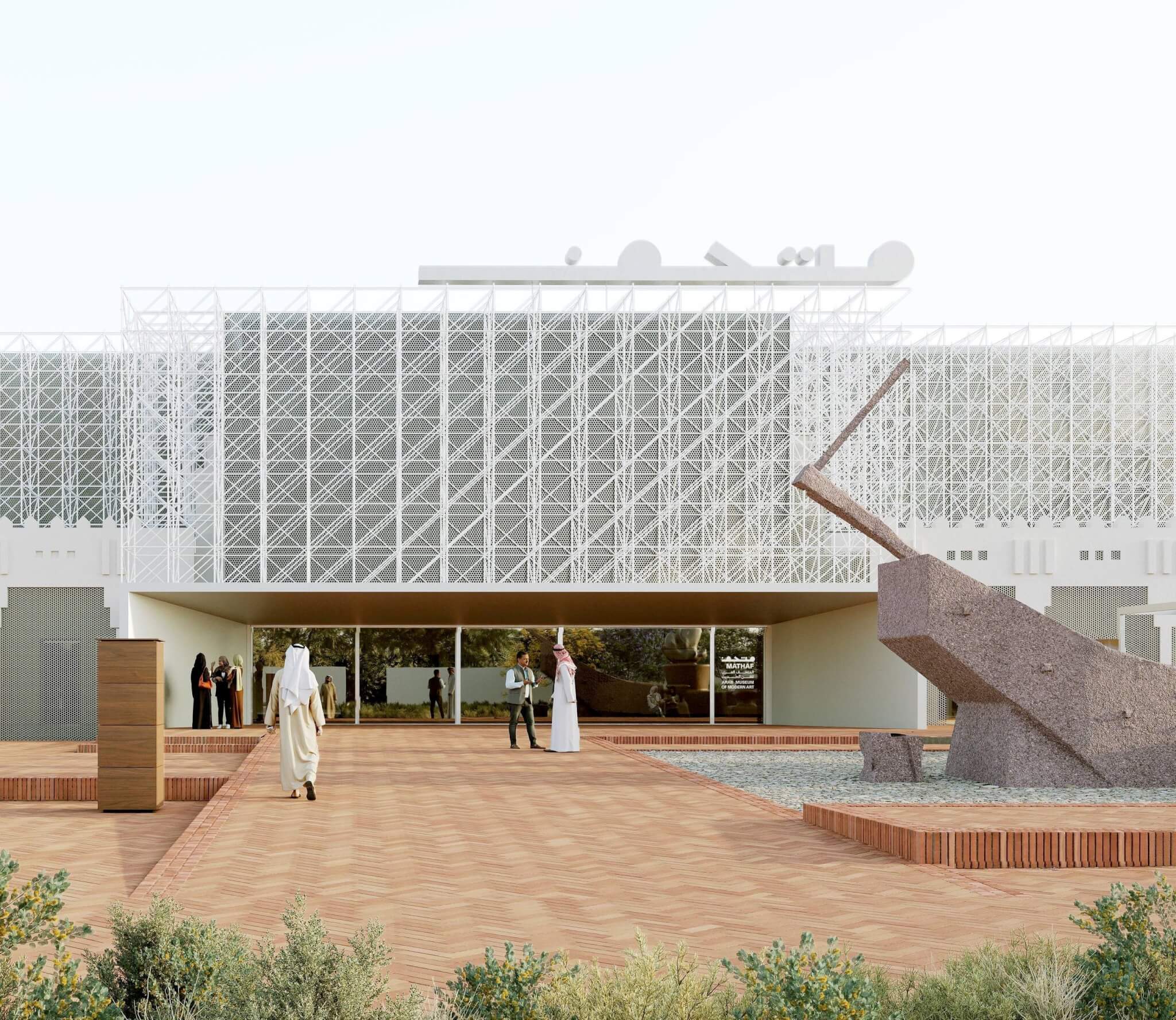
A second exterior rendering shows the proposed gallery space, with a wide, shaded entry carved out of the white, lattice-like facade. The herringbone plaza in front of the building will have a shallow pond and stone sculpture. The area is described as an “Earthen ground plane,” and a landscape responding to the region’s climate.
Ghotmeh’s selection fits a broader pattern in her recent trajectory. Over the past year she has been positioned as an architect fit for cultural, high-visibility commissions, specifically for museums. In May, her firm won a commission to redesign the British Museum’s Western Range galleries. In September, the firm was chosen to transform reformer Usmon Khodjaev’s historic home in Bukhara, Uzbekistan, into the Jadids’ Legacy Museum. And though not ultimately chosen, in March Lina Ghotmeh – Architecture was one of five firms shortlisted for the Kistefos Museum in Norway.
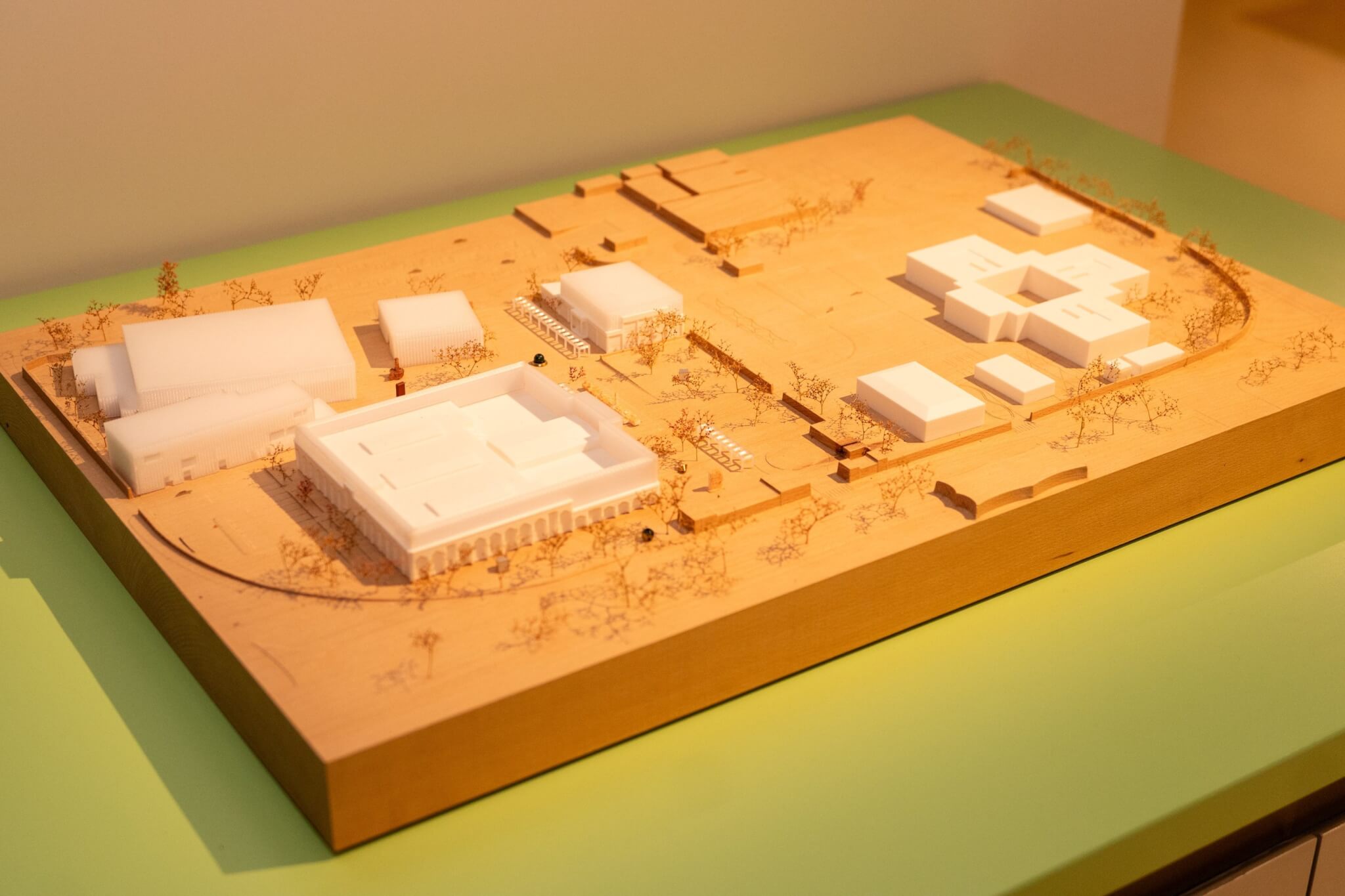
The Mathaf expansion represents a different type of cultural project for Ghotmeh. Rather than introducing a singular landmark building, it focuses on consolidating an existing campus into a more unified institutional environment capable of supporting both exhibition and production. The project works to emphasize architectural coherence, proposing a consistent material and formal language across the campus.
Mathaf’s initial phase, centered on the library and majlis, established the direction of the expansion. The full scope of the project will determine how effectively the campus integrates exhibition, research, and production into a unified institutional environment.
→ Continue reading at The Architect's Newspaper

