
John Lithgow as Roald Dahl in “Giant.”
Photo by Joan Marcus
The main attraction of “Giant” is twofold: the opportunity to watch John Lithgow take on one of the most complicated figures in modern literary history, and the play’s relevance to current debates over antisemitism, Israel’s military actions, Jewish identity, and the question of how — or whether — to separate art from the artist.
Mark Rosenblatt’s drama, which arrives on Broadway following a widely acclaimed London run, centers on Roald Dahl — not the whimsical storyteller behind “Charlie and the Chocolate Factory” and “Matilda,” but the man whose public remarks about Israel were widely condemned as antisemitic, at times extending beyond political criticism into troubling generalizations about Jewish people.
Set over a single, increasingly fraught lunch in 1983, the play imagines a private intervention between Dahl, his fiancée (Rachael Stirling), his British publisher (Elliot Levey), who is Jewish, and a young sales director from his American publisher (Aya Cash), also Jewish — an uneasy gathering that quickly turns into a battle over whether he will apologize or double down before the controversy engulfs his career. The meeting itself is imagined, though the controversy and Dahl’s remarks are real. The action unfolds entirely within Dahl’s country home, where a single sitting room — the last intact space amid an ongoing renovation — is crowded with boxed artwork, dust sheets, and the constant noise of construction.
![[L to R] Aya Cash, John Lithgow, Stella Everett, Rachael Stirling in](https://www.newyorkmetropolitan.com/wp-content/uploads/2026/03/L-to-R-Aya-Cash-John-Lithgow-Stella-Everett-Rachael-Stirling-Photo-by-Joan-Marcus.jpg)
What gives “Giant” its charge is how closely its questions echo today, amid renewed geopolitical tensions, rising antisemitism, and a culture quick to discard its icons. Rosenblatt’s script approaches these issues with intelligence and restraint. Rather than offering a clear moral position, it allows competing viewpoints to collide and overlap. The writing resists simplification — and, notably, finds humor amid the discomfort, allowing laughter to coexist with the play’s most unsettling moments.
At the center of it all is Lithgow, who delivers a commanding, carefully modulated performance. His Dahl is theatrical and domineering, by turns mischievous, bellicose, and quietly menacing — a man who delights in belittling those around him, needling them with pointed, often deliberately provocative questions. It is, in every sense, a gigantic performance — and a reminder of Lithgow’s ability to command a stage. The casting carries an added layer of irony: Lithgow is also set to play Dumbledore in HBO’s upcoming “Harry Potter” series, even as author J.K. Rowling remains a lightning rod for controversy.
The supporting cast provides a strong counterbalance. Aya Cash stands out as the American publishing executive, bringing a controlled intensity that builds into something far more volatile. Her act-ending speech lands as one of the evening’s most powerful moments. As Dahl’s pragmatic fiancée, Rachael Stirling offers a composed, quietly strategic presence, smoothing tensions while subtly asserting her own authority. Elliot Levey is equally effective as Dahl’s British publisher, balancing affability with an undercurrent of discomfort as the situation escalates.
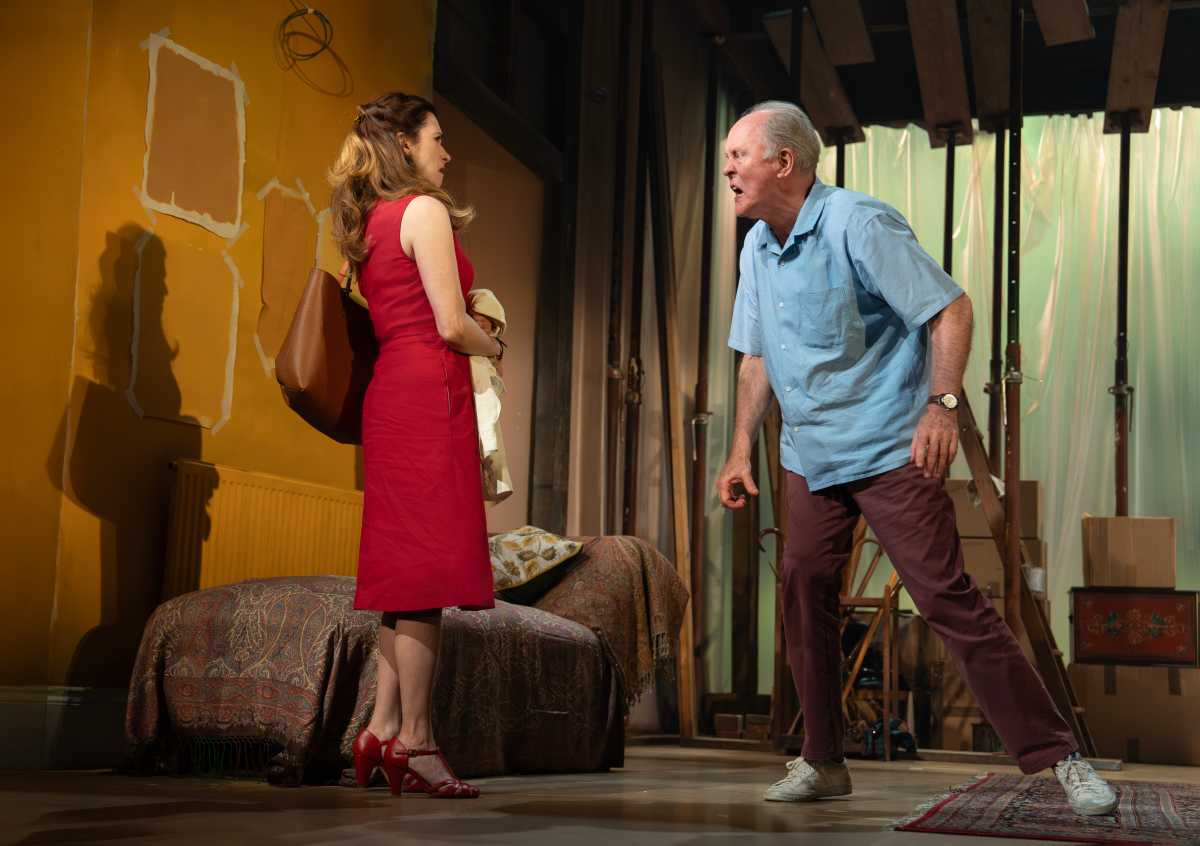
Director Nicholas Hytner keeps the staging restrained and naturalistic, allowing the performances and ideas to take precedence. At its best, this creates a sense of immediacy, as though the audience is eavesdropping on a private confrontation. At times, however, that same approach underscores the play’s limitations.
“Giant” is fundamentally a debate piece, driven almost entirely by conversation rather than action. For all its intellectual rigor, it often feels static, with long stretches that lack forward momentum. The one-room structure places enormous weight on dialogue, not all of which lands with equal force, and the second act, in particular, sags as exchanges begin to circle rather than build. The ending is abrupt and vicious. Rather than offering resolution, it leaves the audience suspended in discomfort, with no clear moral landing point — a choice that feels intentional.
Still, “Giant” is a play that invites — and perhaps demands — engagement. It is smart, timely, and anchored by a commanding central performance, but ultimately more compelling in its questions than in its dramatic execution. “Giant” offers no easy answers about art, artist, or accountability — only the uneasy certainty that the questions aren’t going away.
Music Box Theatre, 239 W. 45th St., gianttheplay.com. Through June 28.
→ Continue reading at amNY

