
Luigi Mangione sits beside his lawyer Karen Agnifilo as Paresh Patel speaks and Judge Margaret Garnett presides at the Manhattan Federal Courthouse, as Mangione appears on murder charges for the killing of UnitedHealthcare chief executive Brian Thompson, in New York City, U.S., January 9, 2026, in this courtroom sketch. REUTERS/Jane Rosenberg
Luigi Mangione, the 27-year-old accused of shooting and killing UnitedHealthcare executive Brian Thompson in Midtown Manhattan in late 2024, on Friday fought the federal charges for which the government has said it will seek the death penalty.
U.S. District Judge Margaret Garnett of the Southern District of New York also heard the parties’ request to set a trial date, indicating she is likely to begin jury selection in September, with trial beginning later in the fall or winter.
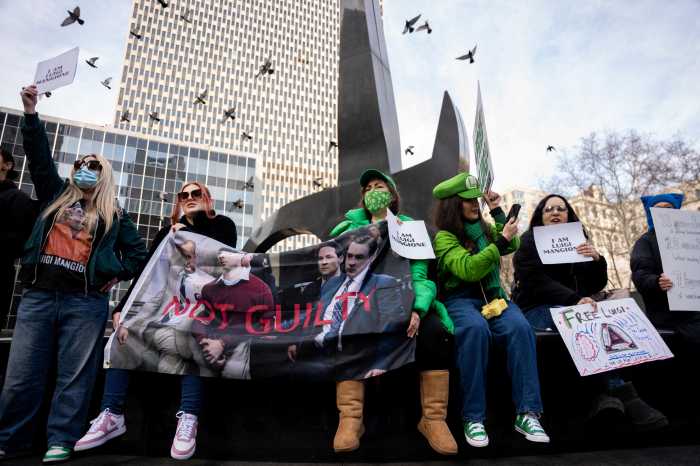
Ahead of the Lower Manhattan hearing, which spanned two and a half hours, dozens of Mangione supporters, many of them younger women, camped out outside the courthouse, lining up to get a spot in the courtroom. A clean-shaven Mangione glanced at the gallery as he took his seat between defense attorneys, wearing a khaki prison-issued T-shirt, with an off-white long sleeve, rolled up to the elbows, underneath.
Most of Friday’s hearing centered on Mangione’s motion to dismiss the third and fourth charges in his indictment: murder through use of a firearm and and a firearms offense related to carrying a gun equipped with a silencer.
The first two counts relate to interstate stalking and cyberstalking.
The latter two charges — the ones that are death penalty-eligible — hinge on firearm use while committing a “crime of violence.”
Mangione’s legal team argued that, as a matter of law, the stalking charges are not crimes of violence — and in turn, the murder and gun charges cannot stand.
Paresh Patel, a public defender in the District of Maryland who specializes in appeals, appeared as special counsel for the hearing.
During oral arguments, he made the case that the stalking charges don’t meet the definition for a crime of violence, since it can be brought for acts that don’t involve violence or threatened violence against another person.
The U.S. Court of Appeals for the Second Circuit has not held that stalking is a crime of violence, Mangione’s lawyers argue, so Garnett is not bound by such precedent. Districts outside of the circuit have been split on the issue.
Stalking charges can be brought for a person threatening their own life — for example, a jealous ex harassing a former partner, claiming they’ll take their own life if calls aren’t returned — and also, Patel argued, the statutes can apply in cases of an accidental death.
Patel posed a hypothetical: A troubled man travels across state lines to visit his sister, planning to harass her and ask her to buy money for drugs. While the two are on a hike, on a narrow precipice, arguing over the money, the man raises his voice and gesticulates wildly. His sister gets distracted, loses her balance and falls to her death.
It’s a case in which no harm or threat was intended, Patel argued, yet a stalking charge could apply, showing that the statute can feasibly be applied to non-crimes of violence.
“If there’s any way that it’s possible … then the government loses,” he told the judge. “Even if it’s far-fetched.”
The government sees it differently. Assistant U.S. Attorney Jun Xiang argued that in any hypothetical scenario, if it’s reasonable for the victim to fear the defendant harming them, the facts of the situation (including in the hiking scenario) would make it so the defendant is also aware that their conduct is causing fear.
In other words, the defendant is acting knowingly.
“The ‘hypos’ fail not because they are too far-fetched, but because they don’t accomplish what they need to accomplish,” Xiang said.
Garnett ended Friday’s hearing without a ruling but said she plans to issue one later this month.
“I think this is a difficult issue, and one that much in this case turns on,” the judge said.
That includes the trial schedule: If Garnett denies Mangione’s motion, the timeline will be more protracted, since she will be trying a capital case. If she grants it, the government is likely to appeal, delaying trial.
No trial date has been set in Mangione’s separate state prosecution. In that case, Acting Manhattan Supreme Court Justice Gregory Carro held a nine-day evidence suppression hearing in December and is expected to rule on those matters by May.
→ Continue reading at amNY

