
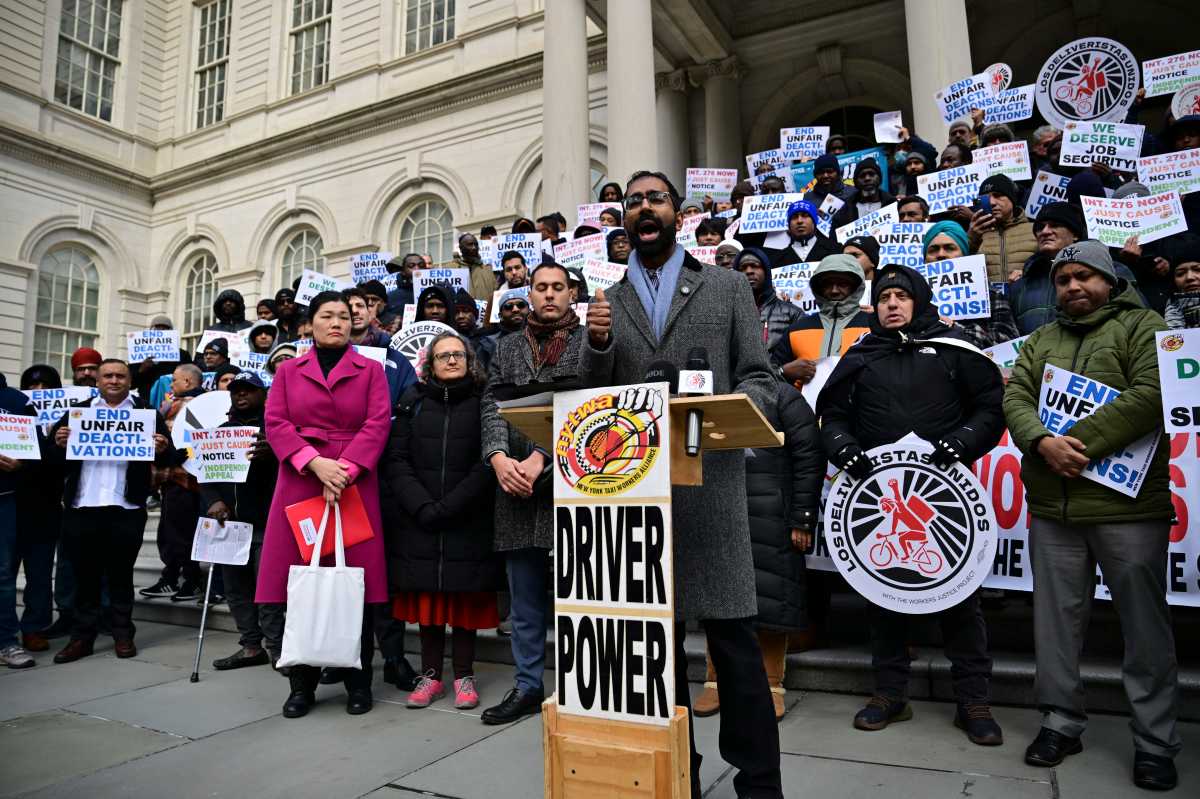
Drivers with the New York Taxi Workers Alliance rally in support of legislation that would add job protections for app-based for-hire-vehicle drivers. Thursday, Dec. 18, 2025.
Credit: Gerardo Romo / NYC Council
The City Council approved on Thursday a pair of measures designed to bolster protections for app-based rideshare drivers and delivery workers against firings without recourse — known as “unfair deactivations.”
The body passed a measure that would add protections against unfair deactivations for for-hire vehicle drivers, Intro. 0276, by 40 to 7 votes with one abstention. It also approved legislation that would add safeguards for food delivery workers, Intro. 1332, by 40 to 8 votes.
Both bills aim to prevent unfair deactivations — a practice that drivers and delivery workers describe as sudden terminations without a stated reason or an independent appeals process in place.
The bills were passed during the final City Council stated meeting of the current session. Should outgoing Mayor Eric Adams veto the legislation, City Council Speaker Adrienne Adams — who is also leaving office at the end of the year — said it will be up to the likely next speaker, Council Member Julie Menin, to override the mayor’s vetoes. Menin is expected to be elected speaker in early January, soon after the next session of the council is sworn in.
“This is just another step in trying to in trying to take care of the human beings behind this technology,” said outgoing Council Member Justin Brannan (D-Brooklyn), the prime sponsor of the delivery worker bill.
“These are billion-dollar app companies, and the reason why they’re billion-dollar app companies is because of the workers that bring in these profits for them,” he added. “So I don’t think we’re asking much to treat them fairly, and that if someone is going to get fired, that there needs to be some sort of recourse.”
The legislation affecting for-hire-vehicle drivers — backed by the New York Taxi Workers’ Alliance — would place far more restrictions on how the companies that employ them, such as Uber and Lyft, can go about deactivating their accounts. It is designed to prevent drivers from being removed from the app without a clear reason, advance notice, or a means to appeal the decision.
During a news conference before the votes, City Council Member Shekar Krishnan (D-Queens), the lead sponsor of the for-hire-vehicle bill, said app companies can currently fire drivers “at any time, for any reason, and with no notice, cause or appeal process.” He added his bill “puts an end to unfair firings.”
The legislation would require app companies to give a stated reason for deactivating a driver — known as “just cause” place the burden of proof on them, mandate the firms give drivers 14 days’ notice before kicking them off the app, and institute an independent appeals process for drivers. The 14-day notice would apply to all drivers, except for those alleged to have committed account sharing, fraud, or gross misconduct — such as violence or sexual harassment.
Proponents of the bill also argue a new appeals process is needed because the only way for drivers to appeal the apps’ decisions currently is through the Independent Driver’s Guild, a group funded by Uber.
Uber spokesperson Josh Gold, in a statement, said the company opposes the for-hire-vehicle bill because it could have “devastating impacts on passenger safety.”
“Among other things, it forces rideshare apps to keep sending rides to drivers for up to 14 more days after a driver has already been told they’re being terminated, meaning New Yorkers could unknowingly get picked up by someone the company has already fired,” Gold said.
Lyft spokesperson CJ Macklin expressed a similar sentiment.
“It makes it harder for us to keep unsafe drivers off the platform, requires public sharing of sensitive victim information that will have a chilling effect on complaints, and places the city in the untenable position of defending individuals accused of misconduct against those they may have harmed,” Macklin said.
The other bill passed by the council would provide many of the same safeguards for deliveristas, who work for apps including Uber, DoorDash, Grubhub, Seamless, and Relay. It would also require app companies to provide a reason when reactivating deliveristas; give 120 days’ notice before permanently removing them; and institute an appeals process.
Gold said Uber does not oppose the legislation. Grubhub — which owns Relay and Seamless, DoorDash, and Instacart did not immediately respond to requests for comment.
→ Continue reading at amNY

