
Yesterday, the U.S. Commission of Fine Arts (CFA) approved the plan for President Trump’s White House ballroom with a unanimous vote of 6-0. This was no surprise, as Trump had removed all six members last October and replaced them with his own appointees in January. My comments to CFA stressed that James McCrery, the former ballroom architect, ought to recuse himself for the vote—fortunately that happened. CFA’s secretary stated “over 99 percent” of the over-2,000 messages received from around the country were opposed to the project. “Don’t let the people speak—but if they do, totally ignore them” seems to be the modus operandi of this administration.
The ballroom plans will now go before the National Capital Planning Commission on March 5. Eight of its newly appointed members can outvote the remaining existing four to continue to rubber stamp the out-of-scale, out-of-place, and out-of-time pseudo-historical building. It seems the ballroom will be approved by the sycophants. Written comments to the NCPC are due by 12:00 p.m. on March 4. Please submit your thoughts!
There are other efforts in progress to stop the ballroom. The National Trust for Historic Preservation has filed a lawsuit to stop construction. About yesterday’s vote, its CEO, Carol Quillen, commented: “We were puzzled this morning when the US Commission of Fine Arts (CFA) approved the concept plans for the proposed White House ballroom, and then, in a second vote—without any advance public notice—also approved the final plans, which had neither been presented nor reviewed.” Hopefully, Judge Richard Leon, who has the Trust’s case, will stop this ridiculous project.
To Holding Peers Accountable
As the rabble-rousing architect who is leading the effort to save what’s left of the People’s House, it is a good challenge. Bringing 13 architects together to write an inquiry letter about potential ethics violations to the initial ballroom architect, plus gathering the 29 who signed the letter to the second ballroom architect, has been a lot like herding cats. But it’s worth it to represent our architectural profession’s efforts to save our heritage and to let Americans know that we can hold our peers accountable. “If not us, then who? If not now, then when?” Last July, President Trump promised that his new ballroom “…will be near [the East Wing], but not touching it and it will pay total respect to the existing building.” Paraphrasing the 1977 movie Animal House, “We screwed up, we trusted him!”

The East Wing was destroyed with no warning, no permits, no Architectural & Engineering Request for Proposals, no bids from contractors, and no abatement of hazardous materials; all as required by federal law. This endangered lives and continues to endanger lives of those exposed to hazardous, airborne, cancer-causing materials. From the outside, funding for the ballroom appears to be a quid pro quo as wealthy donors vie for extensions of existing contracts or hope for new contracts. This is illegal for federal projects.
Prior to the lawsuit filed by The National Trust for Historic Preservation, I had been corresponding with its Deputy Legal Counsel for several months. As someone who has been a Trust member for 49 years, I hoped the Trust would take “definitive action,” I’m proud they did.
Currently I am a candidate to become AIA’s At-large Director for 2027–2029. It’s my hope that I can convince the AIA to submit an amicus brief in support of the Trust’s lawsuit.
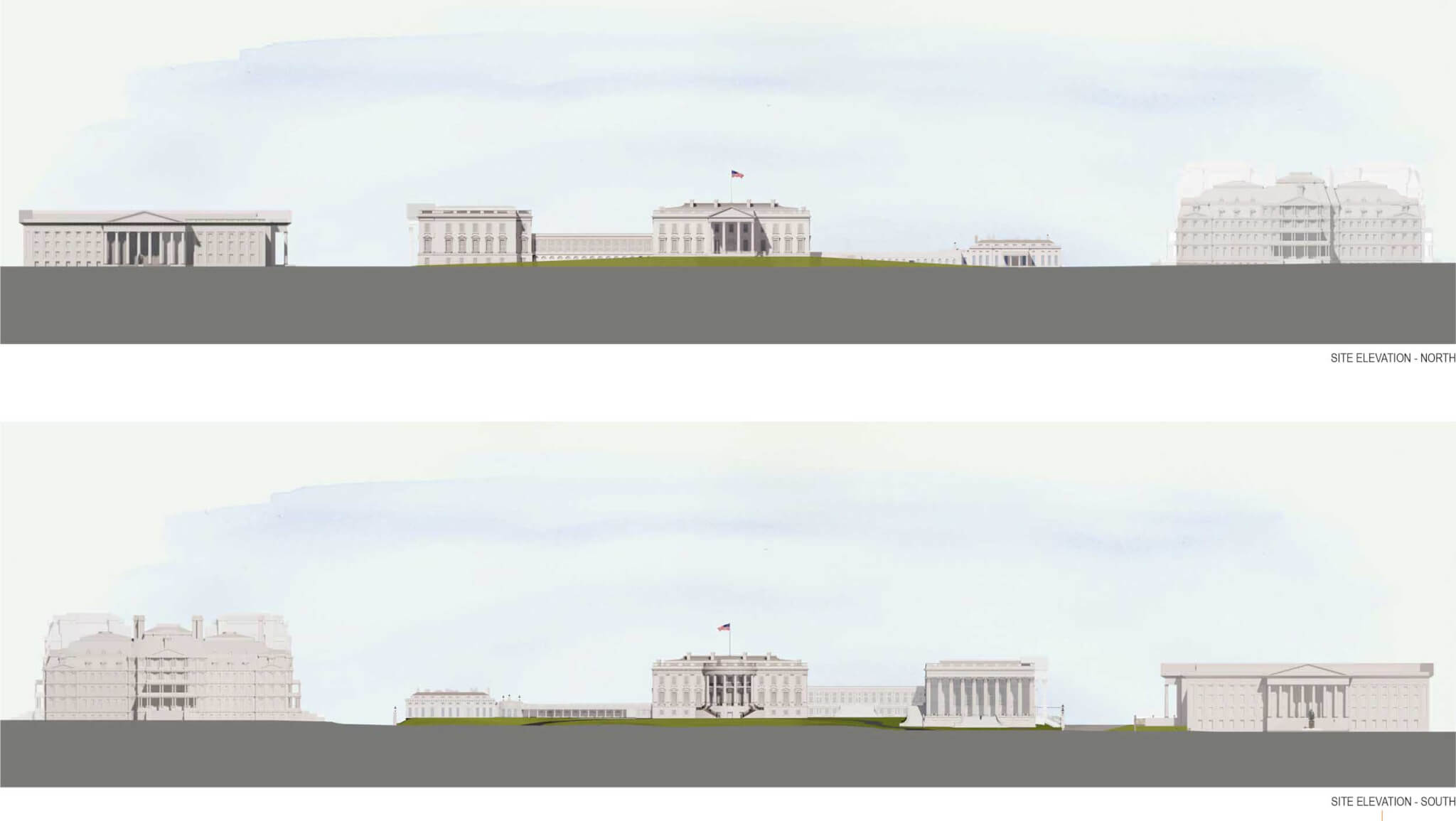
Some may say there’s more important issues than saving our built heritage. I agree, but if we lose our heritage, we lose our democracy. In recent months, there have been more urgent actions, such as responding to the ICE presence in Minnesota. But as a historic preservation architect with 50 years of experience, I am leaning into my expertise and concentrating on what I know to protest where I can.
Last November, Cultural Heritage Partners (CHP), a Washington, D.C.–based legal firm specializing in protecting historic properties, filed a suit along with the DC Preservation League to protect the historic Eisenhower Executive Office Building from a planned literal whitewash by the president’s administration. The painting of the granite facade would cause irreversible damage to the building. I filed paperwork as requested by the Trust with CHP, and I am proud to be an expert witness for this effort.
Trump recently added his name above John F. Kennedy’s on the facade of the Kennedy Center. He then yet announced that he plans to renovate the center, but an internal email shows the changes may be more modest than originally suggested. The effort is affront to Kennedy, who bravely served in the Navy during World War II and eventually lost his life when he was assassinated. Compare this to Trump, who dodged military service during the Vietnam War thanks to a questionable diagnosis of bone spurs.

There are more examples related to the built environment that illustrate why the president is unfit for the Oval Office. Also this week, a lawsuit from a group of conservation and historical organizations argues that the National Park Service is removing signage about relevant aspects of U.S. history like slavery and climate change. Trump seems bent on not only reshaping the physical parameters of our nation’s capital, but also its story. For those who disagree with this revisionist effort, every day feels like an assault on our rights, history, and lives. It’s difficult to keep up, but we must.
The next item on the horizon is Trump’s proposed Arc de Triomphe. Already, three Vietnam veterans are suing because they say it will block views of Arlington National Cemetery. At a time like this, it’s worthwhile to go back to older moments where dissent worked. We ought to adapt Joseph Welch’s famous lines put to Joseph McCarthy for today’s political crisis: “Until this moment, Mr. President, I think I never really gauged your cruelty or your recklessness…Let us not assassinate this democracy further. You have done enough. Have you no sense of decency, sir, at long last? Have you left no sense of decency?”
Samuel Duff Combs is a principal/architect with Combs & Combs in Anchorage, Alaska. He is a candidate for the role of AIA National At-Large Director, 2027–2029.
The views of our writers do not necessarily reflect those of the staff or advertisers of The Architect’s Newspaper.
→ Continue reading at The Architect's Newspaper

