
Mirrored surfaces create the illusion of additional space inside this renovated terraced house in Sydney, Australia, which local studio Alcami Architecture designed around a completely openable courtyard.
Terrace House Mirage is a renovation of a Victorian terraced house in the suburb of Chippendale, which was defined by a typically narrow footprint and a lack of natural light.
Architect Victor Alcami told Dezeen that his studio set out to “dissolve these spatial limitations and extend the perception of space beyond the party walls.”
The project’s most significant intervention is the central courtyard, which expands the home’s usable area while optimising natural light and ventilation.

The courtyard is flanked by a bespoke bi-fold and sliding panel system that helps to transform the ground floor into a fully connected open-air space.
A chamfered ceiling surrounding the courtyard references American artist James Turrell’s Skyspaces while also framing views of a neighbouring tree.
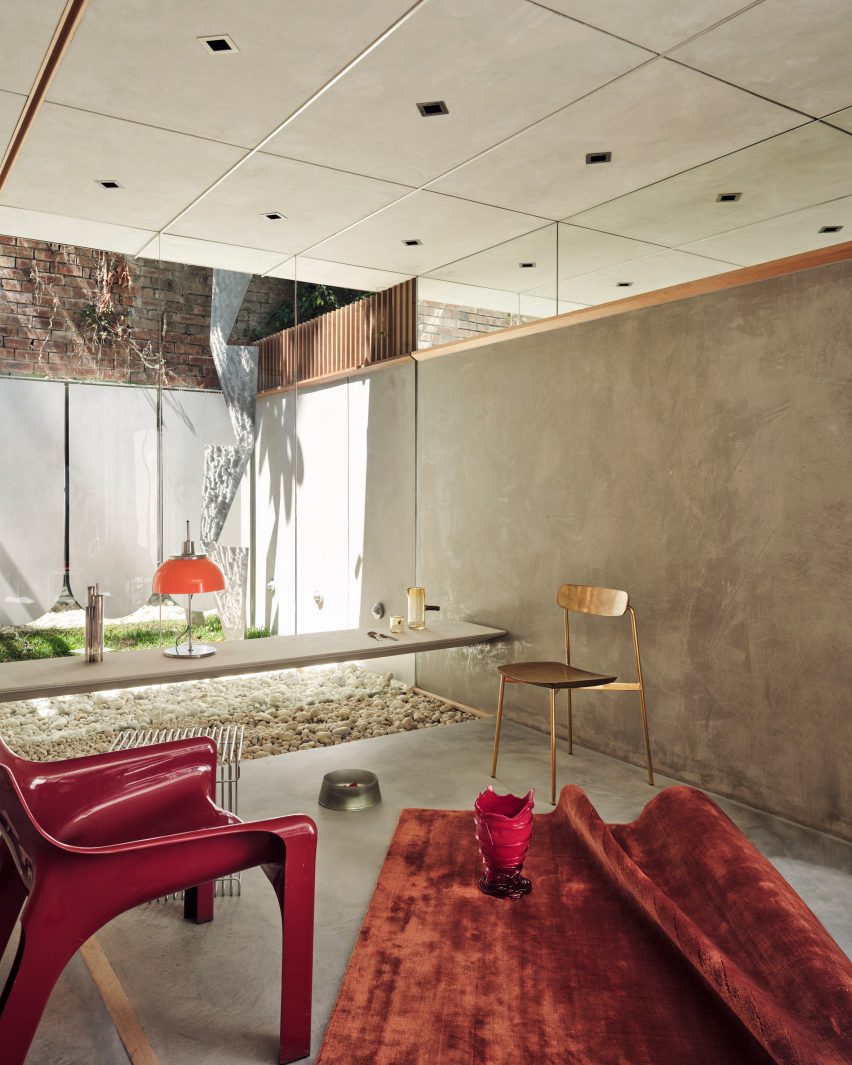
Mirrors along the tops of the walls create the illusion of an infinitely extending floating ceiling, informed by the American Bar in Vienna designed by Adolf Loos in 1907.
“The design challenges conventional notions of space and seamlessly blends indoor and outdoor areas, adapting this terrace to the Australian outdoor way of living with design solutions that are replicable in every single terrace house in Australia,” Alcami claimed.
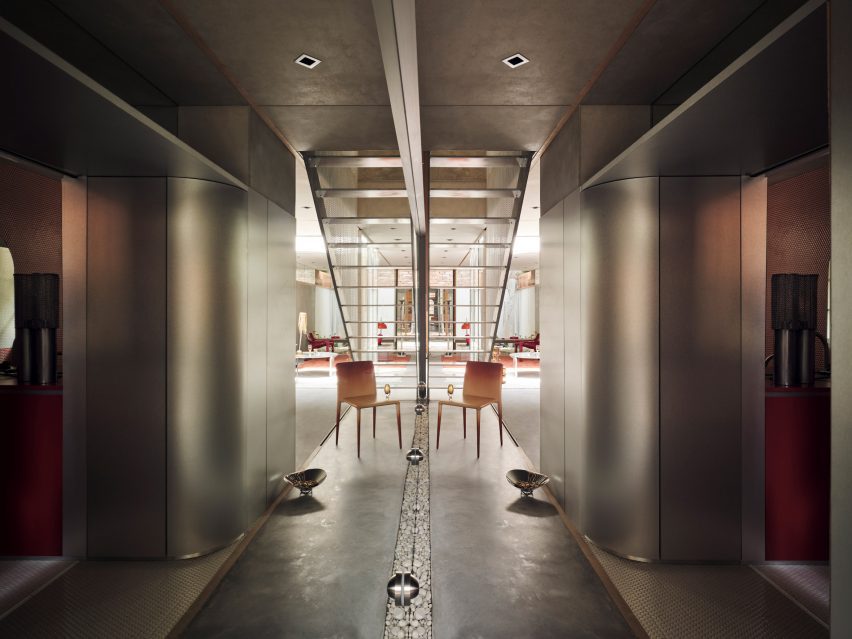
From the entrance, a pebble-lined path extends along the entire length of the house, with a mirrored wall creating the illusion of more space.
The path leads past the central courtyard to a living area featuring a cantilevered bench that appears to float in front of a glass wall looking out onto another courtyard garden.
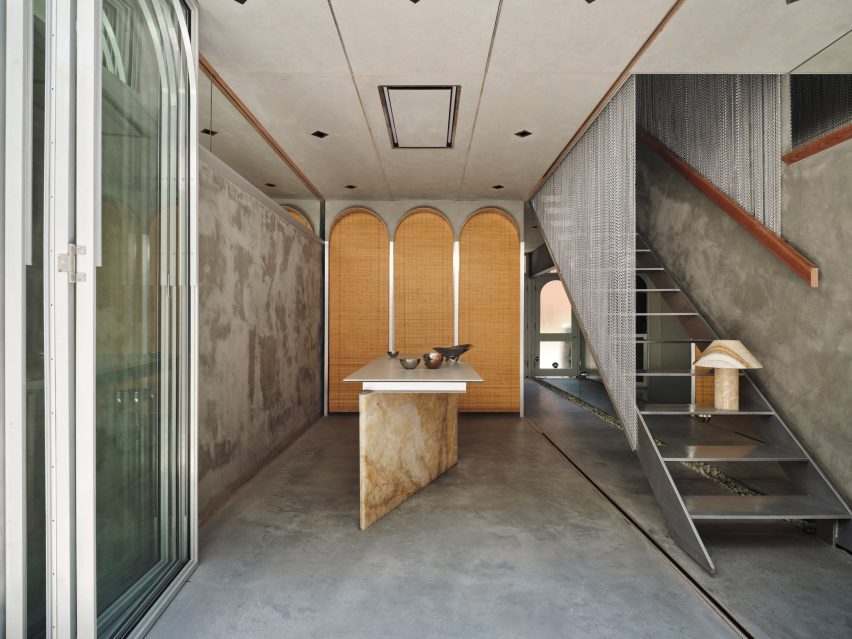
Throughout the project, the architects incorporated elements that reflect the owner’s cultural background, which fuses Spanish and Arabic traditions.
The use of metal chains, roller blinds and textural surfaces references Mediterranean architecture, while the incorporation of horseshoe-shaped arches evokes the famous Mosque-Cathedral of Cordoba.
According to Alcami, this approach allows the standard terraced typology to form the basis for a home that reflects the owner’s individuality and preferences.
“This project aligns with Gaston Bachelard’s phenomenology of space, emphasising memory and lived experience in architecture,” he suggested.
“The presence of vernacular materials serves as a bridge between the owner’s childhood memories and their present-day home, creating a deeply personal environment rather than a generic terrace renovation.”
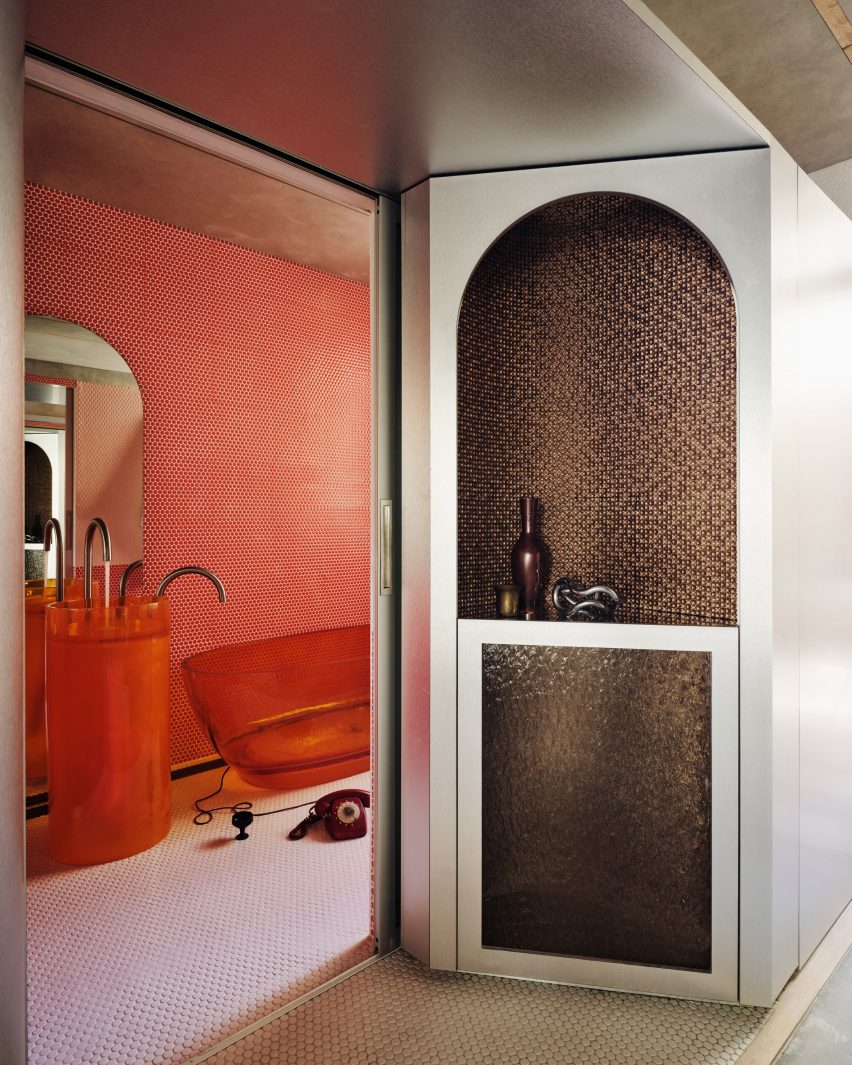
One of the client’s requests was to incorporate their favourite colour – orange – which is used as a bold accent against an overall natural and neutral material palette.
Orange tones are used for furniture and architectural elements such as the kitchen units and fridge, which are concealed behind bamboo roller blinds.

A central island featuring a backlit, translucent-orange onyx stone base serves as a focal point in this space. The island includes an invisible induction hob and also functions as a table, allowing the kitchen and dining areas to merge as one.
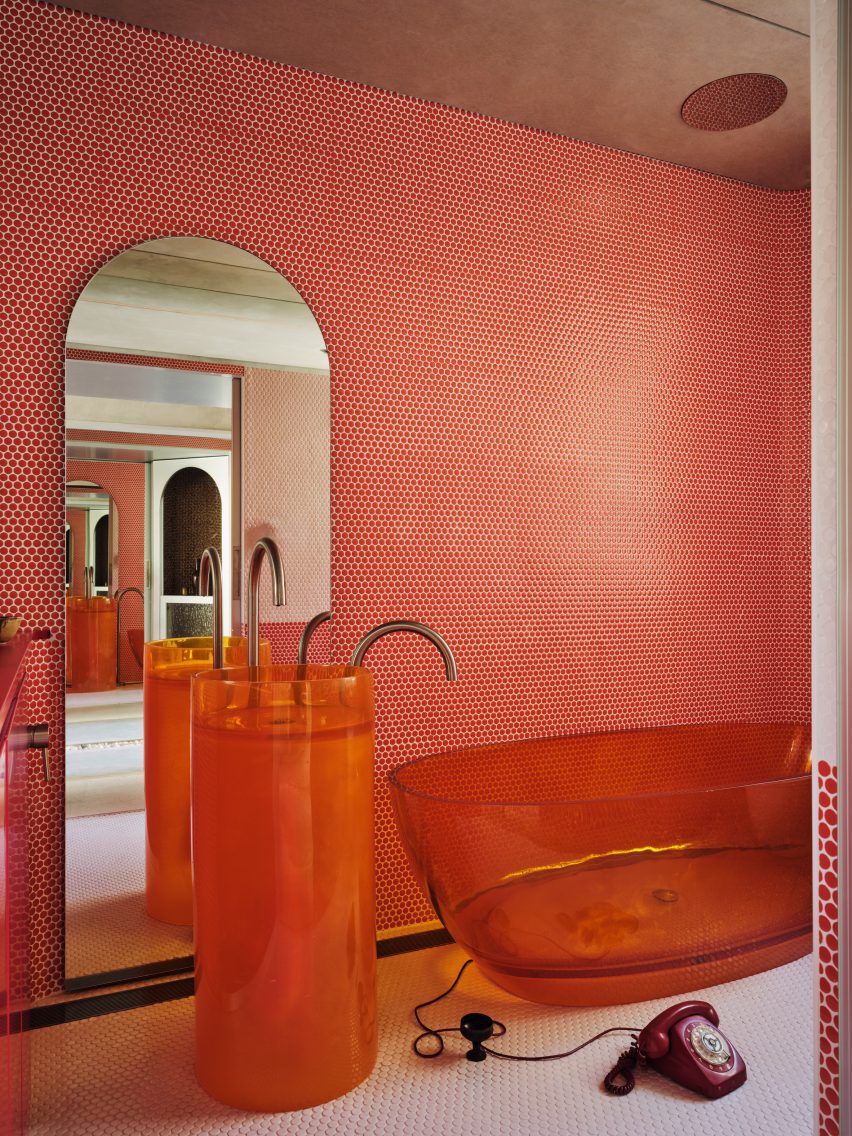
The most striking use of orange colour is reserved for the bathroom, which was designed as an immersive environment featuring an orange acrylic bathtub and freestanding washbasin, along with walls covered in orange mosaic tiles.
The house’s private areas are located upstairs, where the main bedroom benefits from a balcony as well as borrowing light from a skylight above the adjacent corridor.
The remainder of the compact first floor is dedicated to a study or guest room that can be closed off using a bi-fold partition when privacy is required.
A row of orange cupboards extends along the entire length of the plan, emphasising the volume of the space and unifying the different zones.

Alcami claimed that the project’s approach to spatial reconfiguration and its fantastical design details represent an alternative take on a familiar typology that could be adapted to suit many similar homes in Australia.
“This transformation challenges the conventional terrace house renovation, which typically involves moving the bathroom and adding a living area at the rear,” said the architect.
“Instead, this project fully dissolves the terrace into the garden; an architectural statement about maximising light, air and openness within extreme spatial constraints.”
Other recent Sydney homes featured on Dezeen include a house designed as a “kit of parts” and an Arts and Crafts-home with contemporary details.
The photography is by David Wheeler.
→ Continue reading at Dezeen

