
Ghana-based Limbo Museum has partnered with Art Omi to present Limbo Engawa, an architectural installation by TAELON7. The piece opened on March 12 in Accra, Ghana, with plans to travel to Ghent, New York, in the fall. TAELON7’s founder Juergen Benson-Strohmayer, an architect with projects in Austria and Ghana, helmed its modular construction, which takes cues from West Africa’s rapid urbanization. With salvaged materials in its foreground, its design creates areas for congregation and conversation.
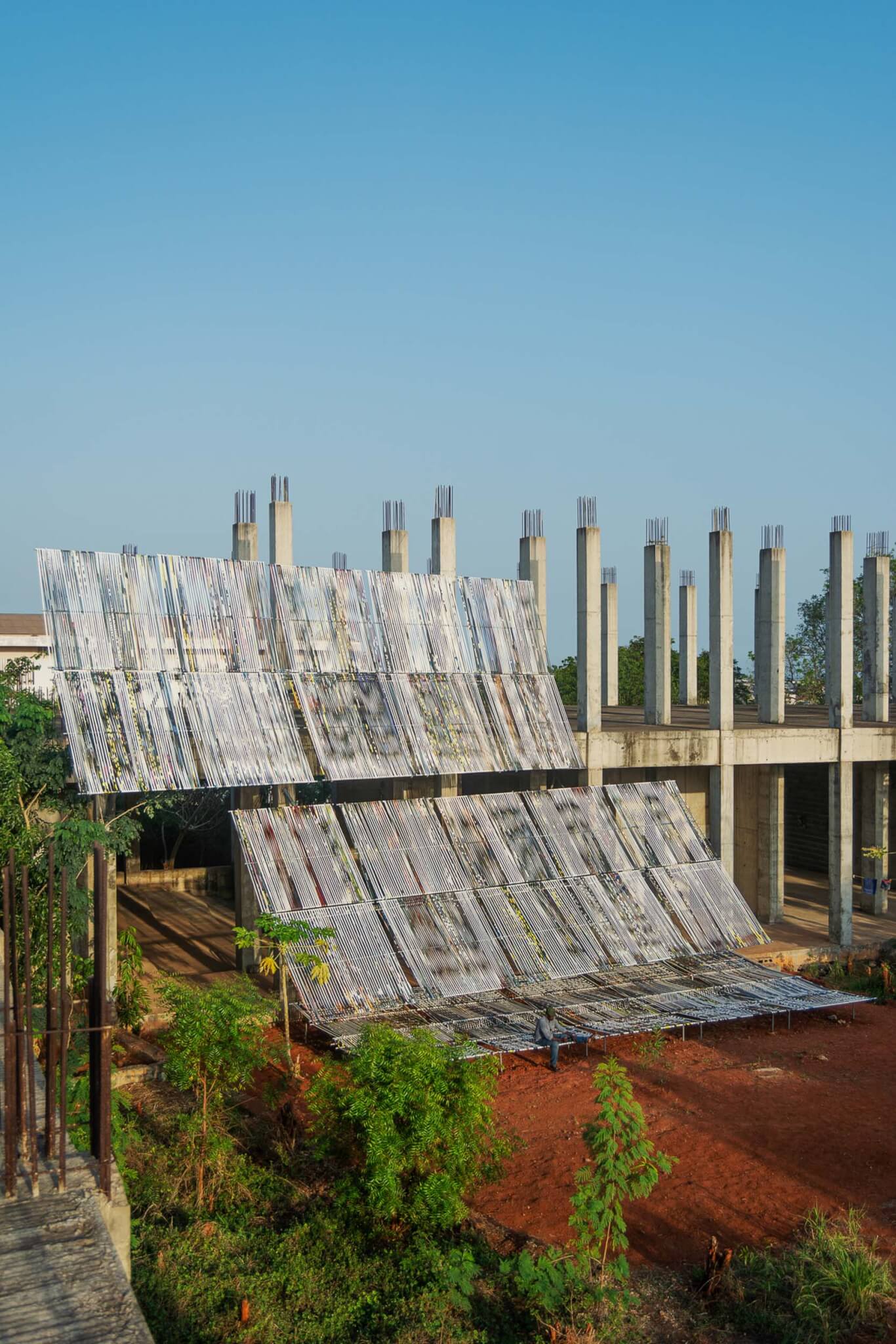
Engawa, is a Japanese term for the transitional spaces between the interior and exterior. The installation captures this spatial context with its composition, which places lightweight, modular, steel frame canopies derived from salvaged billboards within an open concrete pavilion.
“The frames are modular and light enough to be carried by one person,” Benson-Strohmayer said. Repurposed materials composed of chartreuse, magenta, and blue hues weave between the frame’s rails. The resulting facade is a sheer skeleton whose gaps create an illusory effect when situated among the verdant foliage of Ghana’s surroundings, the pale sky it intersects, and the concrete structure. Joseph Awumee oversaw the metalworks installation and Briena Montana served as the weaving lead.
At the bottom of the structure are handwoven day-beds that support lounging, leisure, and conversation. Their design was influenced by informal ad-hoc mattresses commonly used by West African construction workers. Benson-Strohmayer added that, “rather than producing a permanent monument, the project proposes a flexible architectural tool that can activate spaces that are otherwise overlooked.”
The exhibition is set to close in Accra on April 12 before traveling across the Atlantic to Art Omi’s sculpture park in New York. On the art campus, the structure will undergo a contextual transformation. As the structure is biopsied from the Limbo Museum’s concrete shell, it will debut as a freestanding monument in the Hudson Valley.
“The project unfolds across two very different landscapes, yet remains rooted in each place, creating a dialogue between Accra and New York that feels alive, open and deeply generative,” the founder of Limbo Museum Petit-Frère shared in a statement. The new landscape removes Limbo Engawa from the original drama of Accra’s emerging urbanization and rather faces an eventuality in the evolving spatial and temporal context of the Hudson Valley’s changing seasons.
→ Continue reading at The Architect's Newspaper

