
The Shirley Chisholm Recreation Center in the East Flatbush section of Brooklyn is public architecture at its best. The new facility named after the first Black woman elected to Congress was designed by Studio Gang, and backed by the New York City Department of Design and Construction (DDC) and Parks Department.
A voluminous public swimming pool chamber with fish belly beams made of mass timber imported from Austria—the natatorium—is evocative of expressive wood ceilings by Alvar Aalto. Arched clerestories that perambulate the brick exterior hearken to the postmodern monumentality of Louis Kahn. Light dapples the water through the high-performance glazing.
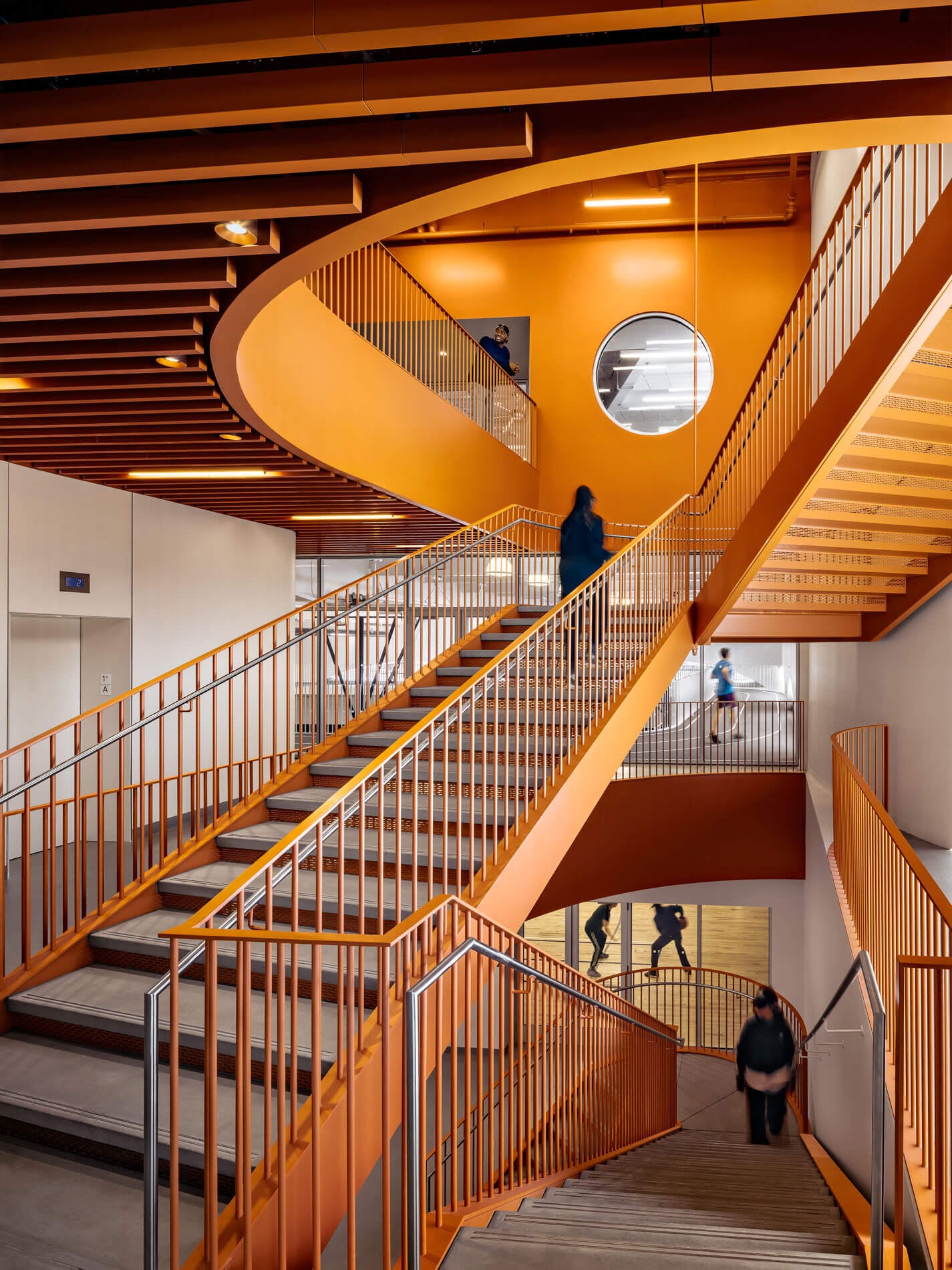
Look closely and, emblazoned onto glass interior partitions, are small flowers inspired by lapel pins from Chisholm’s 1972 groundbreaking U.S. presidential campaign, when she became the first Black woman to run for the Oval Office. Splashes of tangerine orange and powder blue light up the concrete walls and corrugated metal decking—a little paint goes a long way here.
A sculptural facade that culminates at an apex, fronting a pedestrian plaza to the building’s west, responds to the multivalent context—immediately surrounding the center are a large public park, low- and high-rise housing, and a public school. The architects had fun with this one, and it shows.
Not only that, but the Shirley Chisholm Recreation Center denotes the first LEED Platinum v4 public building in New York City. And the whole project came in on budget ($141 million) and was built in half the time (in comparison to the traditional system of lowest bidder contracting) thanks to DDC’s new design-build contracting program.
Design-build contracting shaved at least three years off the project timeline, and earned an estimated 10 percent in cost savings, city officials stated.
“Recreational centers are a type of community center that is really central to the history of Studio Gang,” said Arthur Liu, a design principal and lead of Studio Gang’s New York office. “Jeanne’s Chinese American Service League Kam L. Liu Building was an early project in Chicago whose community-minded spirit has been carried on with this recreational center here in Brooklyn.”
A New Community Staple
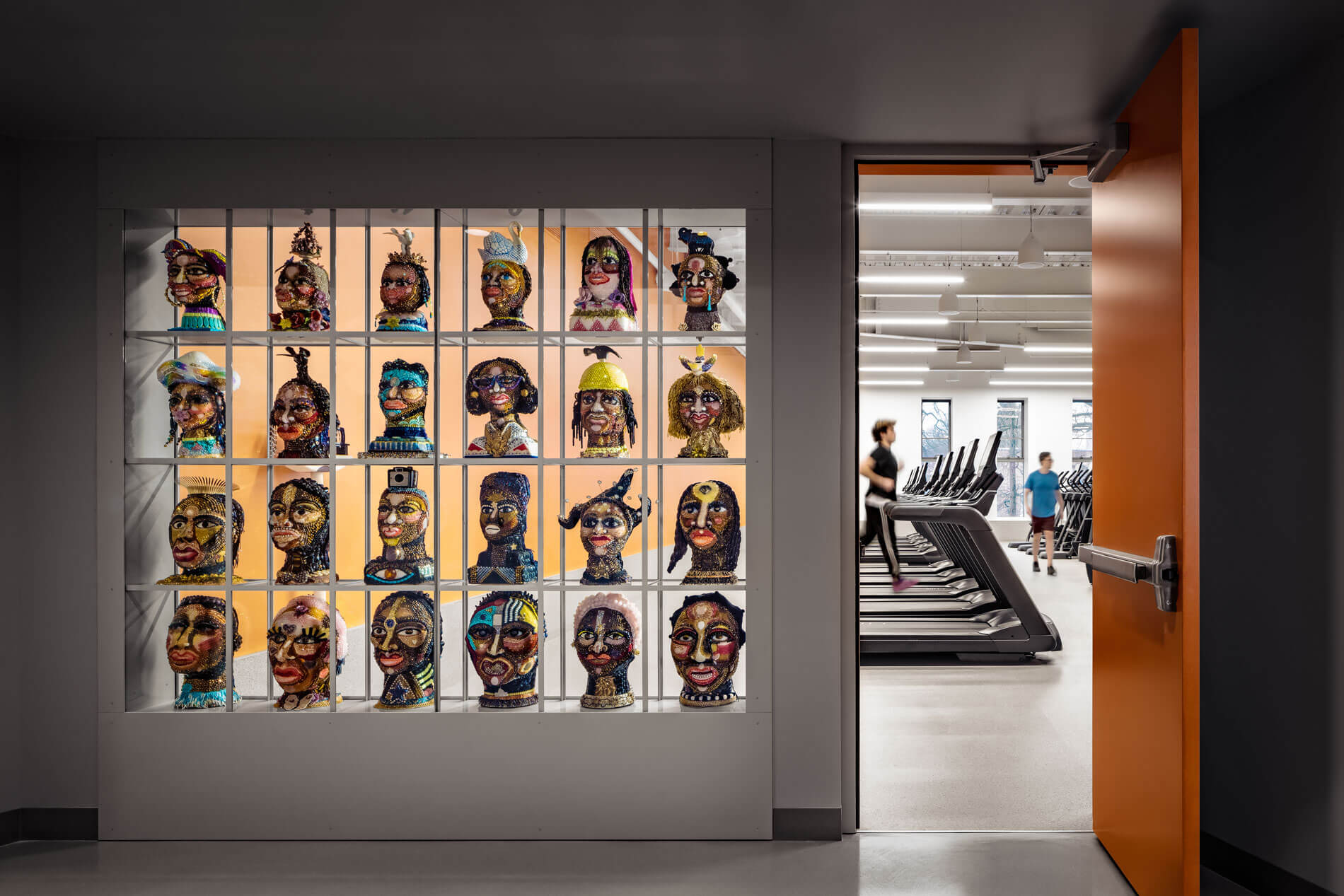
Every school day P.S. 269 students pour onto the plaza and into the recreation center, populated with artworks by vanessa german, as part of the Percent for Arts program. german opted to create several artworks interspersed throughout the 74,000-square-foot building, as opposed to a singular piece, breaking with convention.
Twenty-four sculptural busts by german sit within an enclosed shelf that separates a corridor and the fitness room. (One of the busts is of Chisholm, bedazzled with blue, gold, red, pink, and white gems.) german called her cumulative contribution the East Flatbush People’s Museum of Love and Wonder, the culmination of a year-long residency in Flatbush sponsored by the city.
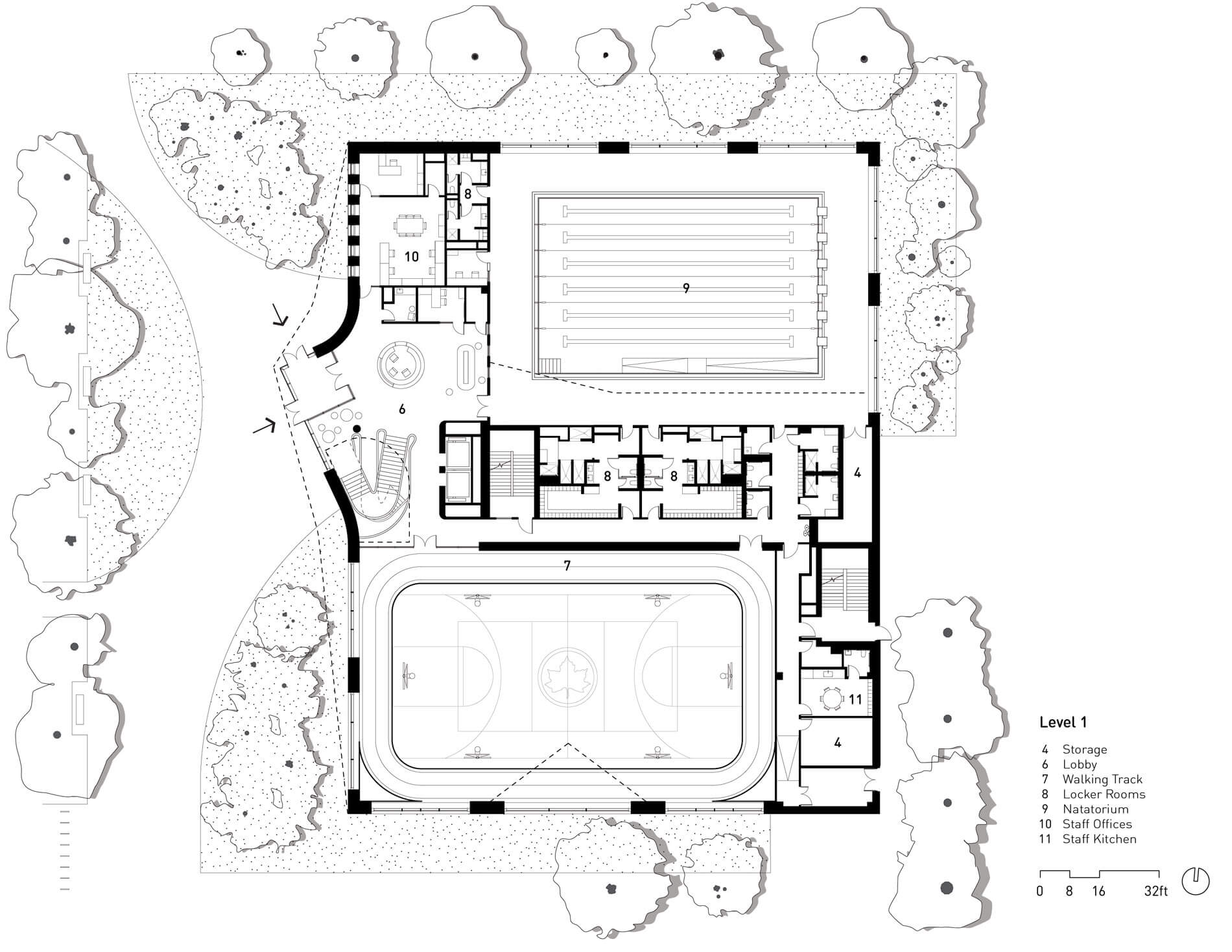
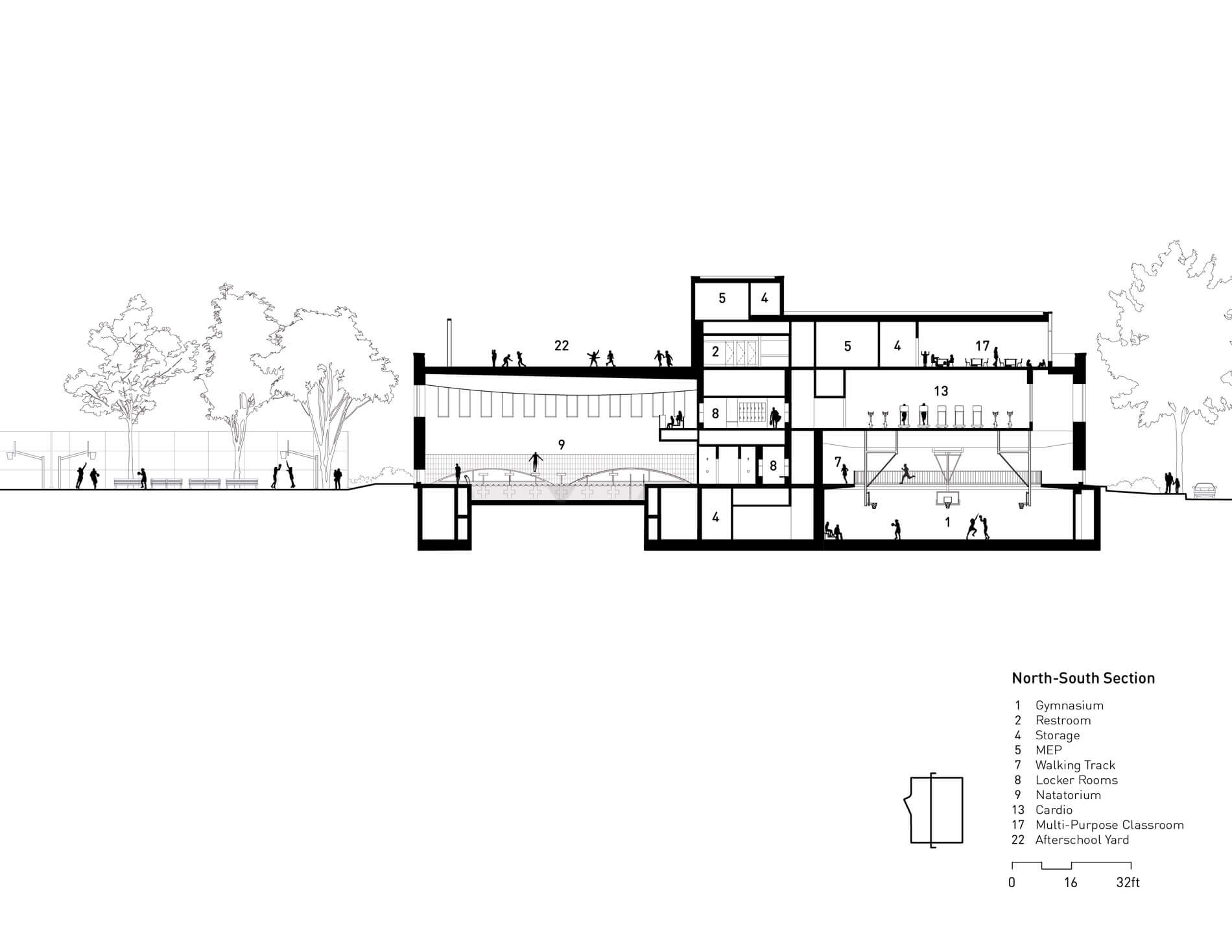
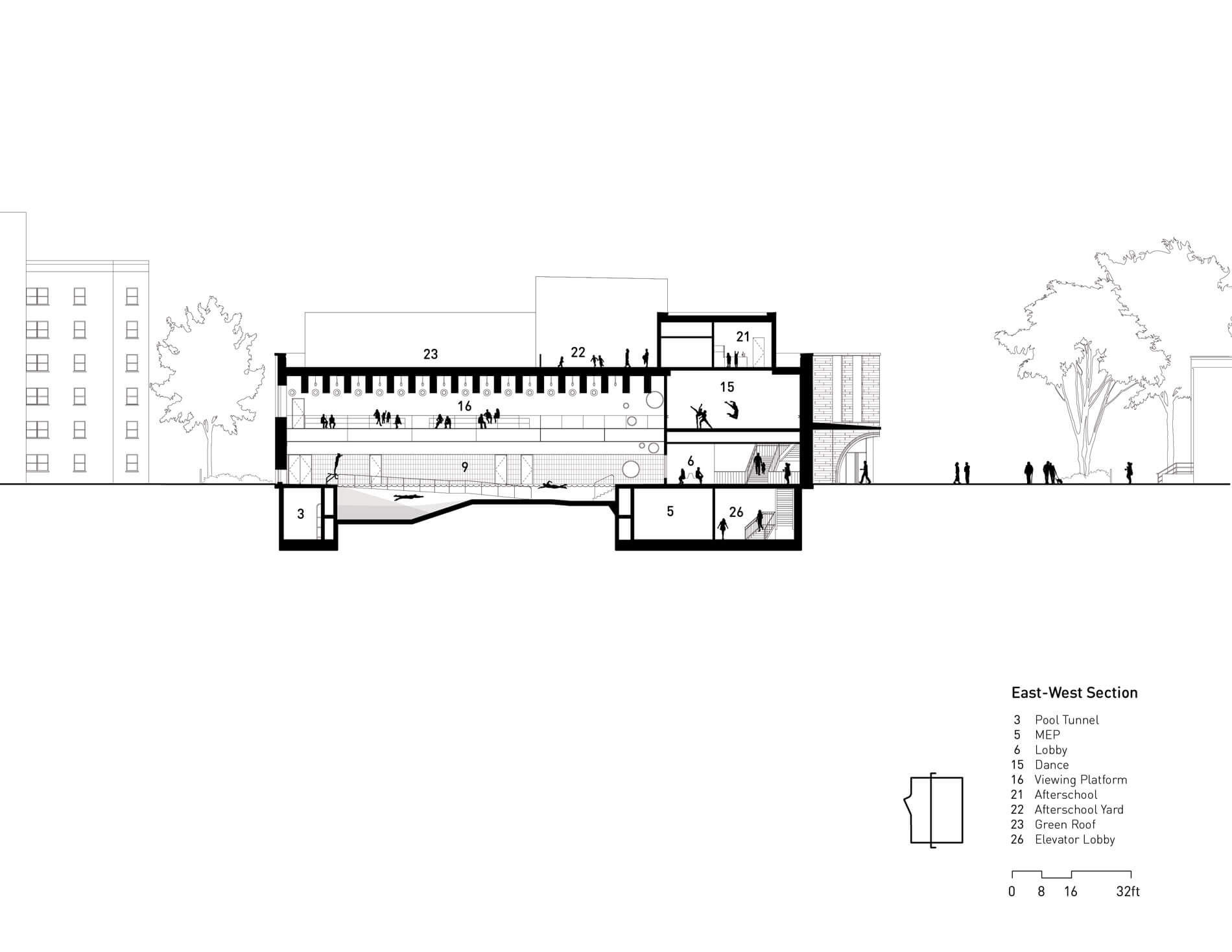
Liu said the building plan is essentially two large boxes that sandwich a circulation and utilities corridor—simple and effective.
Visitors enter the Shirley Chisholm Recreation Center from the pedestrian plaza. Immediately upon arrival, guests see the welcome desk. This nexus serves as a vital point of orientation for the entire building.
To the welcome desk’s left are administrative and mechanical rooms, to its rear is the swimming pool entry and, to the right, a sculptural stair and elevator bank that connects with all the building’s levels. This makes the center immediately legible upon arrival, what Liu called a signature Studio Gang move.
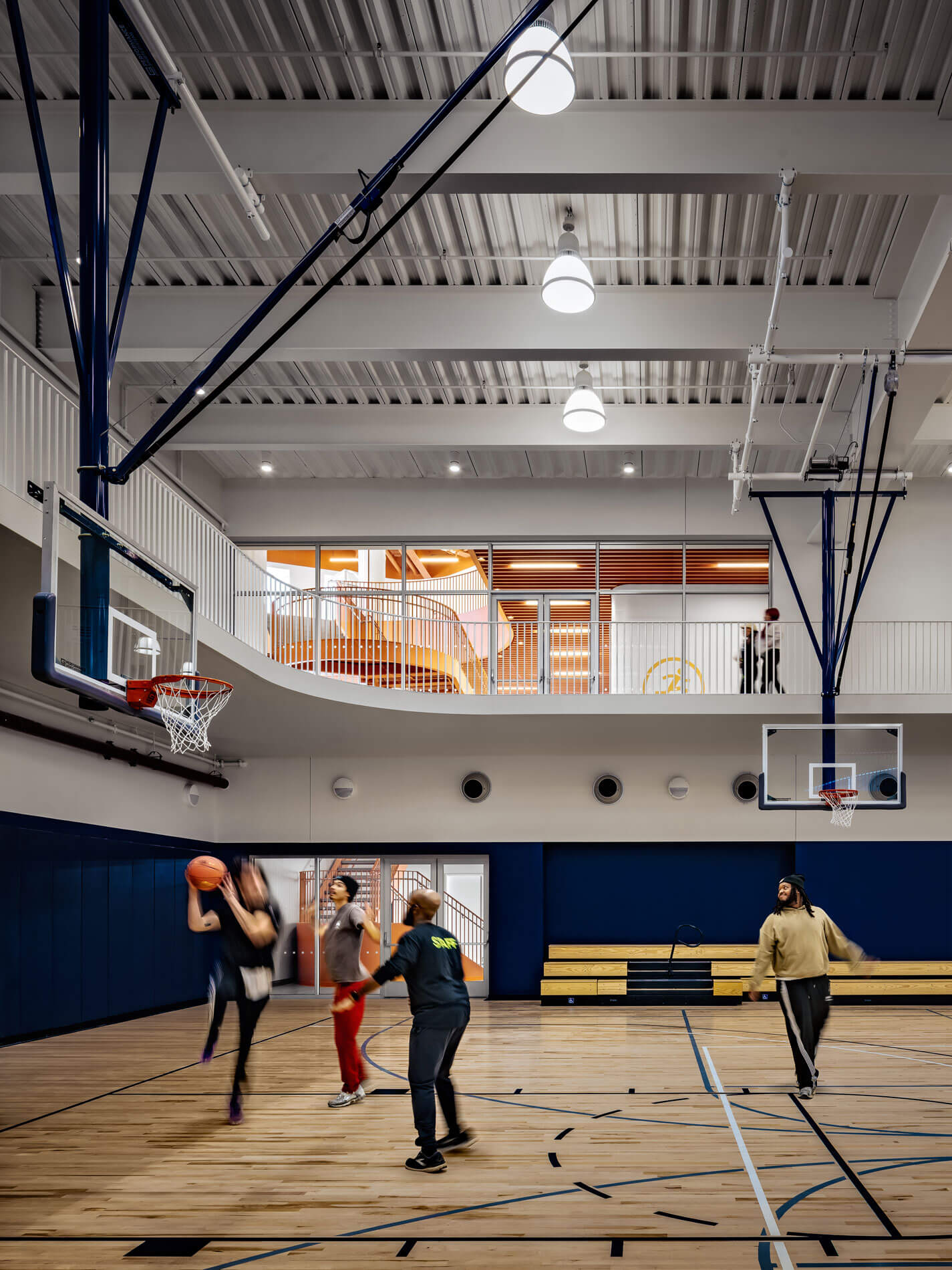
In section, the basketball court is located below grade, and the swimming pool at grade. Strength, lifting, and cardio rooms; and a dance studio are on the second floor while more passive uses (an after-school and teen area, teaching kitchen, and media lab) are folded into the third floor, coupled with an exterior terrace.
Every single one of these spaces is washed in natural light, something you don’t typically get with public buildings packed with this much programming.
“We often do projects with very healthy budgets, like luxury developments,” Liu said. “Often what that translates to is really expensive materials like marble, or a fancy wood that’s been crafted in a certain way. Fabulous architecture emerges out of materials and craft, however there’s so much more that goes into making great architecture.”
“It is about space, proportion, and a very refined assessment of what a place or room really wants to feel like,” Liu elaborated. “In the case of this recreation center, and public projects like it where budgets are much tighter, the goal is to make the space as tidy and well-considered as possible.”
A Structural Feat
Lendlease Construction and Consigli Construction comprised the design-build team. Wallover Architects served as the aquatic architect, and Elizabeth Kennedy Landscape Architect the landscape architect. 40SixFourArchitectureDesign, AtelierTen, McKissack & McKissack served as consultants in various capacities.
Structurally speaking, the building is likewise a feat. Facade engineers at Thornton Tomasetti opted for brick-faced architectural precast panels that were prefabricated off-site. The panels sit atop one another, and the load transfers directly to the foundation. The concrete arches above the clerestories are also loadbearing.
Thornton Tomasetti said this wall assembly approach minimized the amount of structural steel that went into the building, reducing embodied carbon.
Architecturally, this sectional composition creates thick, thick exterior walls reminiscent of other public New York City buildings made of masonry like Metropolitan Avenue Municipal Baths in Williamsburg, or West Village’s Tony Dapolito Recreation Center. It also minimized the facade’s joints count, thereby allowing for arched windows that can turn corners, and wide expanses of glazing.
“We don’t make buildings that are sculptures,” Liu noted. “We make buildings that intend to have a positive, lasting impact in neighborhoods. That’s the mission. It’s fundamental.”
→ Continue reading at The Architect's Newspaper

