
At the Diriyah Gate Development Authority headquarters northwest of Riyadh, Saudi Arabia, three adjoining rooms house projection-mapped scale models of a city currently under construction. The models glow in sync with promotional videos that collapse centuries of history into a few looping minutes. “This is the original birthplace and home of Al Saud, the ruling family,” said Diriyah’s chief marketing officer, Kiran Haslam.
Haslam took his audience back to the year 400, tracing Diriyah’s origins to the Banu Hanifa tribe, who settled along a nearby wadi that provided intermittent fresh water in an otherwise unforgiving landscape. After centuries as a modest settlement, the site gained regional significance in the early eighteenth century as the birthplace and capital of Muhammad bin Saud Al Muqrin, who rose to dominate Arabia through a combination of military power and his alliance with religious leader Muhammad ibn Abd al-Wahhab.
“The richness of longevity, the richness of agriculture, the richness of royalty have existed here over a very, very long span of time,” Haslam insisted. “That is why we are doing this project.”
He jumped to the present. “We have over 25 hotels, and with them, everything you would imagine.” He listed them quickly: St. Regis, Four Seasons, Armani, Corinthia, Ritz-Carlton—and budget options, Radisson and Moxy. The point, he explained, is to offer not only “ultra, ultra luxury” but options across “all budgets and price points.” A similar logic, it seems, governs the choice of architects. “Don’t ask if we’ve worked with an architect,” he added. “We’ve worked with them all. Foster + Partners, Zaha Hadid, Snøhetta, HKS. You name it.”
Diriyah’s Promise
Conceived in 2018 as part of then-ascendant Crown Prince Mohammed bin Salman’s Saudi Vision 2030, Diriyah is being developed by Diriyah Company, an entity owned by the Public Investment Fund (PIF) and charged with planning, financing, and delivering the $63 billion giga-project. Their aim is to produce a contemporary urban environment that draws on the site’s history as a pre-modern capital, and repackages it as a global, heritage-themed destination.
The masterplan comprises 3,450 acres of mixed-use blocks, pedestrian streets, and landscaped desert across largely vacant land surrounding the historic ruins. As part of this effort, the PIF seeks to invent an attractive narrative (more nationalist, less religious) for the kingdom’s origins: a kind of Colonial Williamsburg for the unstable era of small desert states that, until recently, many within the kingdom preferred to forget.
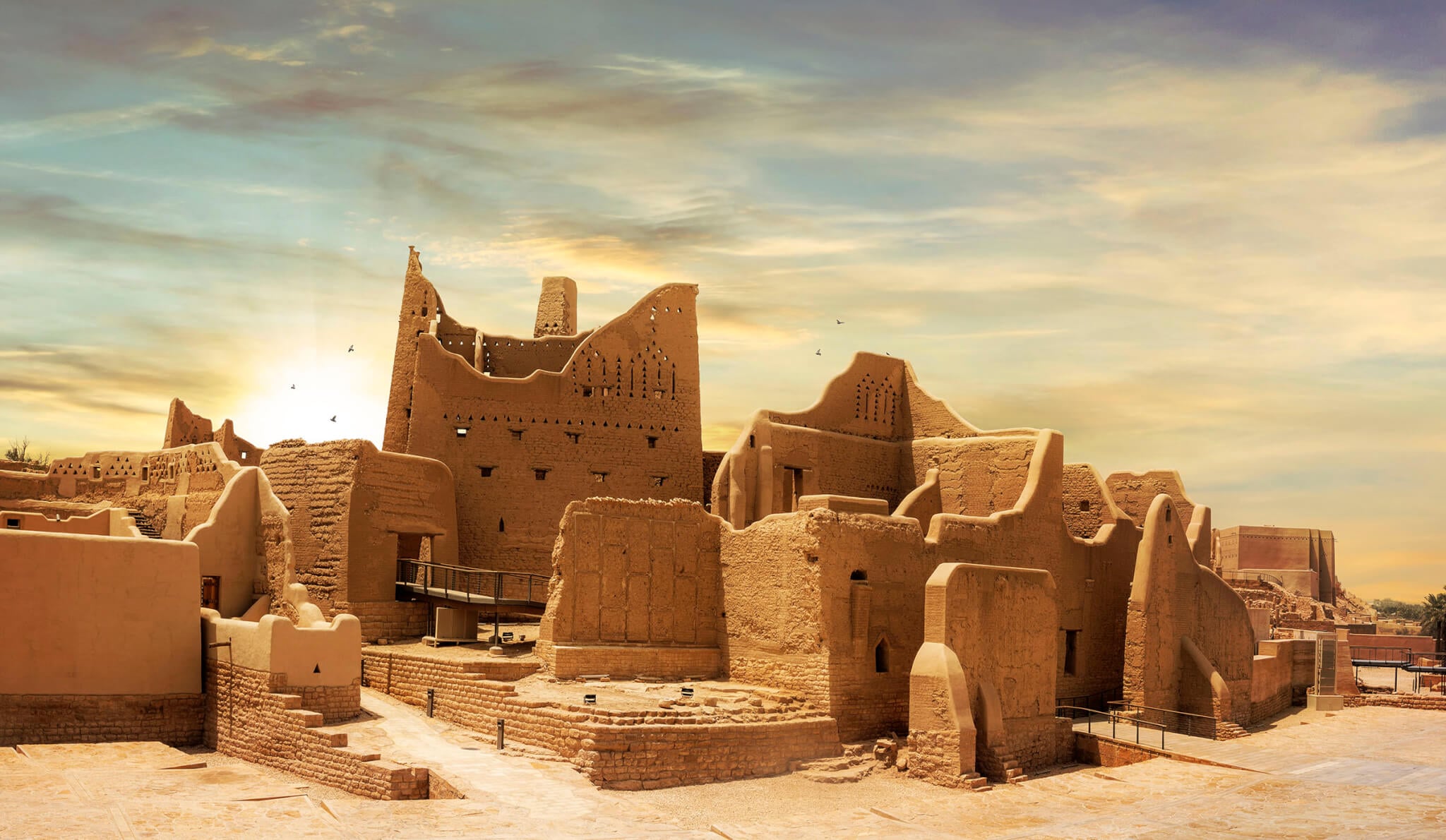
The drive to Diriyah from King Khalid International Airport takes approximately thirty minutes. Along the way, unfinished concrete frames rise in spurts, punctuated by newly opened business centers, immersive attractions, and retail complexes shimmering with LEDs. Eventually, this parade gives way to the present-day town of Diriyah, largely built in the 1970s, where unexceptional strip malls line a handful of main streets. At the town’s edge stands the ruined palace of At-Turaif, abandoned after an Ottoman siege in 1818.
Under the reach of over one hundred cranes, the new city of Diriyah is being built all at once by more than 50,000 migrant workers. As construction accelerates toward an opening ahead of Expo 2030 Riyadh, reports of extreme labor conditions across the kingdom continue to circulate, despite the recent end of the kafala labor-sponsorship system. Beside one of countless unpaved roads on the site, a faded AECOM-branded sign displays an improbable statistic: TOTAL MAN HOURS: 49,736,769. DAYS WITHOUT ACCIDENT: 1,361.
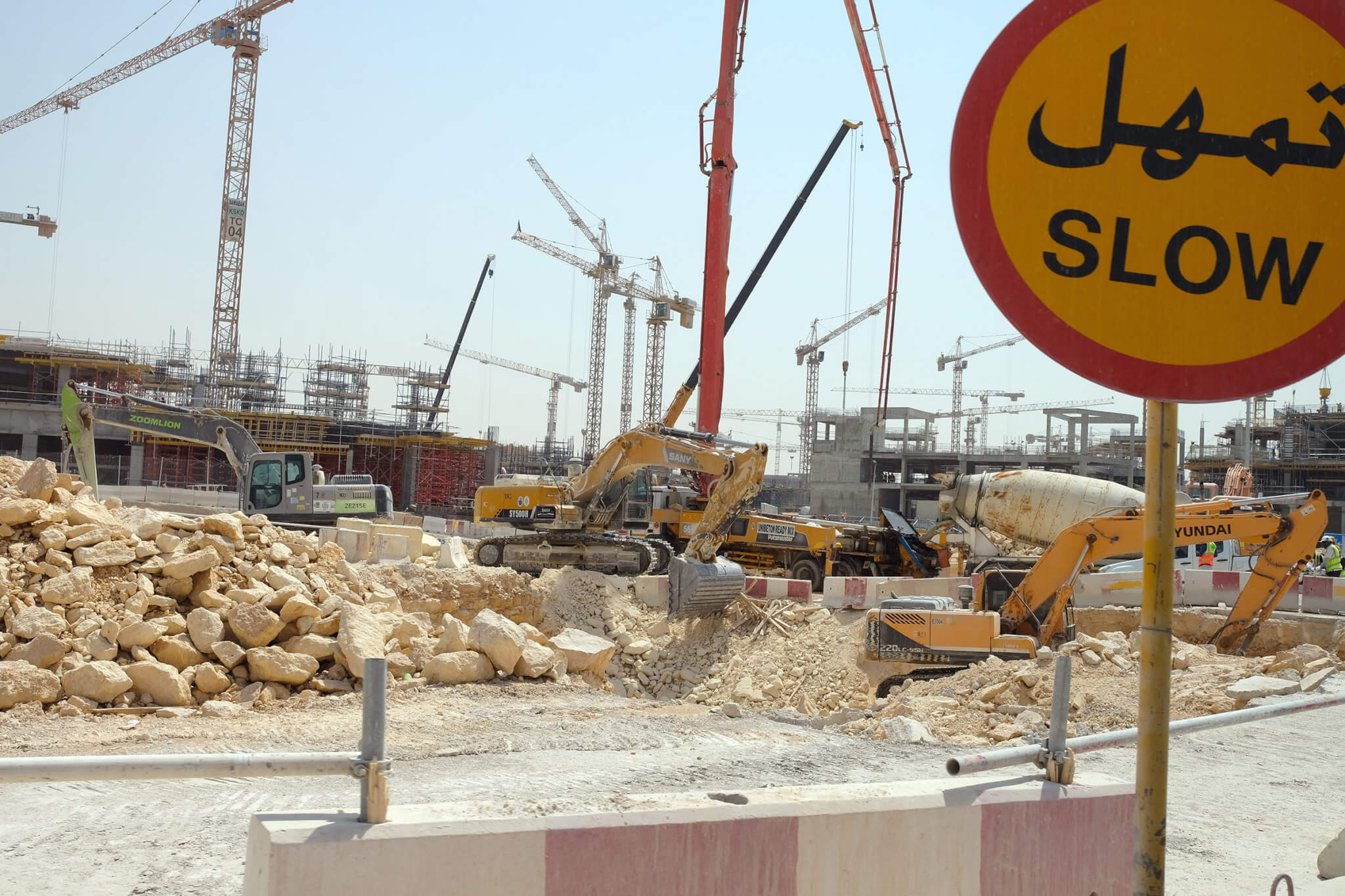
Construction crews are currently excavating roughly 2.5 square miles of bedrock, much of which will be reused as aggregate for new construction. The excavated sections are planned to become the city’s super basement: three continuous subterranean levels housing traffic and MEP systems that support a controlled, pedestrian-friendly urban environment above.
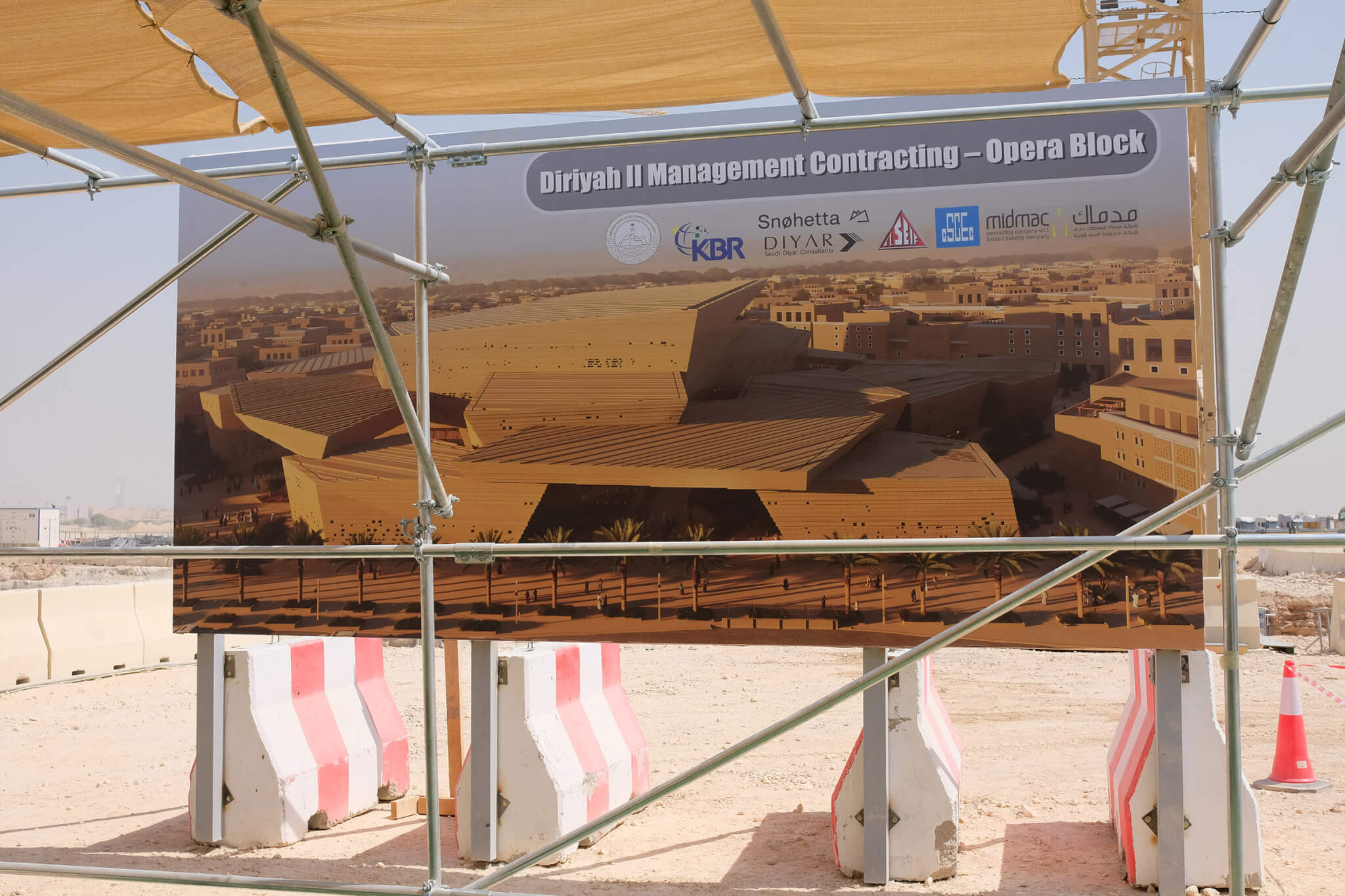
Cut into this web of trenches are the foundations of Diriyah’s cultural buildings. Among these projects is a monumental arena, with a form taking from both geological formations and ancient Najdi forts and palaces, animated by what its designers (HKS) describe as “digital waterfalls.” Nearby, Snøhetta’s design for the Royal Diriyah Opera House draws on images of mud from a riverbed cracking under intense heat, and a stone plateau carved into separate masses by wind and rain.
Enacting the Traditional Future
Riyadh is home to a fast-growing menagerie of ultramodern projects—from the near-mythical, shopping-bag-shaped Kingdom Tower to Boulevard City, a Times Square–inspired entertainment zone, which borders the Epcot-like Boulevard World of global replicas. Eight miles north of Diriyah, an enormous fenced-off parcel awaits the Mukaab. Set to be the world’s largest building by volume, its outer form will mimic the Kaaba, scaled up forty times. If constructed, the cube-shaped skyscraper will hold a spiraling corkscrew tower within its enormous air-conditioned atrium.
Meanwhile, other futuristic experiments across the kingdom include Qiddiya, a kaleidoscopic “city of play” with esports arenas, a racetrack, and a water park rising from desert cliffs to the southwest; the recently announced King Salman Gate, a cluster of diamond-shaped towers planned for Mecca; and, of course, NEOM, the Red Sea megaproject once slated to host The Line, a now-halted scheme promoted as a “revolution in urban living.”
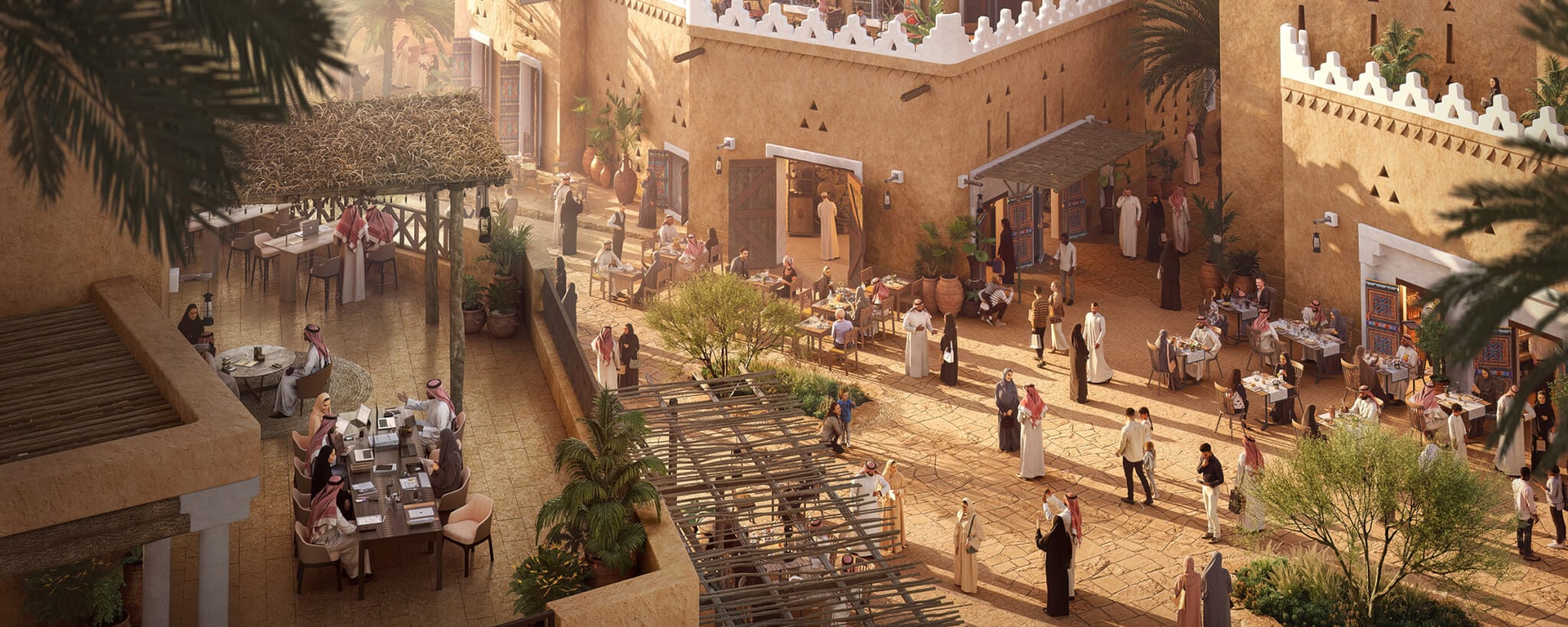
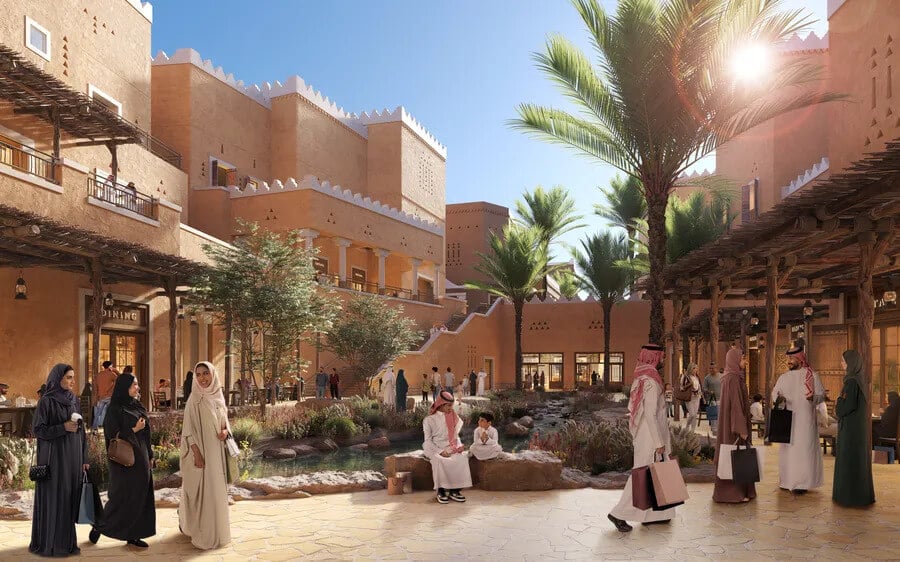
Diriyah’s selling point is different. With the tagline “The City of Earth,” it trades radical form for a revived vernacular of dense, irregular low-rise blocks which feature mudbrick facades, crenelated parapets, and traditional Najdi detailing. The idealized desert palette extends to curated interior elements: woven tamarisk-wood ceilings, hand-dyed fabrics, carved plasterwork, and reproduction antiques like pierced brass lanterns and beaked coffee pots.
But the vision won’t end there. Diriyah is the first built example of broader changes now underway across Saudi Arabia. In March 2025, Mohammed bin Salman announced new national guidelines mandating a traditional regional architectural character for nearly all major construction projects, formalized through the “Saudi Architecture Characters Map,” which identifies 19 regional styles intended to integrate heritage into urban development. After the recent logistical failure of The Line, Diriyah seems a more likely model for the future of the kingdom despite its historicist disposition.
In May 2025, Donald Trump visited Diriyah, where the project was presented to him by Mohammed bin Salman and Jerry Inzerillo, the chief executive of Diriyah Company. A longtime associate of Trump, Inzerillo is a central spokesperson for the development. The Trump Organization has since become involved with Diriyah’s nearby sister development, Wadi Safar.
The Gamble
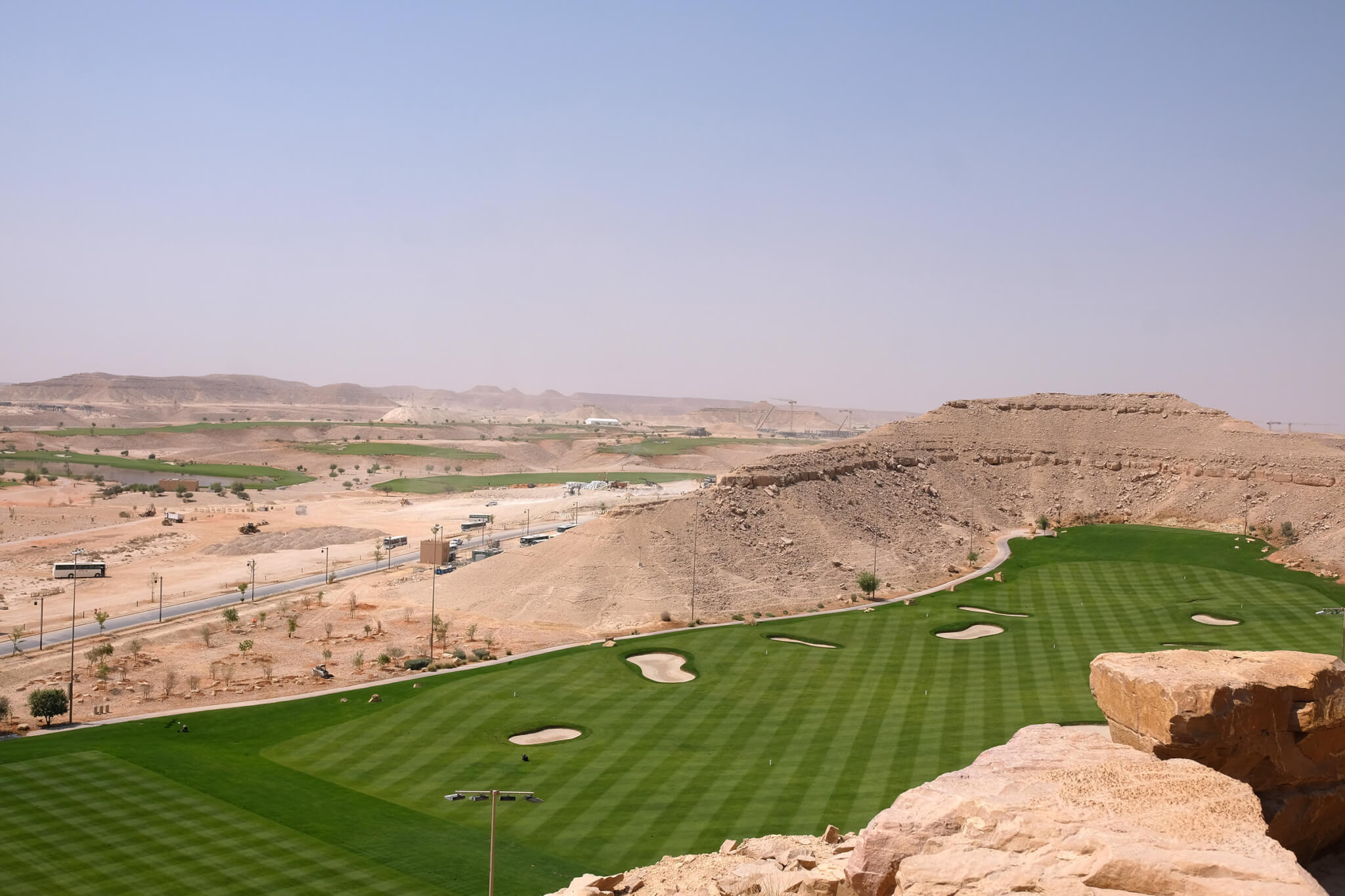
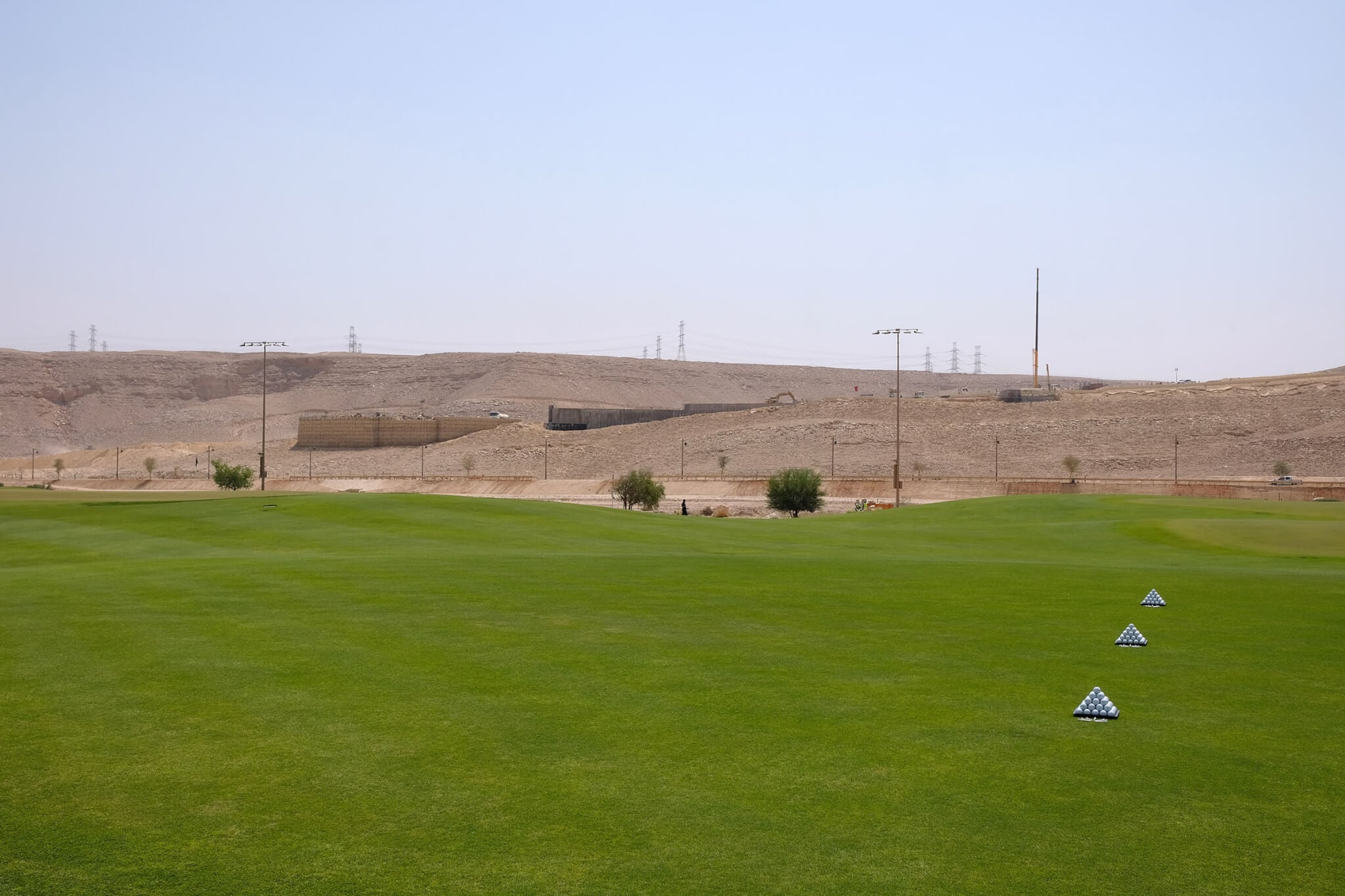
Introduced to me as the world’s largest gated community, Wadi Safar is a 23 square-mile fortress sprawling seven miles south of Diriyah, with branded residences in a revived traditional style. The masterplan includes impossibly green golf courses and a royal equestrian complex with two polo grounds and 263 stables.
Betraying some unexplained anxiety, my guide announced that access is controlled by 50-meter-tall sandstone cliffs that surround the entire wadi. Guards stand at evenly spaced checkpoints along each freshly paved drive, filming with their smartphones in a living surveillance grid. Most of the surrounding infrastructure remains unbuilt.
In Diriyah, the emphasis on security is similarly pronounced. Entry to the newly opened shopping district requires registration via QR code, and its quiet, glass-railed pedestrian streets are continuously guarded. The recently completed section of downtown Diriyah, now open to visitors, comes to life only at dinner or during scheduled shift changes at the nearby worksite. During these transitions, a few hundred workers are released at once. They jog in the same direction, across the square, to board a line of idling white buses with curtains drawn across their windows.
In central Riyadh, public spaces are also mostly vacant, even during what my guide described as peak social hours. Across the street from the Ritz-Carlton Riyadh—the hotel that served as a temporary detention site for members of the royal family during the 2017 purge—the St. Regis Riyadh aspires to the kind of social-media notoriety associated with Dubai. Its open-air arcade lined with glistening tiles leads to a courtyard overtaken with projection-mapped light on every surface. Just after sunset, only a few strangers linger.
Watching the empty courtyard through my camera, I thought back to the projections I heard at the Diriyah Development headquarters: an economic contribution exceeding $18.6 billion, an increase in tourism’s share of national GDP to 10 percent by 2030, 100,000 new residents, 50 million annual visits within five years, 180,000 new jobs. Will they really come?
At Wadi Safar, the guides insisted they will. They asserted that the branded residences, including the Trump Mansions at Wadi Safar (Tagline: Where Winners Reside), are selling rapidly. Buyers from around the world are expected to arrive soon, drawn by what is understood as a kingdom undergoing rapid change. Certain assumptions about Saudi Arabia, they stressed, are “simply misplaced,” citing recent reforms such as women’s right to drive and the possibility that alcohol may be (cautiously) legalized later this year.
For now, state-approved indulgence will have to suffice. Restaurants offer elaborate mocktails, soufflés, shisha terraces, and boutique shops devoted to scented oils and perfumes. In the guest rooms of Diriyah’s first completed luxury hotel—Bab Samhan—a pillow menu rests on the bedside tables. Its offerings include a fiber pillow, smart pillow, cherry stone pillow, buckwheat pillow, neck support pillow, and luxury sleeping pillow. Each promises a unique form of comfort, calibrated to personal preference and temperature regulation.
→ Continue reading at The Architect's Newspaper

