
In Hudson, New York’s historic district, where 19th-century storefronts climb the hill from the river, a blunt midcentury brick warehouse at 502 Union Street has found another life. The building with triple-wythe walls, concrete slab, and steel bones, once stored tobacco and sweets, then stumbled through the 1980s as a maze of drop ceilings and stained carpet. Now it is The Spark of Hudson, a civic hybrid of classrooms, gathering rooms, library, guest suites, and a rooftop solarium. The renovation by GLO Design with Present Forms doesn’t disguise the warehouse, it works to turn the volume outward to let daylight, programming, and neighborhood in.
Hudson is a city that keeps its history close to the surface. Its downtown grid, set by New England whalers after the Revolution, still organizes the streets and alleys. 502 Union street itself has always mixed living and making. Before the 1940s warehouse, maps show a yard of small dwellings and workshops including a carriage maker, a blacksmith, and a wheelwright, each passed along within a single family. The new project picks up that persistent thread, re-packing a small village of rooms into the stout box: public uses downstairs, quieter rooms upstairs, and a gardened roof crowning the whole.

From the street, The Spark of Hudson reads as a plain brick volume with a pale rooftop shed peaks above the parapet. The architects carved a deep portal into the wall, called “innies,” that revealed the thickness of the construction. At the entry, corbeled courses step back to make a shaded canopy over a new aluminum storefront. Elsewhere the 1980s heaviness has been edited away. The ornamental cornice and clumsy awning are gone, while ghost marks and patched brick remain as evidence of former lives. The exterior is not smoothed into anonymity; it is clarified.
Inside, a cafe-like foyer occupies the corner. It was furnished with soft seating, plants, and a long view through glass into the classroom beyond. Polished concrete floors, exposed ducts, and pale wood paneling work to set a clear palette that can take the wear of community use. A larger learning hall opens up for talks and screenings with lighting tracks and acoustic panels tucked into the ceiling grid so the room can adapt to its needs. A smaller classroom lays out U-shaped tables beneath a ceiling-mounted projector.
Here, generosity is about space, not ornament. The old clerestories, once too high to be useful, are joined by lower openings. Rooms share light through glass and curtains, and circulation works visually as much as physically. Where the warehouse once kept daylight to itself, the new plan seeks to let it flow freely.
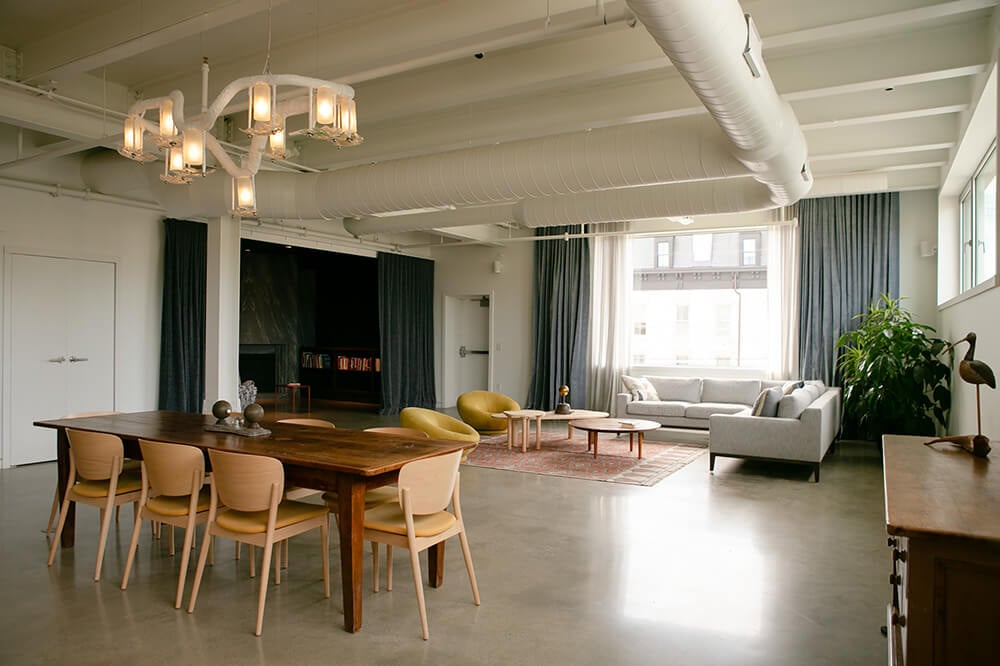
Upstairs, the mood changes. Bedrooms for visiting guests have oak frames, white bedding, thick drapery, and a single landscape above the headboard. Down the hall, the library is dark, upholstered, book-lined, and organized around a fireplace faced in veined stone. The main lounge is long and loose, stitched together by white beams and ducts. Curtains hang from the ceiling that can close to form smaller rooms. The furniture is meant to be eclectic, with a vintage dining table with simple chairs, a cushioned sofa, and a couple of low tables drifting on a rug.

Zoning allowed another story, which GLO Design with Present Forms used to make a greenhouse-like solarium with views of the Catskills. Setbacks built into the terrace were fashioned into a green roof. The new shed does not try to mimic brick, it sets up a counterpoint, opaque mass below, luminous volume above, that feels true to the building’s evolution.
Hudson’s recent revival has been fueled by adaptive reuse as much as preservation, by buildings that keep a memory of working life while accommodating new forms of culture and care. In that context, The Spark of Hudson feels right. It is not a boutique object and not a sealed institution. With GLO design and Present Forms steering, the old warehouse stands again as part of the street’s everyday life.
→ Continue reading at The Architect's Newspaper

