
The founders of Houston-based Cobalt Office, Andrew Colopy and Robert Booth, first met as graduate students at Columbia GSAPP. Before deciding to open the firm, Colopy spent years at Diller Scofidio + Renfro, where he collaborated with Benjamin Gilmartin. Booth was a senior designer and project manager at Marble Fairbanks Architects. Both eventually ended up planting roots in Texas: Colopy was offered a teaching position at Rice University School of Architecture, and in Houston, Booth worked for HLR Architects, where he familiarized himself with the ubiquitous “5 over 1” apartment building typology, before going on to found Cobalt with Colopy. It is this breadth of foundational experience, in civic, institutional, and multifamily residential projects, that Cobalt Office’s cofounders draw from.
Today, Cobalt has found a niche designing multifamily residential projects in exurban areas. The office’s work stands out against a backdrop speckled with single-family housing and podium buildings. Colopy told AN that Cobalt is responsible for roughly 650,000 square feet of residential construction in Texas right now, despite its small staff size. Hycohen Residency, its latest built multifamily housing project in Houston, came in at just $135 per square foot. “People are blown away when they hear that number,” Colopy noted. In its projects, the firm relishes working within parameters set by developers and Texas zoning codes. “We want to be doing things that are complex. That’s the goal,” Colopy affirmed. “We want to continue doing housing, but we’re also trying to move into the space of development, to try opening up more opportunities for us. I think we need more stake at the table to influence decision-making.”
Hycohen Residency, 2024
Motoring along the 288 Expressway in Houston, a driver might see pitched roofs with irregular ridges peek up from the horizon. For Cobalt, Hycohen Residency’s unique profile was a way to grab attention from afar, a more dynamic way to attract renters who might be used to a standard billboard at the complex. This is just one of many ways that Cobalt Office was able to push up against the status quo with the project, creating something novel within its context. The 210-unit complex has a range of 1- and 2-bedroom apartments and a community center. Detention ponds serve as crucial flood-control infrastructure during heavy rains, which happen frequently in Houston. “It was a battle with our civil engineer not to have a fence around one of the detention ponds, which we wanted to become a dog park when it’s not flooded,” Colopy said.
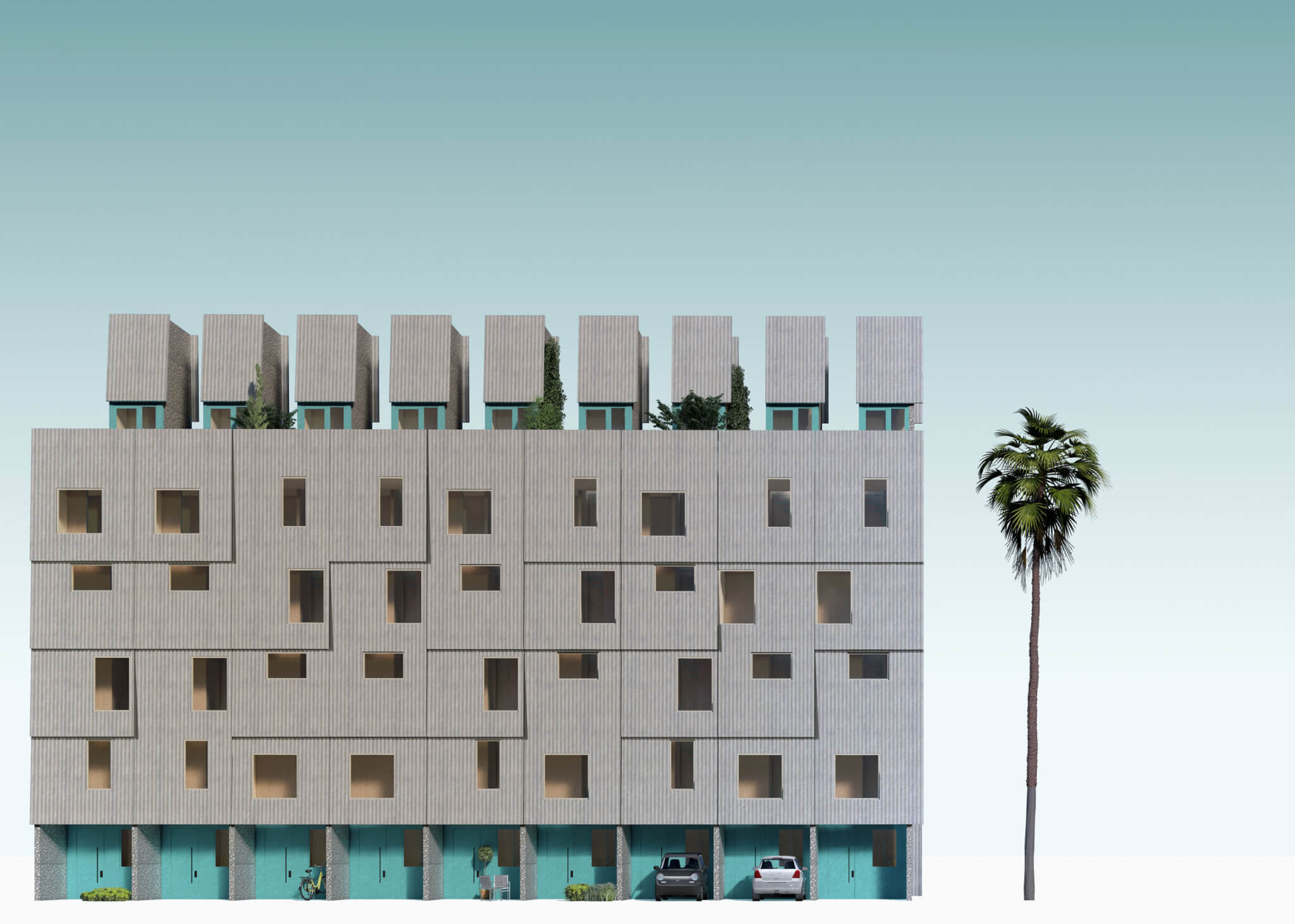
Small Lots, Big Impact Competition Entry, 2025
Last year, the City of Los Angeles, LA4LA, and cityLAB-UCLA launched the Small Lots, Big Impact competition to expedite affordable-housing construction in Southern California. Cobalt Office entered the competition and designed a 5-story residential tower that employs what Colopy called a “Tokyo-style stack of units” supported by a single spiral stair. It didn’t win, but the unbuilt project serves as a marker of sorts for the trajectory in which Cobalt Office is perhaps heading. With their eye to the future, Colopy and Booth want to build residential towers around the country and push boundaries in regard to what’s possible in the multifamily residential sector. “We definitely want to keep doing housing in Houston,” Colopy said, “but we also understand all of the constraints on the typology here and the way in which capital operates, making it hard to do small-scale infill projects.”
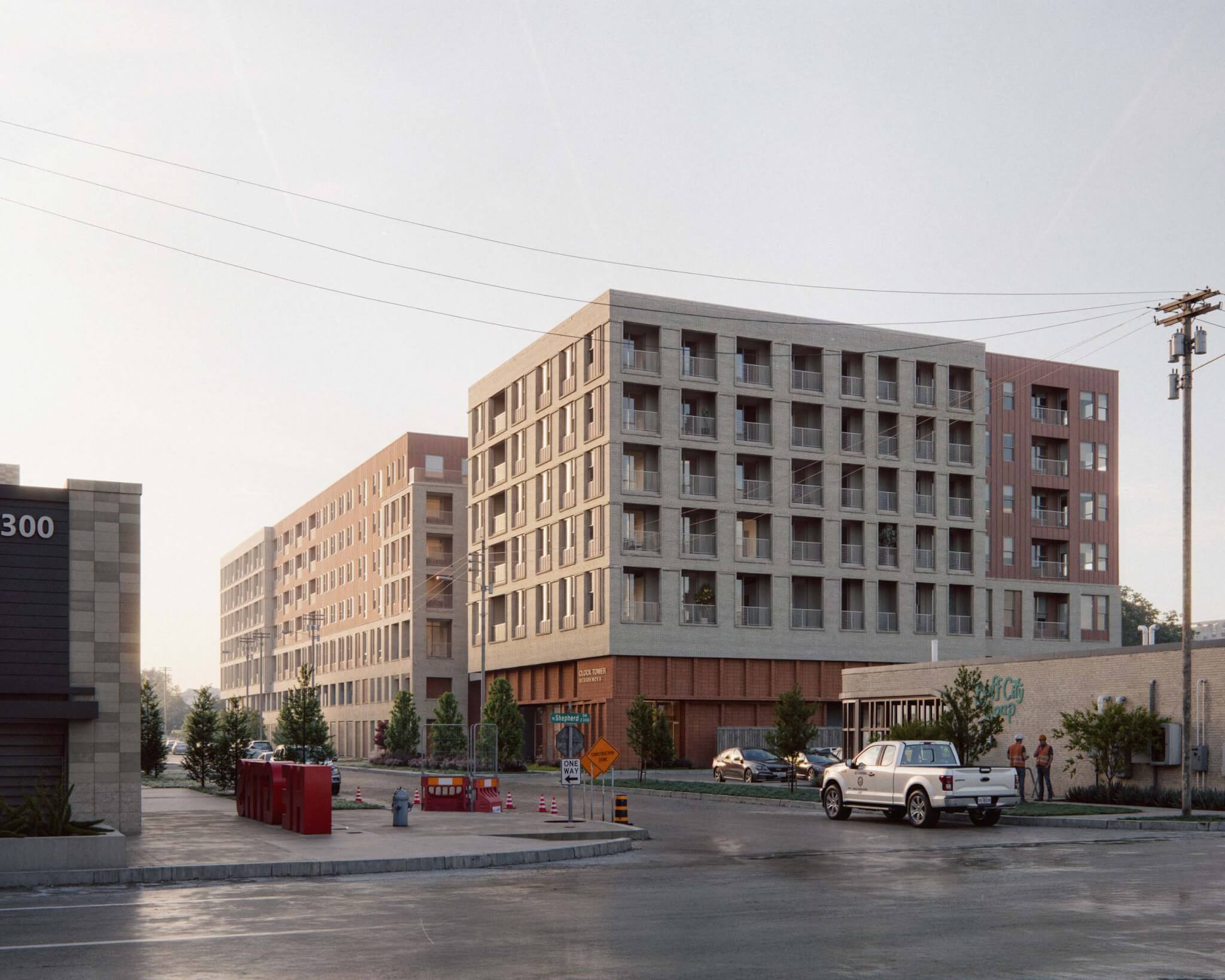
Clock Tower Residences, Ongoing
The Heights Clocktower was built in 1894, making it one of Houston’s oldest buildings. Cobalt Office is designing a new high-density residential project adjacent to the Heights Clocktower Building, aptly called the Clock Tower Residences. The architects say the Clock Tower Residences employ a mixed philosophy of classical and modular development models. “A classical approach would be scaled to the city block, which would be too monumental,” he said, “and a modern, modular approach would have too much repetition. We really tried to find a middle ground.” The result? A handsome 214-unit brick building that is both sensitive to the site and also packed with homes. Meanwhile, a commercial space on the ground plane is expressed in masonry, as opposed to the more-standard glazing, another simple gesture that makes the project stand out from the status quo in Houston.
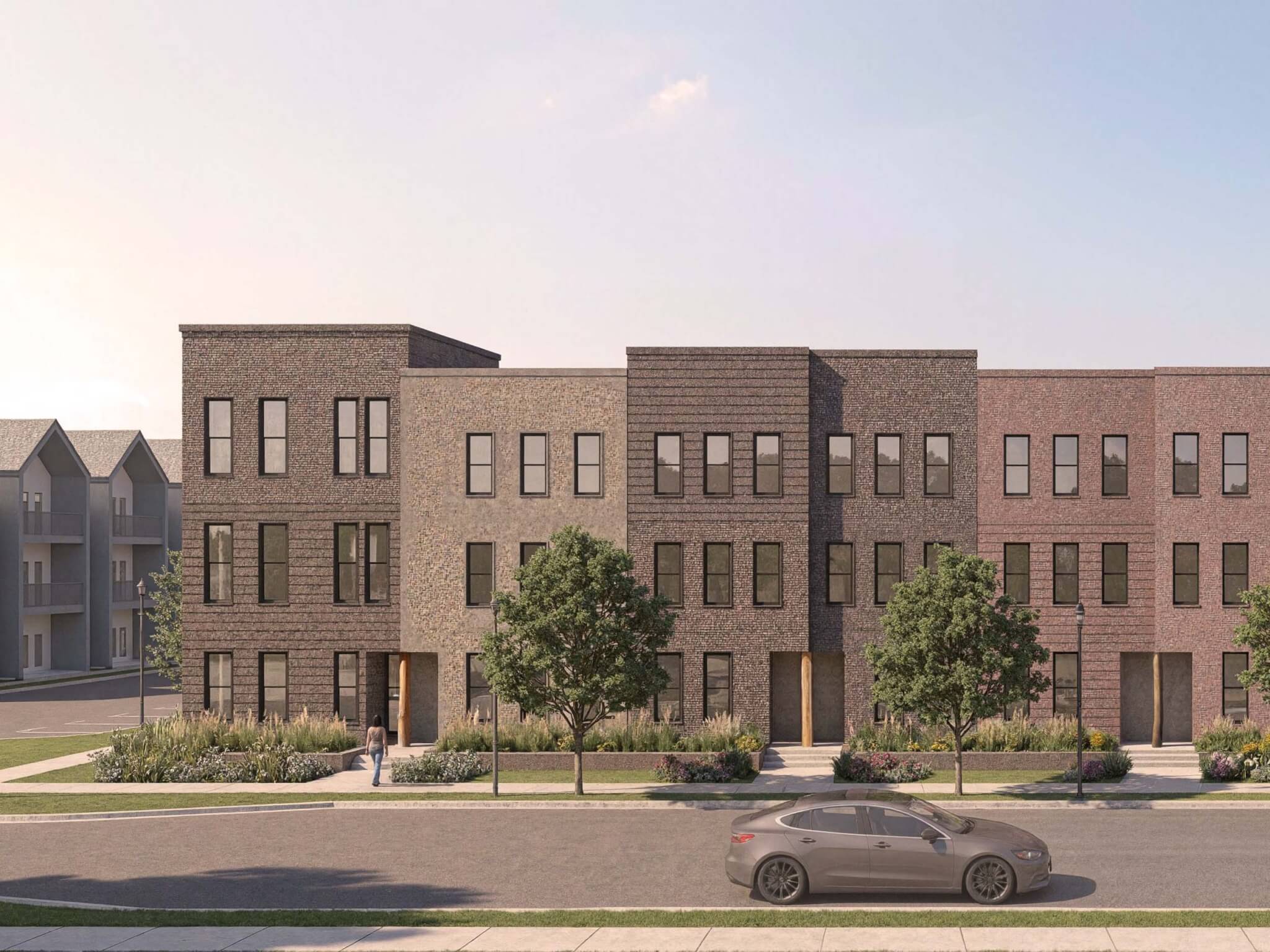
Indigo, Ongoing
Farmland outside Richmond, Texas, is often gobbled up by developers and leveraged for single-family housing and cookie cutter apartment buildings. Meristem Communities’ cofounders, Clayton Garrett and Scott Snodgrass, own a large tract of farmland in Richmond and are aiming to be “way more experimental,” Colopy said. Naturally, Cobalt Office was a good fit as a partner. With Meristem, Cobalt is helping deliver a new mixed-use community called Indigo, which is supported in part by a sustainably managed farm off the site. “The developers are mission-driven,” Colopy elaborated. “They know a mix of housing types makes for a more resilient suburban community.” Cobalt has designed point-loaded buildings that don’t have internal corridors, reducing costs and making for a more architecturally interesting contribution to the development.
→ Continue reading at The Architect's Newspaper

