
A single-family residence in Monterey Park, California, treats the zoning setback—the mandated buffer between building and property line—not as leftover space, but as a design medium. Rebuild Collective and 1+1+ Architects have completed Wandering Courtyard House, a residence on a 0.15-acre parcel seven miles east of downtown Los Angeles. The project finished in August 2025 after 30 months of construction. It was designed by De Peter Yi, founder of the Cincinnati- and San Francisco–based studio Rebuild Collective and assistant professor of architecture at the University of Cincinnati, in collaboration with Laura Marie Peterson, principal architect and founder of the Detroit-based 1+1+ Architects.
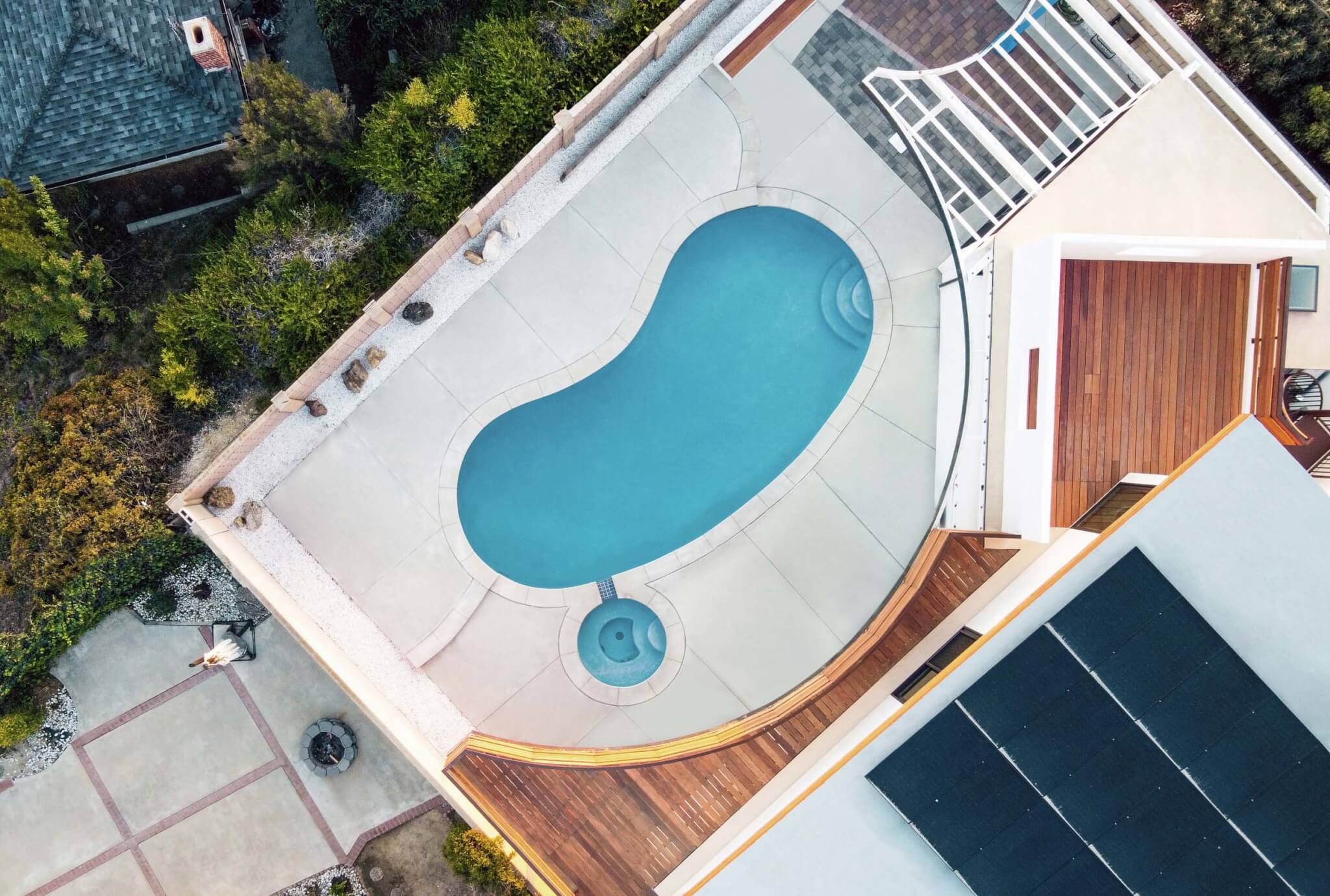
For Yi, the project was personal: a retirement home for his uncle and aunt—the first-generation Chinese immigrant artist couple Yi Kai and Jian Zheng. It replaced a 1956 house that was demolished, though the original kidney-shaped pool was kept.
In Los Angeles, roughly 78 percent of residential land is zoned exclusively for single-family homes. That pattern has produced a landscape most Angelenos know by heart: detached houses floating on their lots like islands, separated by strips of dead grass and chain-link fence. The setback isn’t a designed space. It’s where the garden hose lives or maybe a trash can. Inhabited by no one, designed for nothing, it quietly enforces the idea that the best thing you can do with your neighbor is ignore them.
Yi has been arguing against that logic for years. His 2023 SOM Foundation Research Prize, a collaboration with Gabriel Cuéllar titled “Block by Block: Advancing New American Dreams and Housing Justice by Aligning Design with Zoning Reform,” studied how single-family zoned blocks could become new forms of collective architecture. The project’s central proposition is that zoning reform—particularly California’s Senate Bill 9 (SB 9), which allows single-family lots to be split and rebuilt with up to four housing units—shouldn’t be adopted lot by lot, but coordinated across property lines at the scale of an entire block.
To test this idea, Yi developed “Courtyard Block,” a design-research project and board game proposing that the rigid grid of private backyards on a typical Los Angeles block could evolve into “lively arrangements of courtyards that can adapt to individual or collective use if neighbors adopted SB 9 together.” In a piece he penned for AN, he argued that zoning setbacks are an untapped design opportunity: “SB 9 is a tool for multiplication through division, acting in direct counterpoint to the minimum lot size requirements that propelled sprawl.” Wandering Courtyard House is the single-lot proof of concept.
Rather than designing inward from the property line—the default for any house governed by zoning setbacks—Yi designed outward, shaping the leftover setback zones into a constellation of outdoor rooms. In the east-facing side yard, an interior and exterior kitchen straddle two sides of a single wall, joined by a casement window. In the west-facing side yard, the house curves toward the pool, creating a quieter courtyard: white stucco walls step up in a stair-like profile, and a mature prickly pear cactus anchors the corner where the house meets its lot’s edge. The result, as Rebuild Collective describes it, is a house with as many outdoor rooms as indoor rooms.
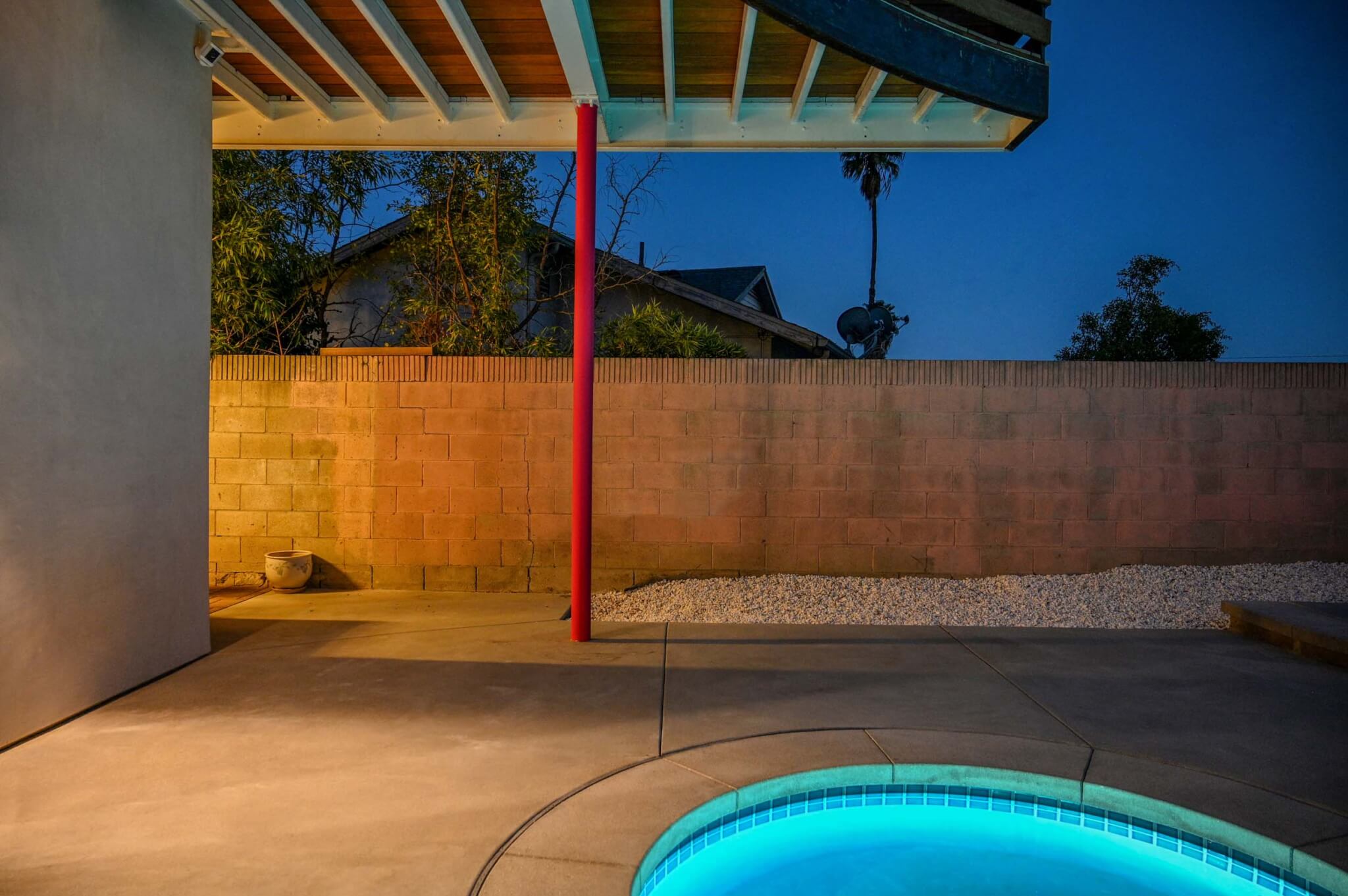
In the rear yard, an 80-foot-long curving teak deck on the second floor—permitted within 50 percent of the rear setback—sweeps around the kidney-shaped pool like a slow arm, adding roughly 650 square feet of shaded outdoor space on the ground floor and 450 square feet of open-air balcony above—a house that “shapes the spaces around it” by designing “within the existing code.”
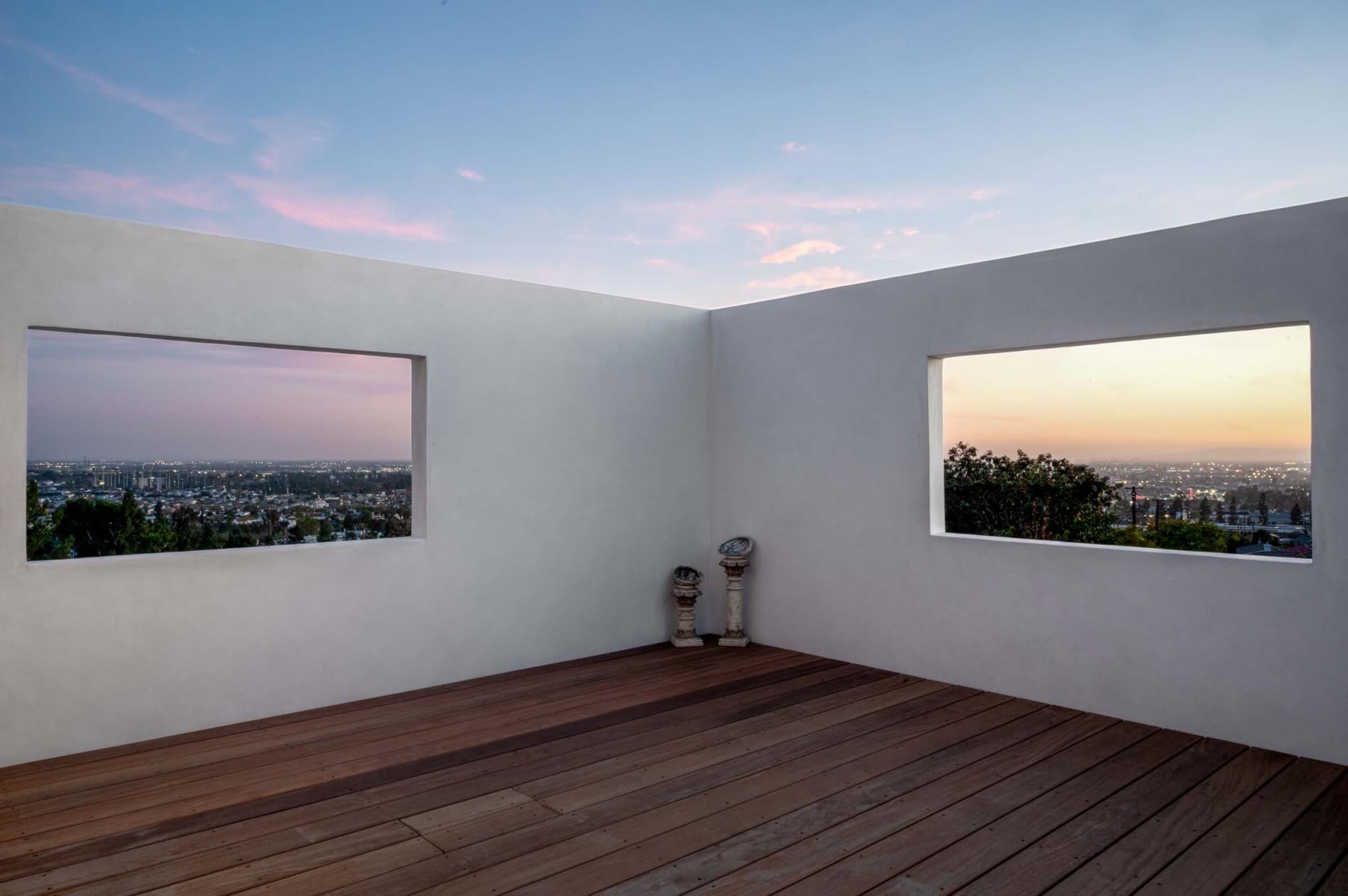
Up on the deck, partial-height stucco walls frame the Los Angeles skyline through large rectangular cutouts. Two openings on one corner present the city in opposing orientations, side-by-side—one east toward the San Gabriel Mountains, one west toward downtown. The same sky, two different paintings of it. Yi compared the effect to James Turrell’s outdoor “Skyspaces,” where a built frame transforms a rectangle of atmosphere into something contemplative. “Taking something mundane and making it special,” he said of how the light shifts across the walkway throughout the day.
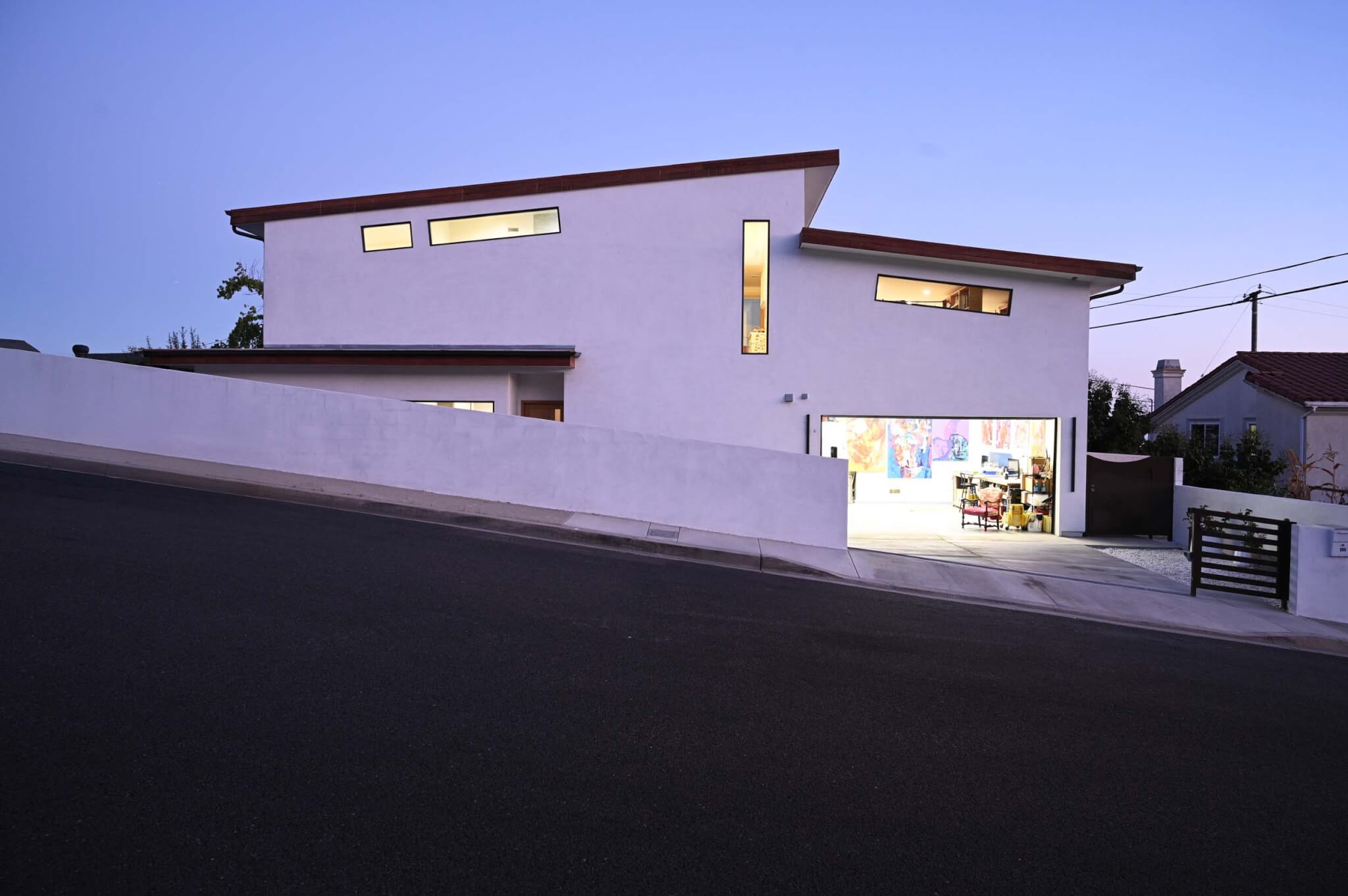
The project is also a cross-cultural argument—one that maps directly onto Yi’s zoning research. 1+1+ Architects described the project as combining “elements of the American backyard with the Asian courtyard.” The American backyard is private, enclosed, inward-facing—a space of retreat and separation. The courtyard, in Chinese architectural tradition, is something else: communal, porous, oriented toward shared life. At Wandering Courtyard House, the arc of the second-floor terrace draws on the tradition of courtyard houses and gardens in China. Its butterfly roofline echoes the midcentury homes found throughout the predominantly Chinese neighborhood. Monterey Park became the first city in the continental United States with a majority Asian population by the 1990 Census; today, roughly 65 percent of its residents are Asian.
Gaston Bachelard wrote that every corner of a house is a diagram of the psyche—the basement as the unconscious, the attic as the rational mind. He never wrote about the setback or the threshold where the fantasy of private life meets the reality of a neighbor. Wandering Courtyard House turns the forgotten margins of the lot into the most charged spaces in the house. In the gap between this house and the next one, something is growing. Maybe it’s a neighborhood.
→ Continue reading at The Architect's Newspaper

