
When foundry workers cut the head of Charlottesville’s Robert E. Lee statue in half in the fall of 2023, the bronze got thick and clumpy in the furnace, refusing to liquefy cleanly at 2,250 degrees Fahrenheit. The foundry owner, a Black man who had taken on the job at great personal risk, studied the lumpy alloy and offered a diagnosis: “This metal has a lot of bad juju stuck in it. It’s cursed.”
The statue had stood in what is now Market Street Park since 1924, unveiled days after the Ku Klux Klan marched through town. Its removal in July 2021 followed a years-long legal battle, a deadly white nationalist rally, and a Virginia Supreme Court ruling. The Jefferson School African American Heritage Center took possession of the statue and, rather than displaying it in a museum, partnered with University of Virginia associate professor Jalane Schmidt to pursue a more radical idea: melt the monument down and invite artists to recast it as new public art.
The project is called Swords into Plowshares, after the biblical injunction to transform instruments of war into tools for cultivation. On March 14, the Jefferson School presented three finalist proposals from Hood Design Studio, MASS Design Group, and PUSH. They are on view through May 20. Community voting is open through May 30, and the winning design will be announced on July 10—the fifth anniversary of the statue’s removal.
The philosopher Bruno Latour once argued that the sin of images is not their existence but their stillness. The Lee statue was, above all, a freeze-frame—a single figure, a single claim about who mattered, arrested in bronze for anyone who passed to absorb without question. That is what monuments have traditionally been asked to do: stop time, fix meaning, present a version of history that looks inevitable.
Western cultures have historically privileged the archive—the fixed, permanent record—over the repertoire: the embodied knowledge carried in gesture, song, ritual, and collective practice. A bronze equestrian general is pure archive. But what is remarkable about all three Swords into Plowshares finalists is that each one shifts the balance toward repertoire—toward forms of public memory that demand participation, care, and renewal. The three proposals agree on this much. Where they diverge is on the question of what replaces the freeze-frame: a shelter, a scattering, or the land itself.
Rooted
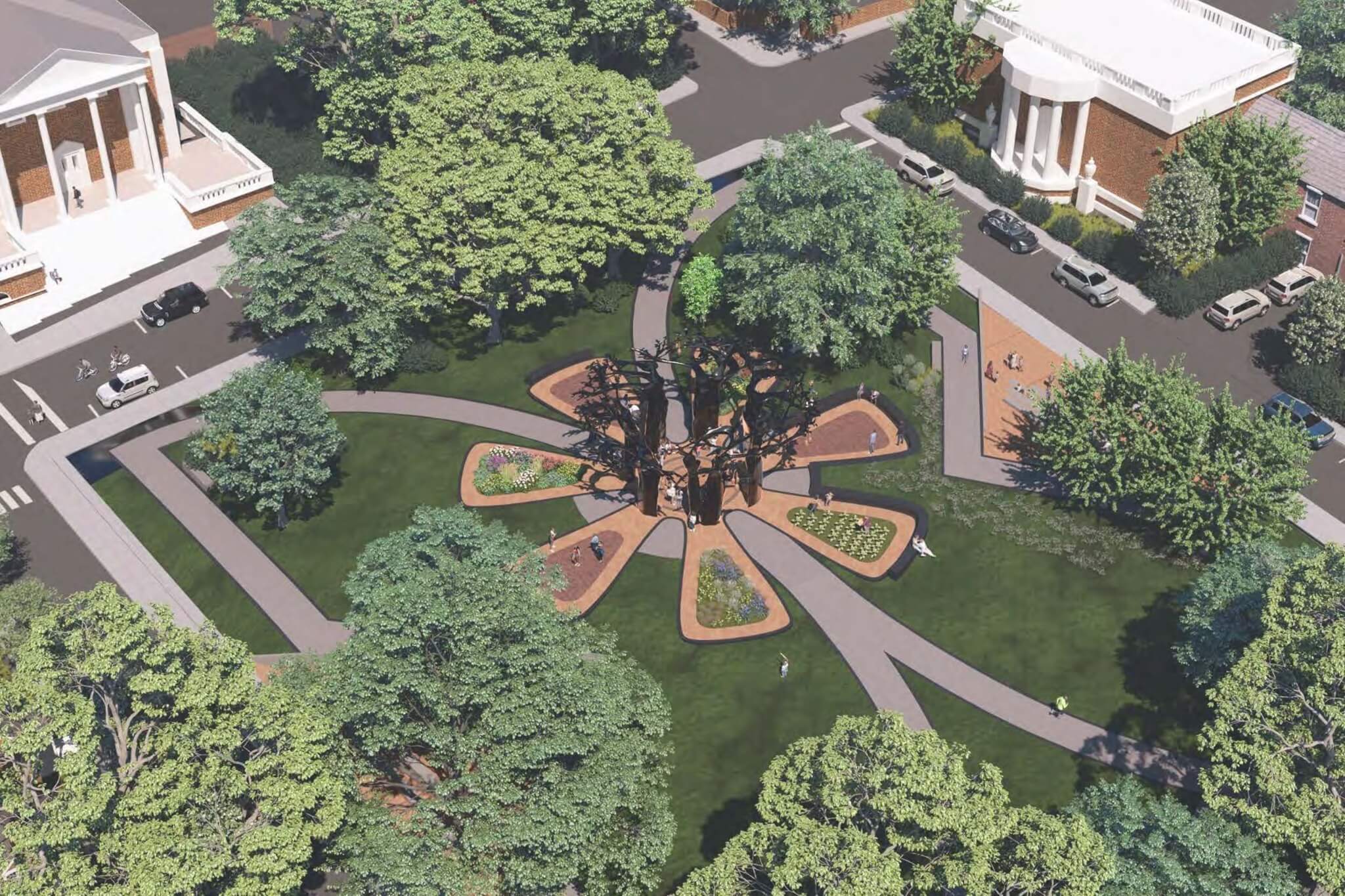
The most physically monumental proposal comes from Boston-based MASS Design Group and sculptor Dana King. Rooted would place a 27-foot bronze baobab tree at the center of Market Street Park—not a sculpture you admire from a distance but a tree you walk inside, its seven trunk-pillars thick enough to pass between, its branches reaching out and knitting together overhead like open arms.
In sub-Saharan Africa, the baobab is the tree people gather under to tell stories, settle disputes, share food. King envisions the interior as a sanctuary: community members’ handprints pressed into the bronze, and a soundscape that translates a living baobab’s bioelectrical pulse into music.
MASS is an architecture firm with deep experience in memorial work—the firm designed the Embrace sculpture and plaza on the Boston Common honoring Martin Luther King Jr.—and it shows: they have redesigned the entire park, not just placed something in it.
The baobab’s 27-foot height roughly matches the height of the Lee statue on its pedestal. But where Lee sat on horseback above you, demanding that you look up, the baobab is something you enter. Replacing the symbol of exclusion with a symbol of shelter.
Ringing and Shouting
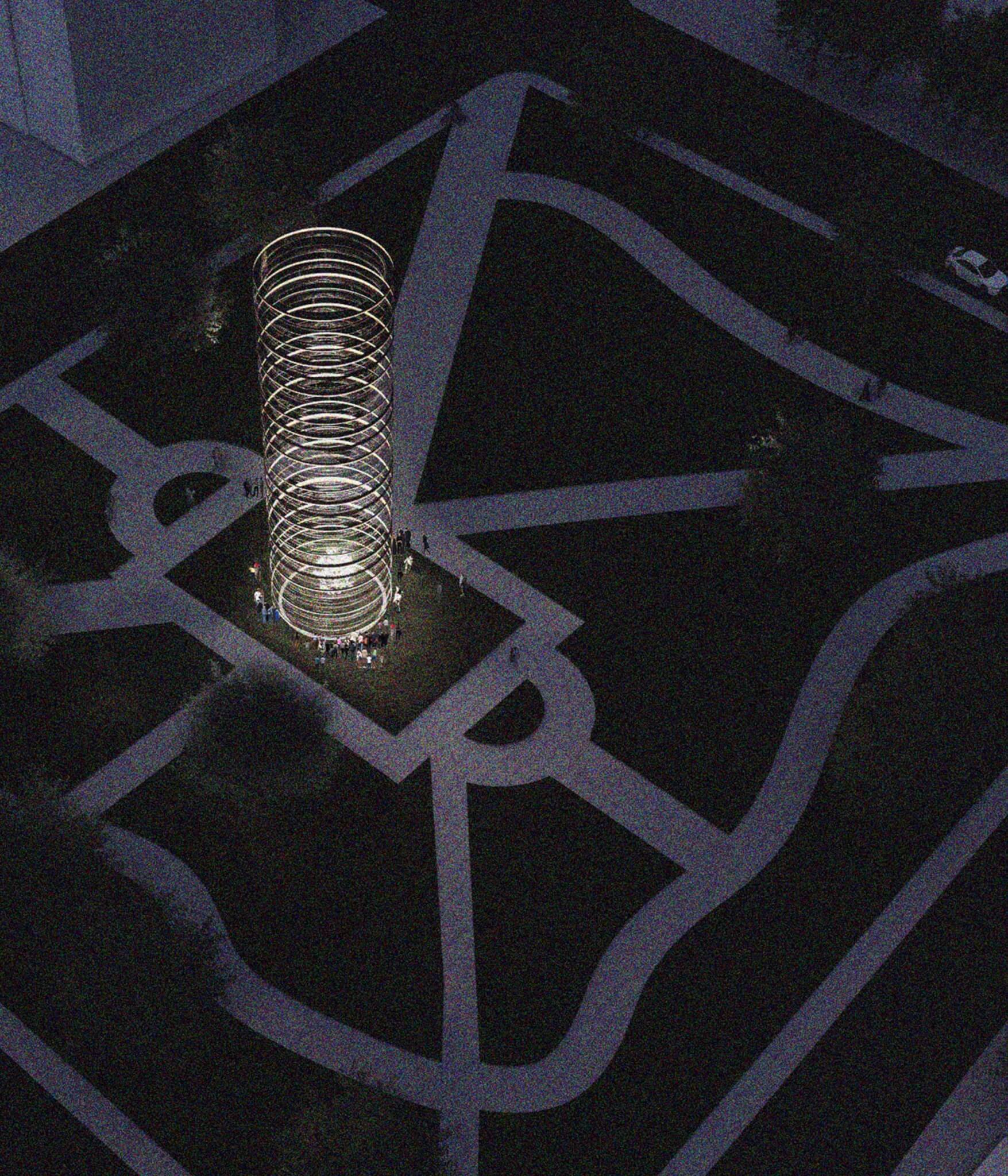
Hood Design Studio’s Ringing and Shouting begins with 24 sculptural “Witness Tree Rings”—each is 20 feet in diameter and stainless steel inlaid with reclaimed Lee bronze, and engraved with words, names, and symbols generated through community storytelling sessions. The sessions are held beneath notable old trees across Charlottesville—a willow oak at Monticello planted in 1807, an oak at Highland that has been standing for 300 years—trees chosen because they have lived through the city’s contested history and, in Hood’s framing, serve as silent witnesses to it. All 24 rings are stacked at Market Street Park into a shimmering tower called the “Guardian,” with a white pine sapling rising through its center—the Haudenosaunee symbol for the Great Tree of Peace, under which weapons were buried to seal an agreement between nations.
But the Guardian is temporary. Each ring is ceremonially removed and carried to its neighborhood, where it is permanently installed around the base of its witness tree as a circular bench and gathering place. Hood structures the process around the Ring Shout—the oldest documented African American performance tradition, rooted in West African circle dances that survived the Middle Passage. The studio calls the project an “anti-monument” and a “social sculpture”: the engagement is the artwork; the rings are its residue.
Hood’s proposal suggests that the most honest response to a monument that concentrated meaning in one place for a hundred years is to scatter it. What Market Street Park is left with is a single ring, a growing tree, and the memory of a tower that chose to come down.
Land Forge: A Collective Future
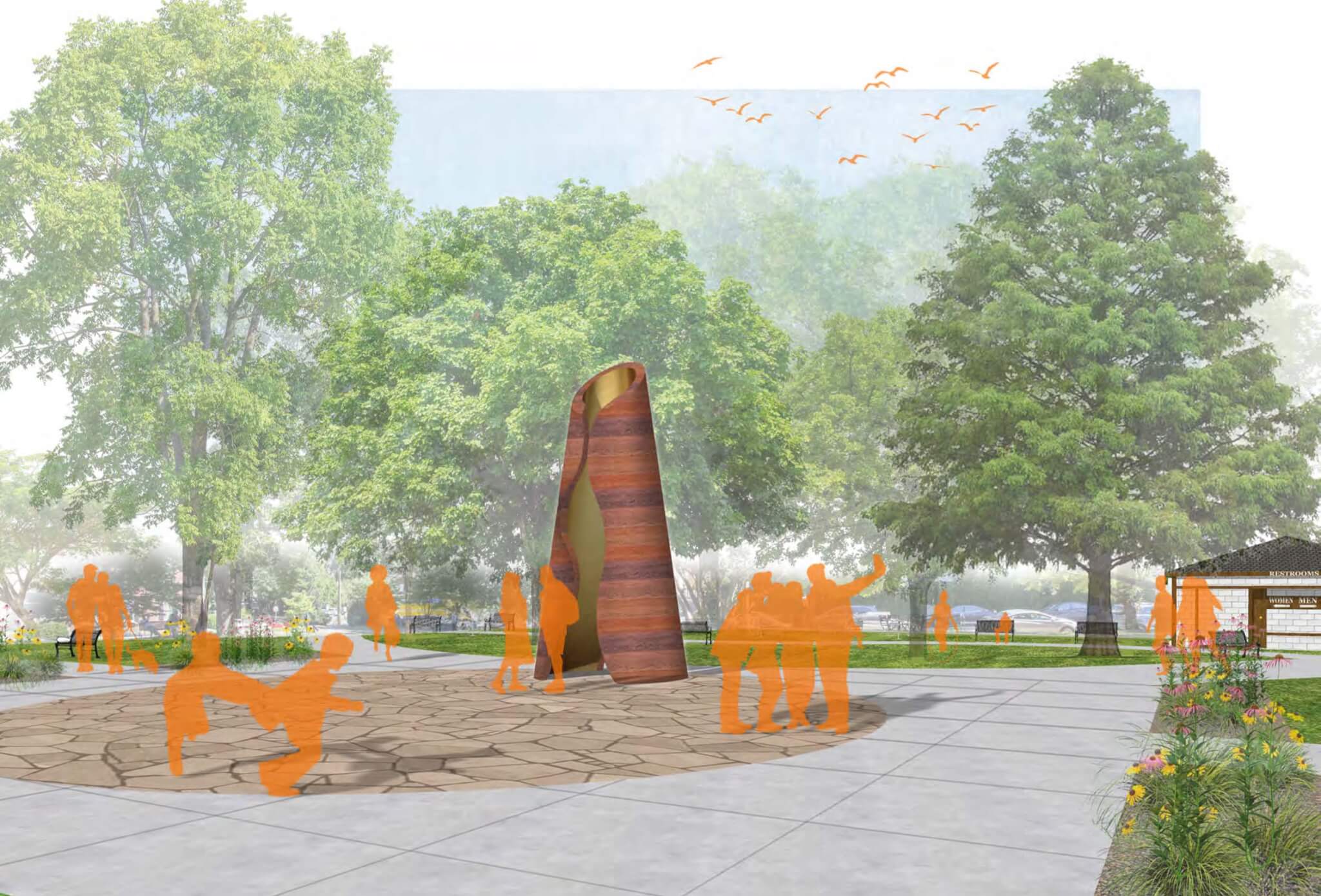
If MASS replaces the site and Hood disperses the object, Washington, D.C.–based PUSH Studio goes further: it reclaims the ground. Land Forge: A Collective Future is the only proposal that begins not with the statue but with the soil beneath it—and with the history of who has owned, been expelled from, and been denied access to land in Charlottesville from Reconstruction to the present day. The Confederate statue, PUSH argues, was not just a symbol of racial domination—it was an instrument of a land regime.
PUSH places sculptures in six parks, forming a “Black Narrative Network” comprising two 25-foot rammed earth towers with bronze interiors at Market Street and Booker T. Washington parks; and four six-foot pillars at Tonsler, Forest Hills, Court Square, and Belmont. Residents contribute soil from their own yards that is then compressed into the rammed earth layers—a material gesture connecting the forced relationship enslaved people had to Southern land with a voluntarily reclaimed one. The strata harden into a record of collective presence. The Western equestrian monument tradition is not the only bronze tradition. There is another, and it is African: the Benin bronzes—a West African cast-metal tradition looted by British forces in 1897 and now the subject of global repatriation efforts. Each of the six park sites is mapped to a specific historical narrative, tracing an arc from bondage through displacement through present-day gentrification. The studio plans to collaborate with the Piedmont Community Land Trust, Virginia’s first, which creates affordable homeownership for low-income families. The same forces that erected the Lee statue are the forces that today make it difficult for Black and Brown families to remain in Charlottesville. PUSH is the only proposal that says so directly, and the only one that links the art to an active housing organization.
What Grows from the Ingots
A decade ago, Zyahna Bryant, then a 15-year-old high school student, led the push to remove Confederate imagery from Charlottesville. What followed—the legal battles, the deadly rally, the years in a bus depot, the secret melting at an undisclosed Southern foundry—has made the city something it never asked to be: a test case for what a country does with the material remains of its worst ideas. The Charlottesville melt is, as far as can be determined, the first time a Confederate monument has been destroyed and its material offered back to the community as raw material for new art.
All three finalists incorporate ritual drawn from the African diaspora—the Ring Shout, Adinkra symbology, Benin bronze traditions. All three insist the artwork requires ongoing participation rather than passive observation. All three refuse the logic of the monument they are replacing: the single, permanent, unchallenged assertion. But the deeper question—the one Charlottesville is actually voting on—is whether it is enough to replace one symbol with a better one, or whether the real work starts when you stop talking about the statue and start talking about the land.
The cursed bronze is ready to become a baobab, a constellation of witness rings, or a set of rammed earth towers veined with the metal that once formed a general on horseback. Whichever Charlottesville chooses, it will be building something that has never been built before: a monument designed, from its first pour, to stay alive.
→ Continue reading at The Architect's Newspaper

