
Prefabricated straw panels and Passive House strategies were applied to Aska’s Animal Haus, a home in Victor, Idaho, designed by Bozeman, Montana–based Love Schack Architecture. Completed in 2025, the 3,292-square-foot house sits just across the border from Teton County, Wyoming—where land prices and building costs rival those in nearby Jackson—but it was designed with a different set of priorities.
The owners run Aska’s Animals, a nonprofit animal rescue with a rotating cast of dogs, pigs, and goats. They are long-term residents of the Victor community with a young son and a growing boarding business—the kind of clients Schack describes as “legacy clients,” building not to flip but to stay. They needed a home that could support their family and their rescue operation under the same roof. Architect Lindsay Schack’s solution was to work with the site’s sloping topography: the family lives upstairs, while a walkout basement below provides durable, sanitary space for the animals, with direct access to the yard. When the rescue eventually moves to a separate building, the lower level converts to family space.

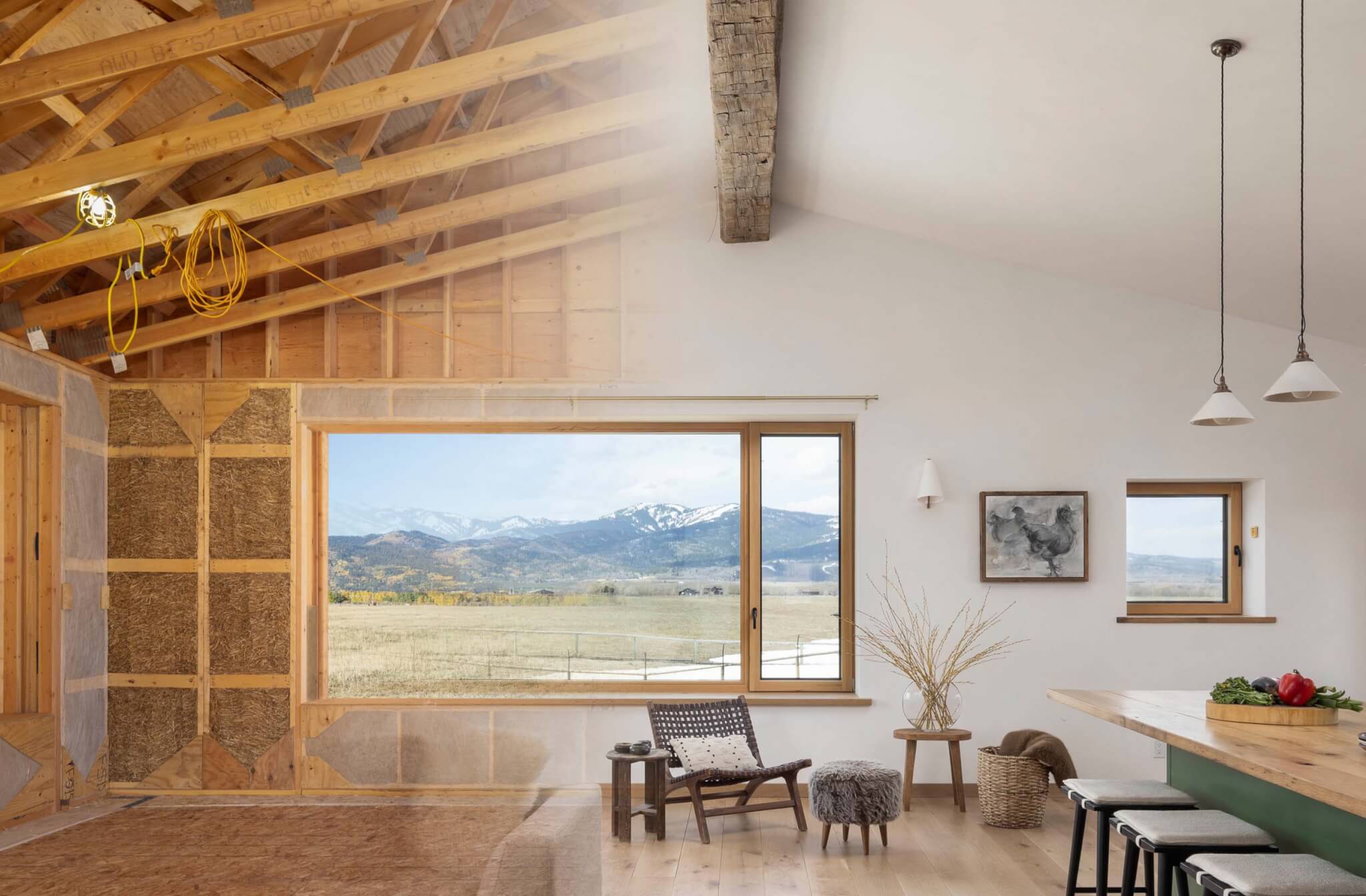
The material that made the project possible is still relatively new: prefabricated straw panels manufactured by New Frameworks, a Vermont-based company that is expanding its regional operations. The panels look and behave like conventional structural insulated panels—wood-framed assemblies that arrive on a truck ready to be lifted into place. The difference is what’s inside. Instead of foam, the bays are filled with chopped, compressed straw—not whole bales, but an agricultural waste product processed into dense insulation that doesn’t attract pests and resists fire much like heavy timber. The finished panels can be covered with standard drywall or used as a substrate for plaster, making them compatible with natural interior finishes. Electrical and plumbing run through a service chase wall framed on the interior side of the panels—a detail that looks entirely conventional to the tradespeople who show up to wire and plumb the house.
“Everyone thinks it’s kind of like hippie-dippie from the ’70s,” Schack said of straw’s reputation in the building industry. Her practice has long been committed to Passive House principles and the use of non-toxic materials. Traditional straw bale construction, which requires post-and-beam framing in Idaho’s high seismic zone and a massive amount of labor, was never practical for her clients.
“We recognized early on that while there’s good technology out there that can relate to energy efficiency, not all the materials involved are non-toxic or easy to recycle,” she told AN. “We decided we would like to design with materials that we felt strongly about.”
The panelized system sidesteps the cost and labor problems entirely. Local tradespeople recognized the framing immediately. “The insulation material was different to them, but that was really the only change,” Schack said. The panels are light enough that Will Langman, the owner-builder, could erect much of the structure himself using a Gradall rather than a crane.

The project wasn’t without challenges. A week of heavy rain hit just after the panels arrived on site, and the team installed moisture sensors to monitor the straw as it dried. It did, and Schack said the lesson was straightforward: time your installation to the driest weather possible.
The wall assembly is vapor-open, meaning moisture can dry to both the interior and exterior—a quality that matters in Idaho’s dry, wildfire-prone climate. The system achieves approximately R-3 per inch of insulation, and while the walls are slightly thicker than a foam equivalent, Schack sees that as a feature: the added depth creates generous window sills and strong acoustic performance. Paired with airtight construction and balanced ventilation, the house stays warm and breathable through long mountain winters.
Getting code approval took patience. “The first time, it always is a little challenging from a code review perspective, because it’s a new system,” Schack said. But once local officials understood the material’s performance, “they became cheerleaders for the project.”
The Mountain West is developing fast, and much of what’s going up, Schack said, doesn’t always have the best building science behind it. Aska’s Animal Haus is her answer to that: a home where affordability, health, and environmental responsibility aren’t competing goals. “Once people understand what Passive House is and what it’s based upon, and what it gets you,” she said, “there’s really no alternative.”
→ Continue reading at The Architect's Newspaper

