
A new supertall at 520 Fifth Avenue in Midtown, Manhattan, designed by KPF and developed by Rabina, sports a facade of arched modular frames, stretched—and sometimes dramatically—into varying proportions. The arch motif loosely recalls nearby Beaux Arts landmarks Grand Central Terminal and the New York Public Library, but does so as part of a parametric surface condition. Its changing proportions—from round to squat, wide to thin, before stretching higher at the crown—are determined less by composition than by the dimensions of interior programs: a calculated mix of offices and condominiums stacked above a members-only club at the tower’s base.
The 1,000-foot tower joins a cohort of recent New York towers that draw selectively from early 20th-century styles. The Brooklyn Tower by SHoP and 270 Park Avenue by Foster + Partners—both tagged as neo–art deco on Wikipedia—similarly abstract familiar historical motifs at supertall scale. In Downtown Brooklyn, vertical lines of bronze rise into the sky as in a Hugh Ferriss drawing, while in Midtown, JP Morgan’s whopping setbacks produce an emblem-like silhouette reminiscent of the Empire State Building.
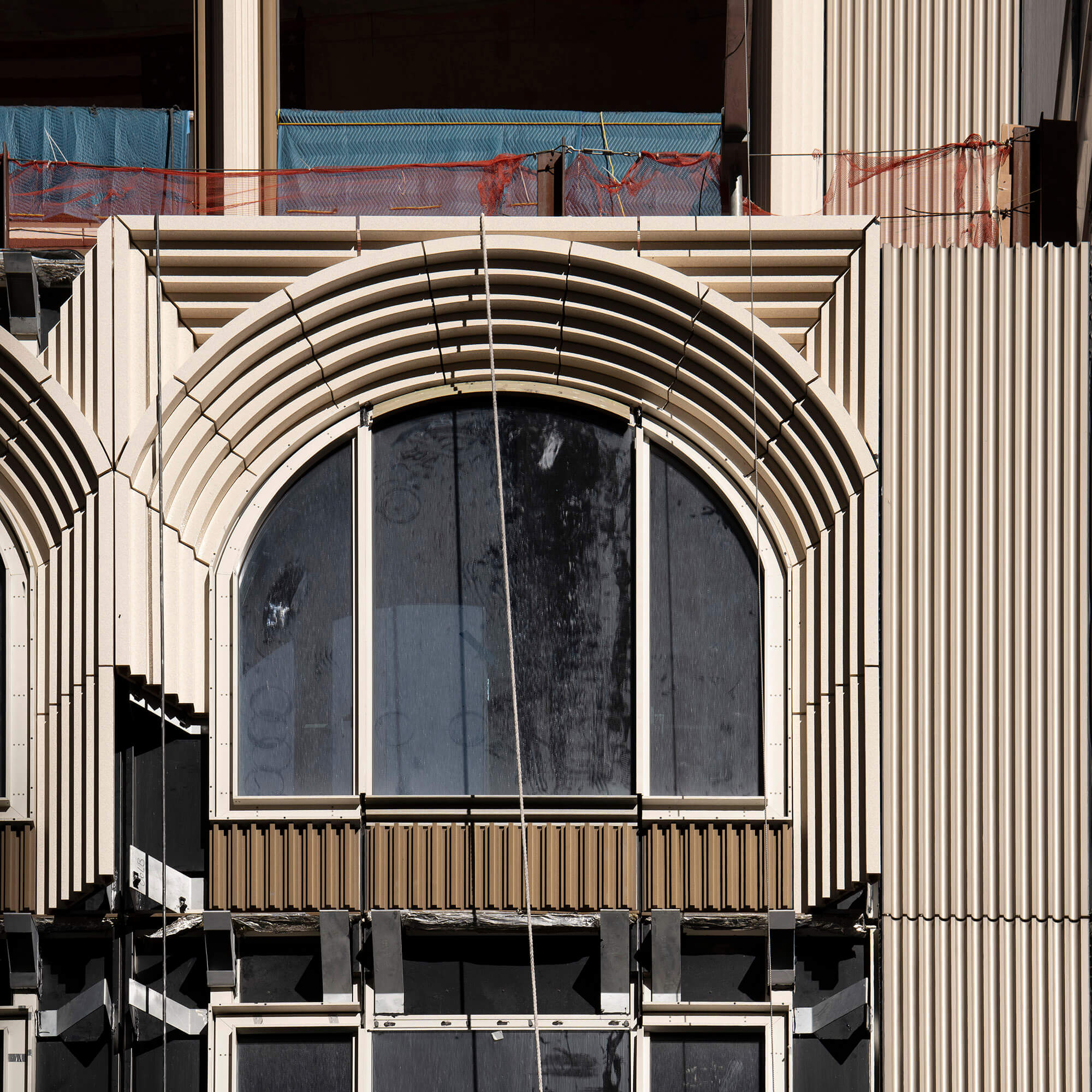
The historically themed innovation at 520 Fifth Avenue includes soaring verticals between bays of arches and stepped perimeter terraces at each setback. Set within a stepped rectangular frame, the modular arch—scored with open joints between panels at regular increments—expands and contracts as it duplicates up each of the tower’s four elevations. Its proportional variants are linked to the dimensions of the interior volumes they enclose, whether they be office, one-bedroom, penthouse, or otherwise.
Occasionally, as the system slips out of sync, moments of dissonance occur—rows of arches that seem to disappear, leaving frames purely rectangular, or groupings of modules that look unexpectedly small. Along the west elevation, the arches frame reflective shadowboxes concealing shear walls at the tower’s edge.
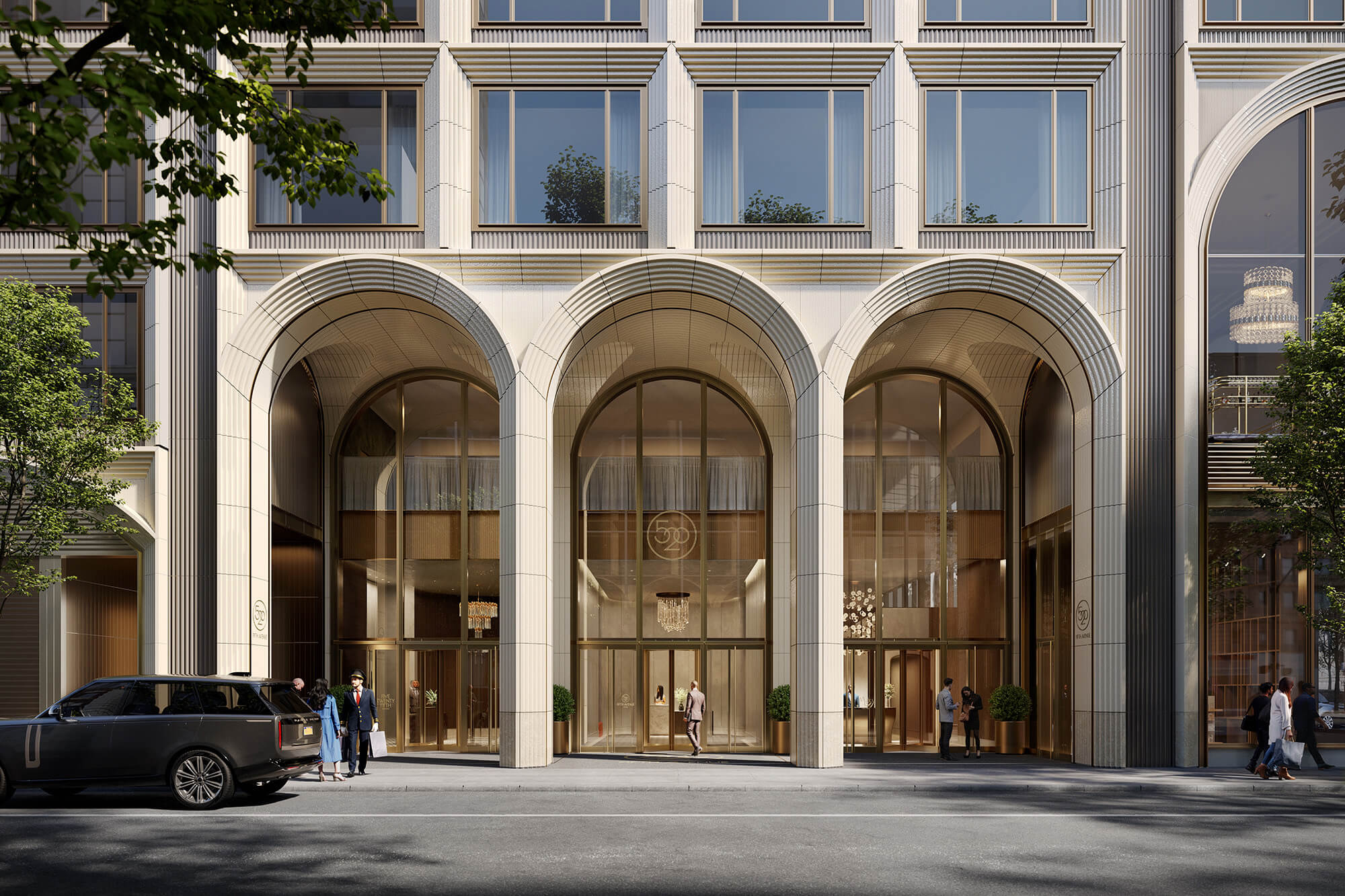
Naturally, one of the central challenges in the use of historical styles is cost. In the early 20th century, New York’s art deco towers were often clad in brick or terra-cotta as economical stand-ins for stone at their upper levels. KPF’s strategy is similar. Terra-cotta, now regarded as a premium material, anchors the tower’s base, while above the seventh floor, painted aluminum panels are finished with splattered treatments to mimic the appearance of the terra-cotta below.
What accounts for the recent turn to historical styles in some of New York’s tallest structures? Is it a reaction to the infamy of decidedly contemporary Billionaires’ Row? An attempt to draw associations with feats of a decadent past? Whatever the reason, the phenomenon suggests that architectural ornament still matters, and to the extent that it appears (once again) at the scale of the skyline.
If KPF’s ambition is to differentiate the supertall, the elements are certainly there. Arched openings, stepped terraces, a grand entry; each expressed through a considered material palette. Yet what most distinguishes 520 Fifth Avenue is the degree to which the arch is subordinated to optimization. The element exists at the whim of other factors—not so much revived as reprocessed, run through a script as a means of mapping an expedient image of the past onto a distinctly 21st-century typology.
Project Specifications
→ Continue reading at The Architect's Newspaper

