
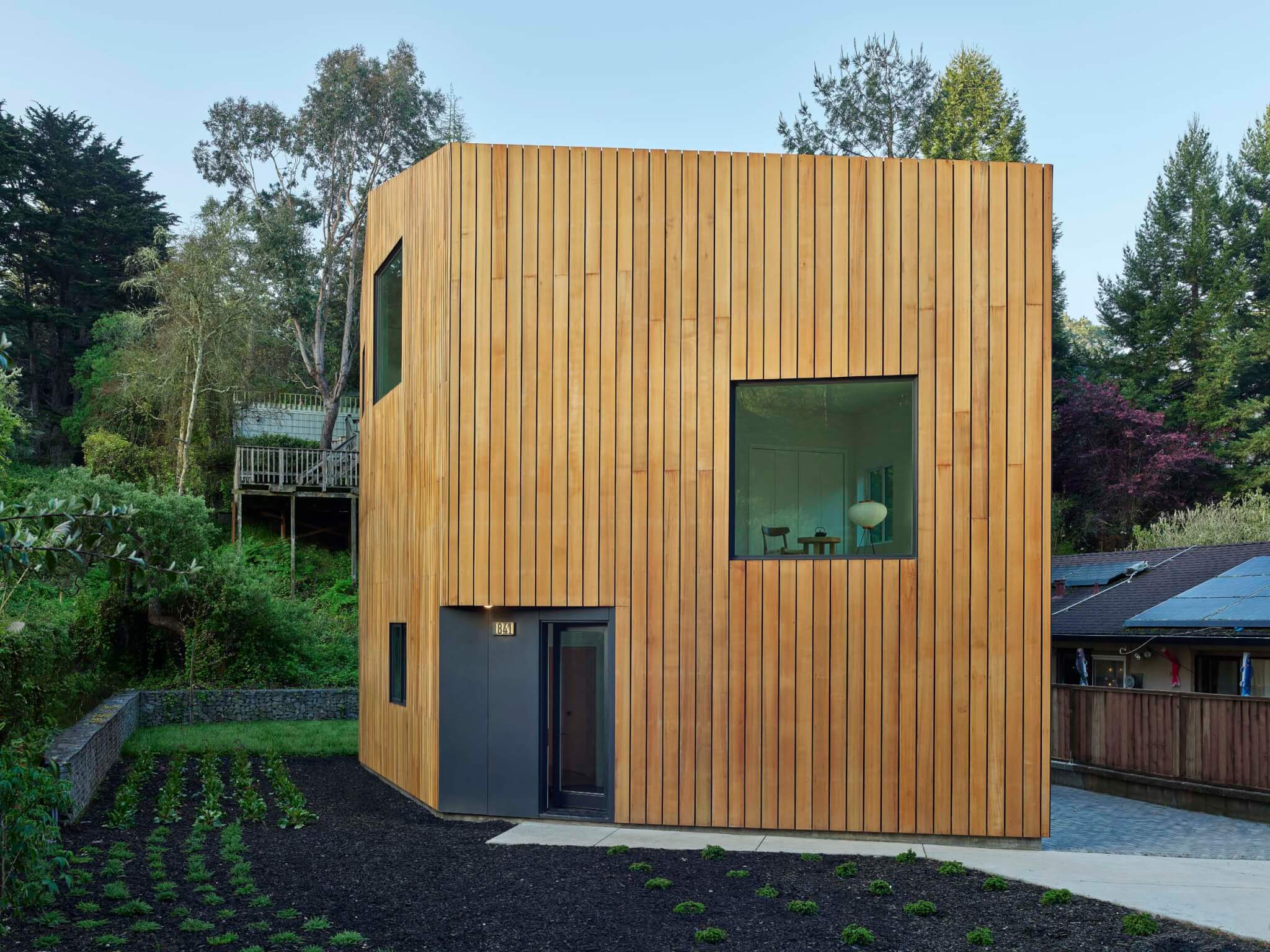
In a photo of the final model of this house in Sunshine Valley, California, a wooden rectangle sits atop two bricks in the middle of a sloping field. A stand of trees along the ridgeline behind is cast in the Central California coast’s signature marine fog. The rectangle is vertically bisected: thick boards on the left, thinner boards on the right, each alternating with bands of black. Square windows hover on either side of the midline.
The real house would take seven years to build. The rectangle of alternating board sizes is delineated by bands of black echoing the wintry underside of willows—built up and stretched out at angles, it unfolds as you move around its perimeter and is punctuated by those floating square windows.
Clad in a cedar rainscreen, the house rises with a verticality you would expect in a denser setting. Architect David Jaehning understood early that his design would require vertical proportions. The folding planes and four- and eight-degree angles make visible the extreme setbacks and regulations that shaped this project. Constructed in one of the most regulated counties in the most regulated state in the nation, this building embodies an ecological, bureaucratic, and architectural response.
A Site of Many Constraints
The 5,000-square-foot lot runs along a riparian woodland and Dean Creek, which cuts diagonally through the north side of the property and required a 30-foot setback from the bank. And a stand of three arroyo willows to the east carved out another 30 feet. A diseased tree, later removed, cut in with an additional 30. Then midway through the project, a dusky-footed wood rat nest was found, triggering yet another 30-foot buffer.
Including the standard 20 feet setbacks for front and rear yards and combined 15-foot side-yard setbacks and a daylight plane, Jaehning was left with 800 square feet of buildable area out of 5,000. Because this fell under the allotted 53 percent of the total lot, which for this site totaled 2,500 square feet, a height variance allowed them to build up rather than out.
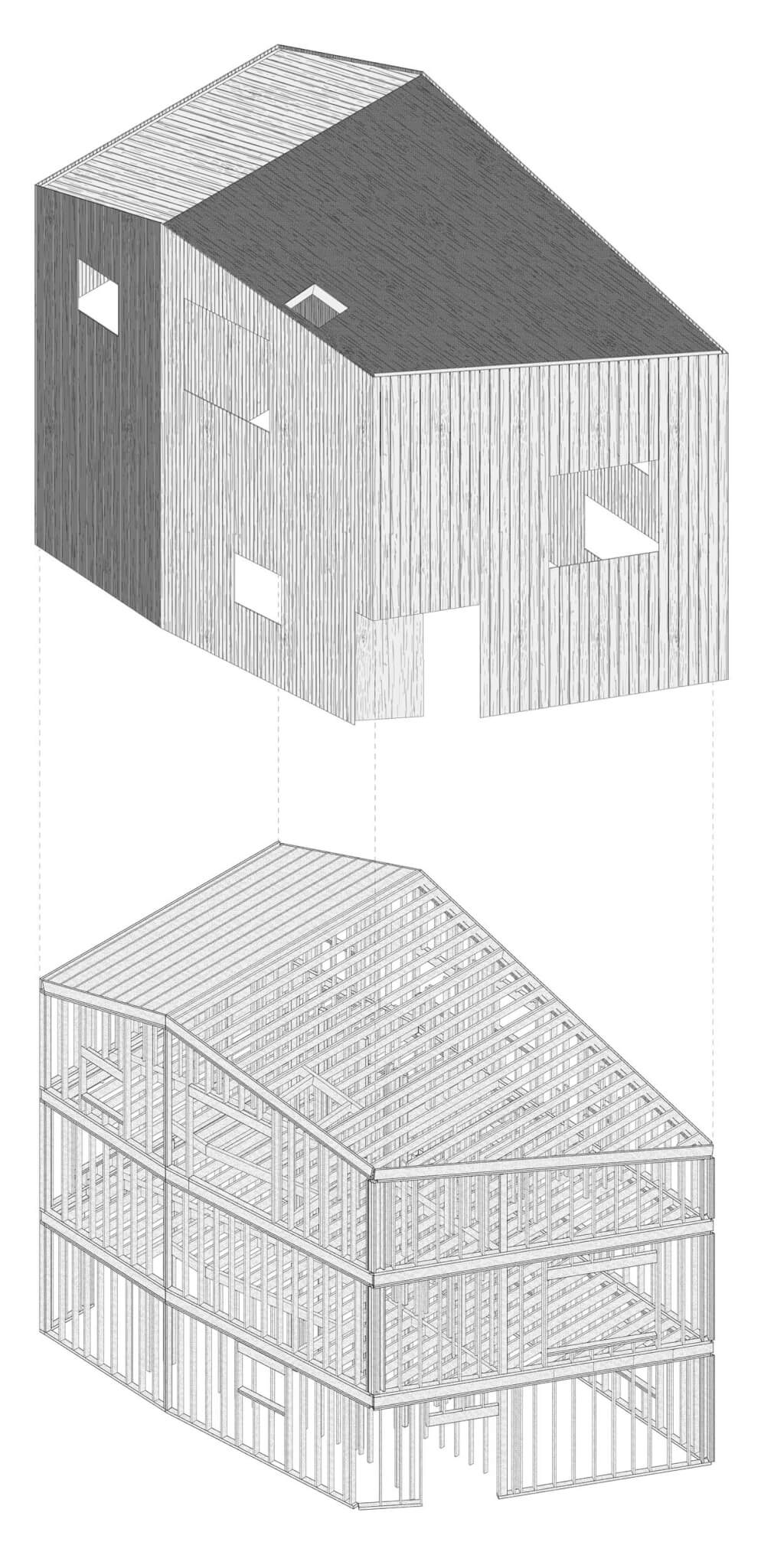
These overlapping site conditions and setbacks warped the rectangular form into a series of folding planes and angled walls that step back from each boundary. “The house’s massing exaggerates the faceted quality of the site’s remaining buildable area,” said Jaehning.
(Not) Another ADU Battle
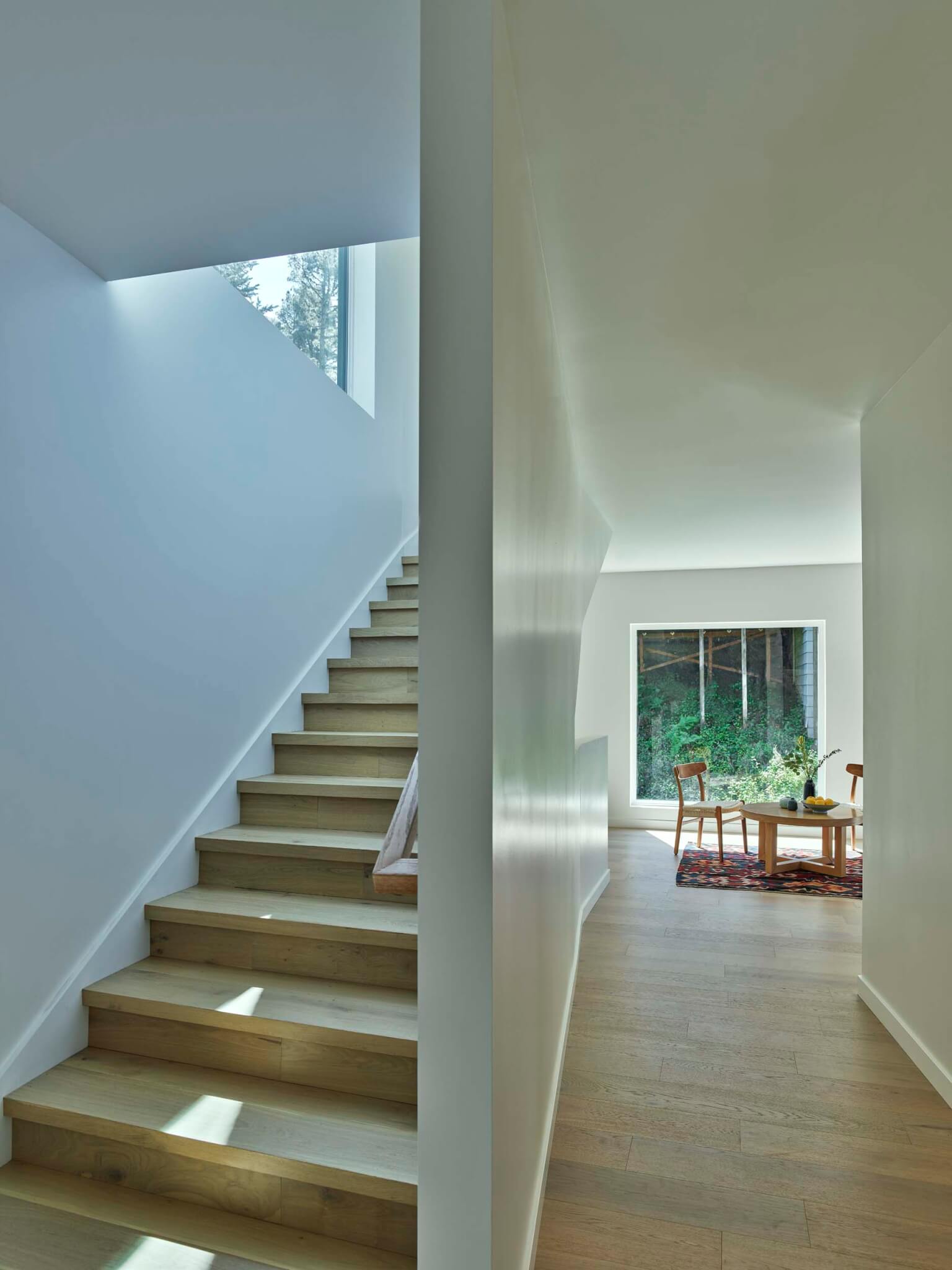
The main residence is located on the upper floor of the building and consists of two bedrooms and two baths, with large windows overlooking the riparian corridor. A junior ADU occupies the ground floor, sharing a split entrance with the main residence. The client initially wanted a two-car garage. To accommodate, the architect proposed cantilevering over the creek’s setback area, which was denied to preserve air rights. That meant that the garage, also a zoning requirement, would occupy the entire ground floor, already planned for an ADU. So Jaehning sought a variance for uncovered parking to accommodate the accessory dwelling unit instead.
When the county denied it, Jaehning appealed to the Board of Supervisors. After the board tried to table the issue, Jaehning reminded its members of the governor’s mandate: Counties must allow ADUs to address California’s housing crisis. “I asked them to go on record: Would you rather have two cars enclosed than house another family?” After the six-month battle, the board ruled in his favor—a significant legal precedent.
Material and Perception
According to Jaehning, the cedar facade references Sea Ranch’s weathered wood and learns from Sol LeWitt’s rule-based wall drawings and Sigurd Lewerentz’s masonry work. “I lean into material detail and matters of perception,” said Jaehning. These influences show up in elements like the rainscreen boards. Inspired by Lewerentz’s rule (to never cut a brick but stretch the mortar instead), Jaehning exaggerated the gaps between each board (1/2 to 3/4 inch) and painted the top and bottom edges black. In the end, the cladding consisted of 544 hand-painted boards in alternating widths—1 by 1, 1 by 4, 1 by 8—arranged to create an undulating visual effect across various planes.
Jaehning pointed to Rosalind Krauss’s essay “The Grid, the /cloud/, and the detail,” which discusses Mies van der Rohe and Agnes Martin’s work across three scales of perception: the distant view (overall form), the close view (material detail), and the intermediate view—what Krauss calls “the atmosphere” or “the cloud.” “This is where form, detail, and material effects become present,” said Jaehning. “Your eyes oscillate between scales—between form and detail as you move towards and around the house.”
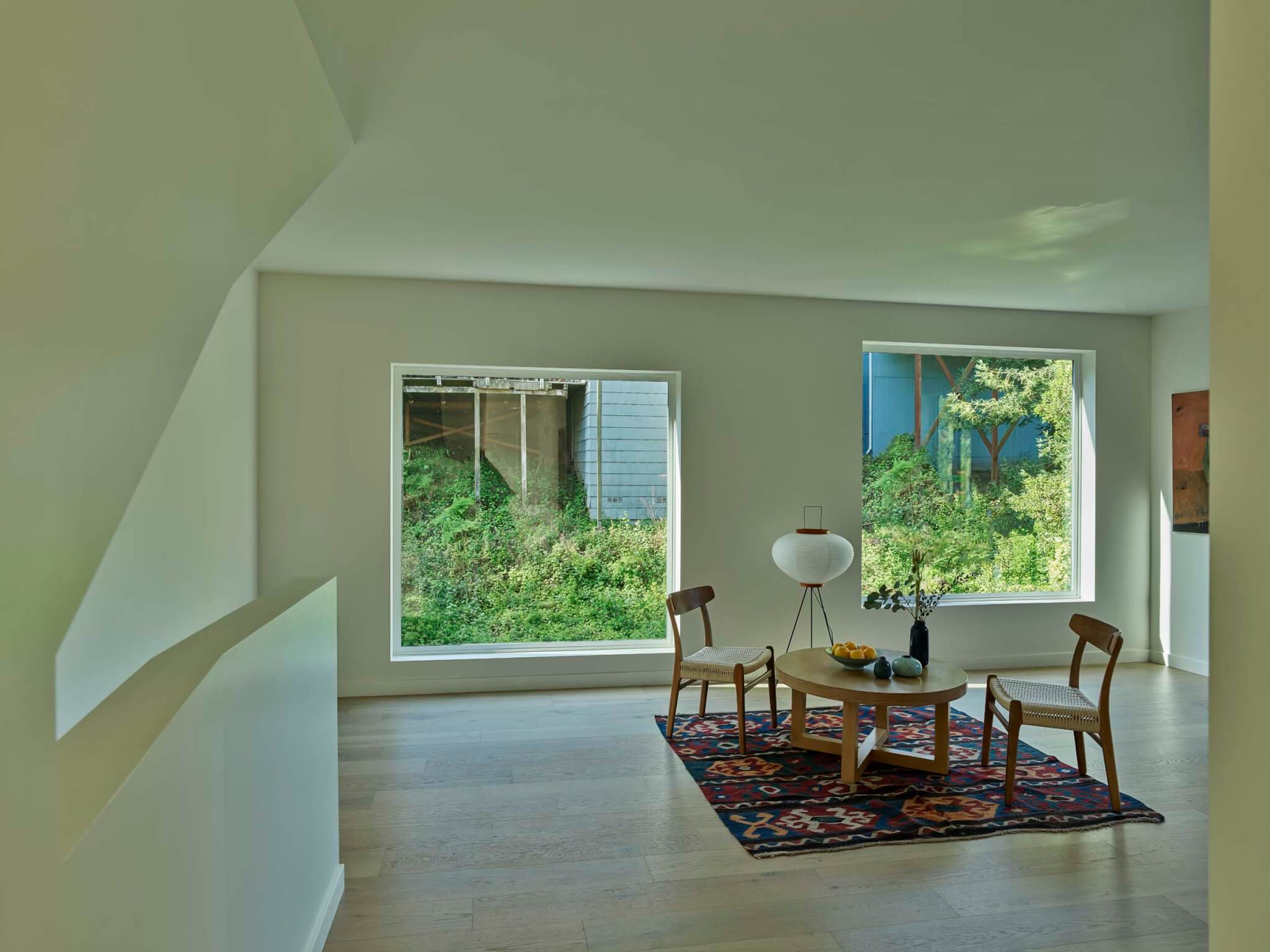
Square windows puncture the rainscreen at regular intervals. “I’m in a square stage,” Jaehning noted. “Our lives are full and chaotic. I feel that especially for a home, architecture should create a place of refuge, quiet. The square sets up a static, equal view—it creates a stillness and allows the eye to wander more.” It is through those apertures that the cloud enters.
Place Is Landscape
In response to the property’s failing retaining wall, Jaehning built a perimeter gabion wall, providing structural support while being porous enough to allow water to flow through. For the wall, the architects designed a soil and seed mixture to be packed into the caged wall with burlap netting. “The idea was to form a soft hard line wrapped in the native riparian species that grow all around,” explained Jaehning. The gabion wall was designed to become part of the riparian corridor over time, to settle the house into place. Eventually, continued Jaehning, “it would be like visiting an unexcavated archaeological site.”
From a distance, the house’s form appears strange and interesting. Like the artworks Jaenhing referenced, you want to walk around it, see how it unfolds from different angles. Knowledge of what shaped it also makes the strangeness legible and compelling. The building doesn’t hide its constraints or origins in seven years of administrative process. It amplifies the intersection of environmental protections and local zoning requirements into thoughtful, regionally relevant architecture, minimalist for its own moment.
Elizabeth Snowden is a writer and editorial strategist based in the San Francisco Bay Area.
Project Specifications
-
- Architect: David Jaehning Architect
- General Contractor: Jack Chen
- Structural Engineer: Dimas
- MEP Engineer: Design/build by contractor
- Civil Engineer: Sigma Prime
- Facade System: Custom cedar rainscreen built on site
- Cladding: Custom cedar rainscreen built on site
- Glass: Milgard clear insulated glass unit with argon fill
- Windows: Milgard
- Doors: Milgard
- Roofing: Rheinzink standing seam
- Waterproofing: WR Meadows air-shield LMP
- Exterior: Rockwool
- Interior: Owens Corning batt
- Fixtures: Delta
- Landscape Products: Zeo-Lock permeable concrete paver
→ Continue reading at The Architect's Newspaper

