
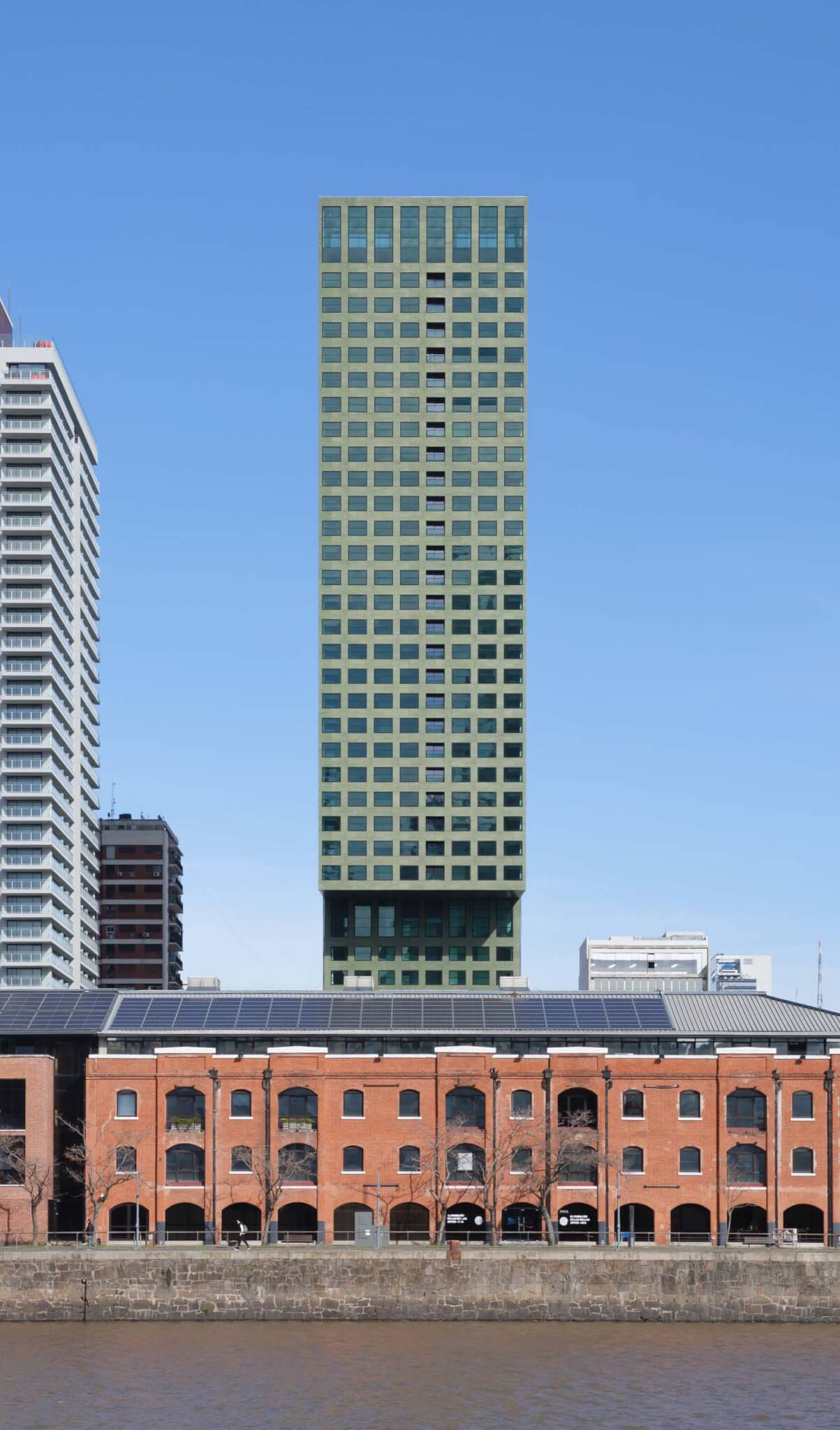
In Buenos Aires, Argentina, architecture studio adamo-faiden has created an impressive green high-rise that manages to both stand out and assimilate with its surroundings. Strategically located, the project straddles new and old in the city’s downtown area. On one side, the tower is flanked by Puerto Madero, the redeveloped quayside area with its luxury high-rises, and on the other, by Huergo Avenue and the city’s historic civic quarter.
Huergo 475 Tower, a project in collaboration with Consultatio, accommodates 507 residential units and communal spaces across 39 floors, with a total built area of 479,639 square feet (44,560 square meters). The tower reaches 395.7 feet (120.6 meters) in height. Three basements hold parking facilities and technical areas, above which a 27,717.07-square-foot (2,575-square-meter) public plaza has been created, which is accessible during office hours. A public access walkway doubles as an atrium with a soon–to-be-inaugurated cafe and restaurant, intended to encourage both footfall and public engagement with the building.
Argentine architects Sebastián Adamo and Marcelo Faiden were adamant about designing a more inclusive and democratic project that would encourage residents to interact with neighbors both within the tower and in the local community. Throughout the building, multiple communal spaces allow residents to gather. Outside, the architects prioritized establishing a dialogue with surrounding architecture as well as local flora and fauna. It was their intention to embrace rather than alienate the wider community, a radical approach for an area otherwise characterized by exclusive and insular skyscrapers with high perimeter fences and hostile security. The EDGE-certified tower also maintains a connection with the natural environment—its moss–green facade mimics the hues of the surrounding trees and parkland while also maintaining the water-repellent properties of the building material.
Structurally, the building is constituted around a central core with a perforated perimeter partition and partially lightened beamless slabs. A 37–foot (11.30-meter) overhang was incorporated from the 13th floor upward, using a specially designed bracing structure that distributes the load toward the central core at 5–floor intervals, together with the two lateral facades that act as Vierendeel beams.
The exposed-concrete facade not only acts as a structural element but is integral to defining the project. The monolithic appearance was achieved using a textured formwork that visually softens the concrete-pouring sequence thanks to its ribbed design. The balcony railings, fixed panels, and windows were all designed to match this palette.
This is the studio’s first project of this scale. For the building, it drew on more than 20 years of experience, accrued on smaller–scale dwellings. Adamo explained that it was an adaptation for the studio: “It required a deployment of construction techniques that are very different from those at a smaller scale—that is, a scale below 15 stories. It has to do with the wind pressures on buildings over 100 meters tall and with the complexity of the systems that must be managed with a project of this type. But it also has to do with domestic techniques, with ways of inhabiting.”
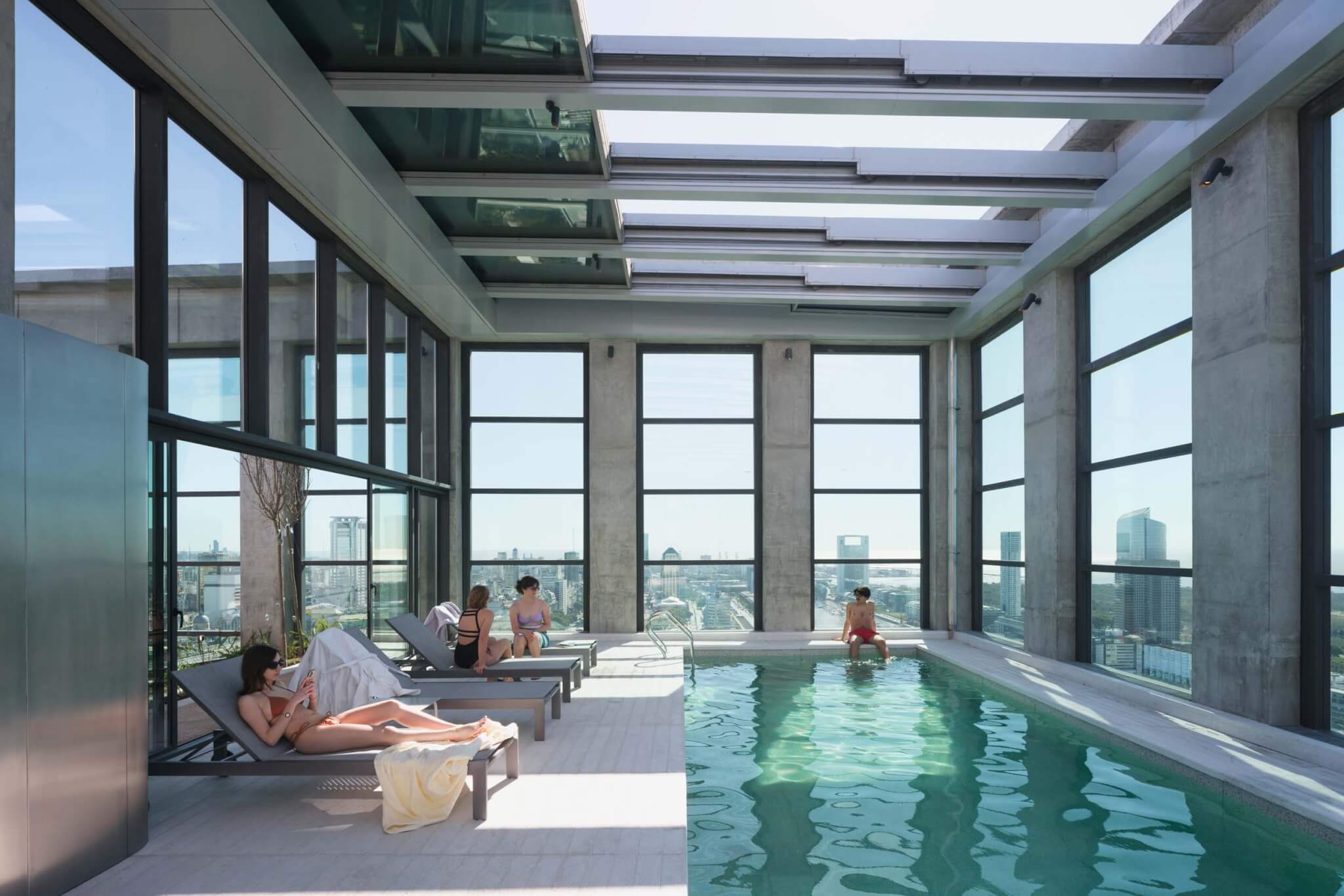
The building’s programming challenges the idea that housing should be developed solely to address the private realms of domestic life. With Huergo 475, all common spaces were designed as if they were an expansion or extension of one’s own home. These are places where one can share part of domestic life with others, such as collective kitchens, shared laundries, game rooms, study rooms, gyms, and spaces for cultural activities. These public spaces are distributed evenly and fairly throughout the tower and are meant to incentivize communal exchange.
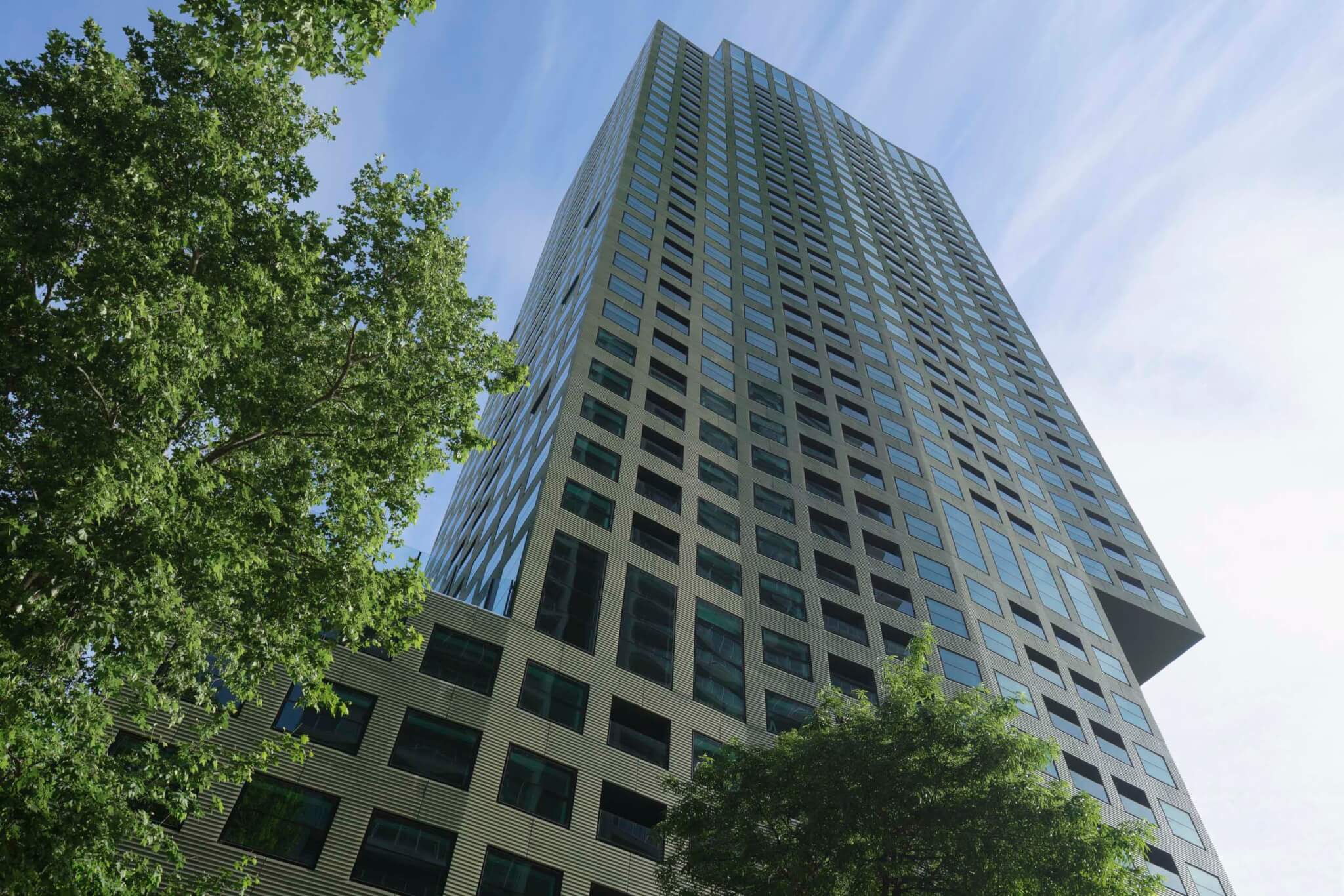
The architects envisioned the building as a living, dynamic thing, which is reflected in their decisions around the project’s distinctive facade and volume.
“We understood that the finishing details of the facade needed to have varying scales and distances. On one hand, there’s the urban scale. The tower can be seen from over 10 to 15 blocks away, so decisions were made with this in mind. The movements on the long facade, which is the broken facade, are part of a kinetic play where the facade catches different light reflections and shines due to these breaks,” explained Adamo. “This creates an effect where the tower is never seen in the same way. As one moves, these planes generate reflections and flashes of light. We found this interesting because it creates a connection with the person viewing the building, offering a synesthetic experience. We designed the facade breaks in plan, and the paint color has a sheen that picks up light reflections in different ways.”
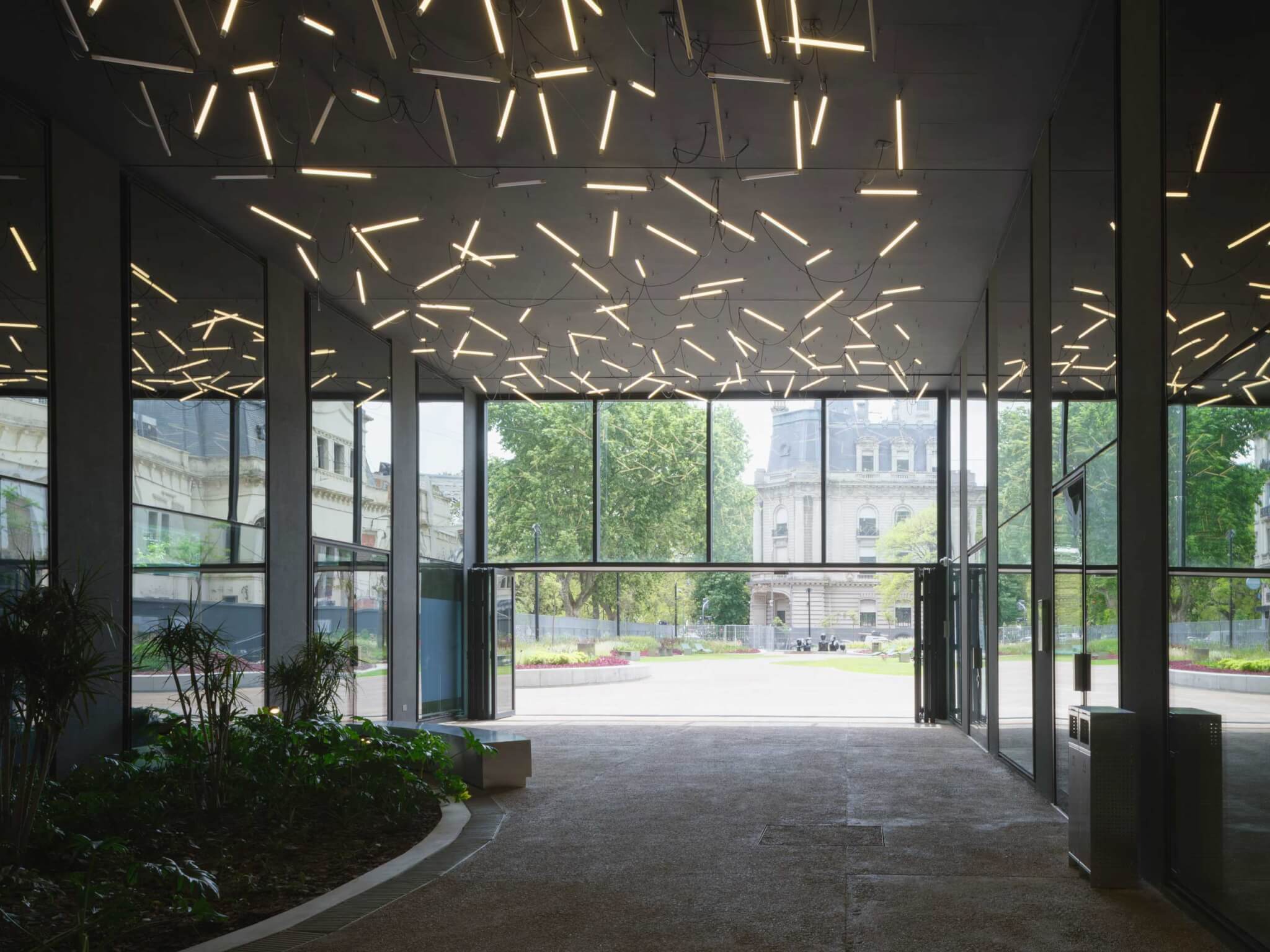
The architects also emphasized the neighborhood and pedestrian scales of interaction, taking into consideration how the project would integrate with the surrounding built environment, as well as shape the human-scale experience. The studio wanted to demonstrate how aesthetic, visual, and formal decisions can be integrated harmoniously with technical and constructive choices in the execution of the project.
With this huge project under its belt, the firm remains reluctant to define or pigeonhole itself, even after 20 years in the trade. “We are deliberately evasive to the point that, unlike many studios we know of, we don’t have a description of our profile,” said Adamo. “Our biographies are the things we’ve done and not so much a description of what we do, because we reserve the freedom to describe ourselves or, on the contrary, that difficulty of describing ourselves, which could limit us in the future from doing something different.”
Vanessa Bell is an Anglo-Argentine freelance writer and curator, specializing in Argentine architecture and interior design, art, food, and fashion. She also creates bespoke tours of Buenos Aires, where she has been based since 2010.
→ Continue reading at The Architect's Newspaper

