
Scene from “Marcel on the Train.”
Photo by Emilio Madrid
Before Marcel Marceau became the world’s most famous mime, he was a 20-year-old Jewish man escorting children across Nazi-occupied France with forged identity papers and no military training. That moment in his early life anchors Marcel on the Train, Marshall Pailet and Ethan Slater’s new historical drama making its world premiere at Classic Stage Company (CSC). Pailet directs, and Slater stars as Marceau.
Running approximately 100 minutes without intermission, the play unfolds largely inside a cramped train compartment — a setting that turns CSC’s intimate space into a pressure chamber. The staging is spare but evocative. Lighting and shadow compress the space, heightening the sense of confinement, while the grind of wheels and hiss of brakes pulse beneath the action. Danger never feels distant.
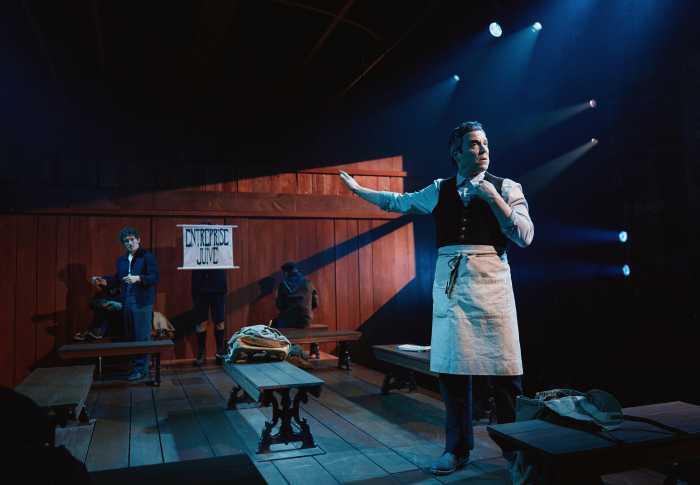
From the outset, the tone is somber. The four children traveling with Marcel are using false names. Marcel himself is no seasoned resistance fighter. He has been pushed into escorting the children by his cousin, who is supposed to meet them along the route and assume responsibility. When that cousin never arrives, Marcel is left alone to decide whether to continue or turn back.
Scenes aboard the train are interwoven with flashbacks to Marcel’s father in their butcher shop and glimpses of the children’s futures, suggesting that even successful escape does not erase trauma. And yet, within that sustained sadness, Marcel insists on joy.
In one chilling exchange, a Nazi officer conducting an inspection calmly identifies himself as a French citizen performing his duty. Marcel expresses surprise — he assumed the man was German. The moment lands with quiet force. Persecution depends not only on invaders but also on neighbors willing to enforce it.
Marcel performs to steady the children and to steady himself. Slater incorporates mime, physical improvisation, and shadow puppetry — invisible knife juggling, exaggerated clowning, and a recurring butterfly motif. At times, he evokes Charlie Chaplin, who used his art in “The Great Dictator” to mock and condemn Hitler. The comparison underscores the idea that performance itself can be a form of resistance.
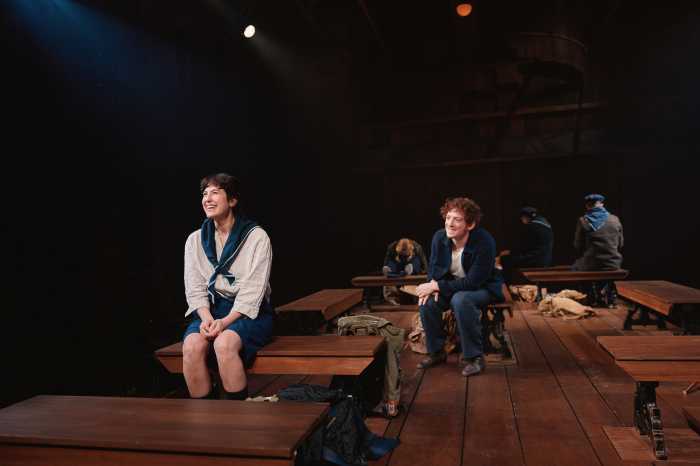
The emotional tension lies in contrast. The children’s grief feels heavy and enduring; Marcel’s joy is improvised and fragile. His optimism may be bravery, denial, or simply necessity. Performance becomes a shield — thin, temporary, but sometimes enough.
Slater gives a terrific performance — physically agile and emotionally transparent. He avoids mythologizing Marceau, instead presenting a young man straining to hold everything together. When his cousin fails to appear and responsibility settles fully on his shoulders, the flicker of panic is visible.
Among the adult actors playing the children, Tedra Millan’s Berthe is sharp and visibly strained, her fear barely contained. Maddie Corman’s quieter Etiennette conveys a lingering sadness that resonates even in stillness. The male children, played by Alex Wyse and Max Gordon Moore, bring argumentative energy and flashes of humor, though they leave a lighter impression.
“Marcel on the Train” does not present heroism as grand or inevitable. It depicts it as improvised — born of fear, doubt, and responsibility accepted in real time. In focusing on a young man who did not see himself as a fighter but stepped forward anyway, the production suggests that moral courage can emerge from unlikely places — and that even in the darkest compartments of history, someone still has to decide to move forward.
Lynn F. Angelson Theater, 136 E. 13th St., classicstage.org. Through March 22.
→ Continue reading at amNY

