
Alex Honnold approached his free-solo climb up Taipei 101 like he would any ascent up a mountain. For the seasoned climber the building’s 1,667-foot height maybe considered squat, at least relative to past ventures.
Prior to mounting Taipei 101, sans ropes and harnesses, Honnold studied the facade of Taipei 101, comparing the challenging elements of its makeup to that of a “climbing pitch,” the term climbers use to differentiate segments of an activity. He said in an interview prior to the climb that where rocks and buildings differ is in steepness.
“Buildings are steeper than most rock faces,” he said. “Most rock faces, even the ones that look vertical, aren’t actually vertical, or they’re not vertical for the whole way.”
Detailed Footing
When it opened in 2004 Taipei 101 reigned as the tallest building in the world, deposed by the Burj Khalifa just five years later. Its architects were C.Y. Lee and C.P. Wang, a pair of Taiwanese designers with a robust portfolio of skyscrapers across Asia. Their firm worked closely with structural engineers from Evergreen Consulting Engineering and Thornton Tomasetti.
Taipei 101’s tiered massing takes cues from Asian pagodas. That repetition was replicated across the building’s verticality, from its “truncated pyramidal base,” to the eight modules at its center, each comprising eight stories, to its spire.
Its glass and aluminum curtain wall reads as lattice. This facade system connects with large columns and one-story trusses replicated every eight floors. From a technical standpoint, the double-paned glazing was selected for its heat and UV protective properties and the facade system can be lauded for its arming against seismic events.
Honnold dubbed the eight, 8-story modules in the building’s center “bamboo boxes.” And the designation isn’t far-fetched. As the hosts of the Netflix livestream pointed out the building is riddled with symbolism.
C.Y. Lee & Partners imbued the building with elements of Chinese tradition. Starting off with its pagoda-like tiering, the architects also referenced the spindly nature of bamboo stalks and the boxy form of Chinese ingots, or money boxes. (After all, it was built as the Taipei Financial Center Corporation).
Numerically speaking, the building’s 101 stories are a nod to the “renewal of time” and its construction at the start of a new century. The number eight holds particular importance, denoting abundance, prosperity, and good fortune.
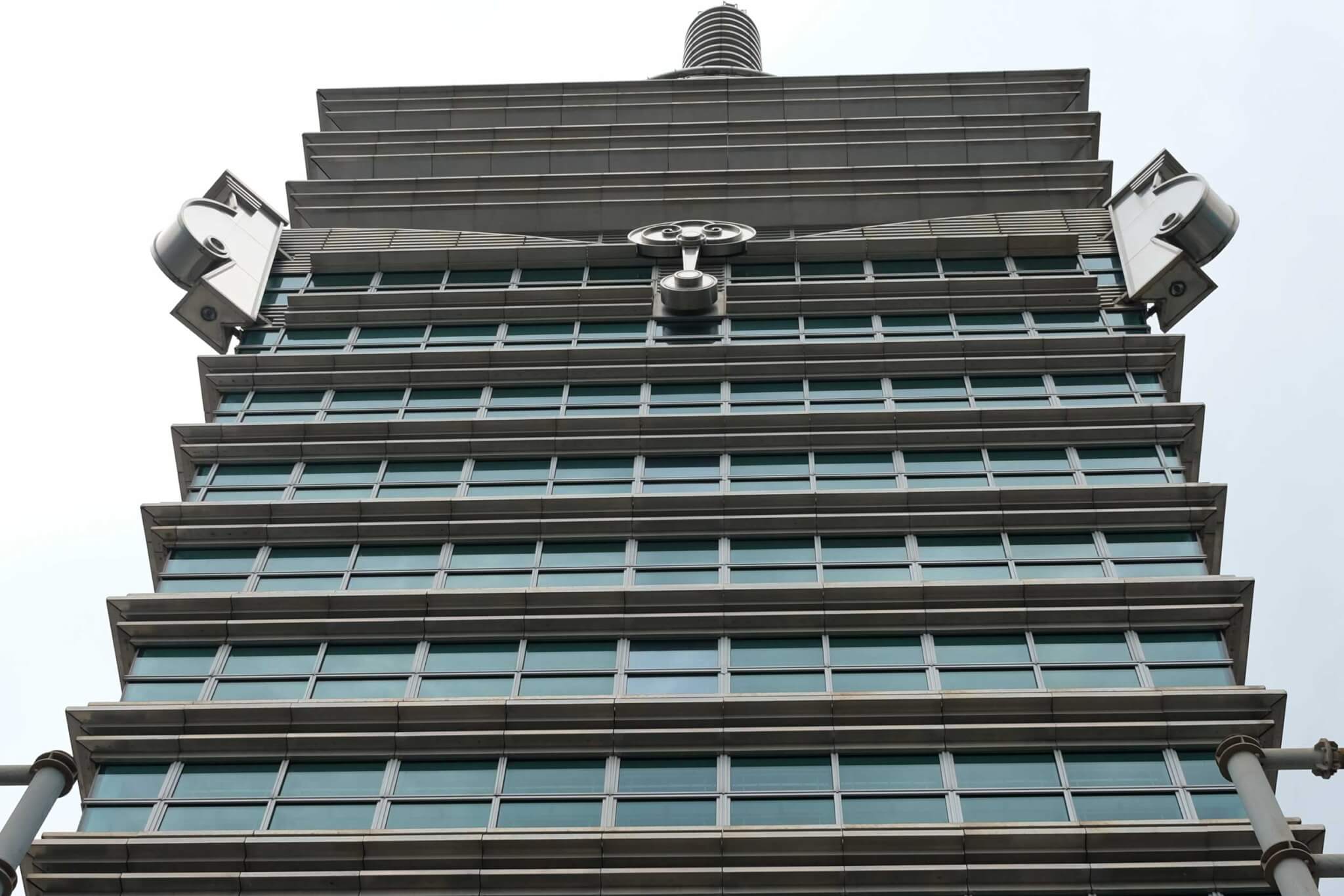
Decorative elements known as ruyis line the building. They are larger-than-life versions of the decorative objects that hold symbolism in Chinese culture as motifs of good fortune. Scaling these elements and the metal ornaments adorning the facade ended up being some of the “scariest” moments for Honnold, he recalled in a post-climb interview with Variety .
The modules occupy 64 stories of the building’s middle, well over half its height. Their sameness adds an element of predictability, but for Honnold this portion was tasking. He described the section as such: “This means you do quite a hard effort for almost 100 feet and then there’s a balcony, and then you do hard effort for 100 feet and there’s a balcony.”
For some viewers one of the harrowing clips of Honnold’s climb was when he was making his way up the spire and went completely hands free, expertly clenching his leg on one of the concentric rings forming the section that comes just before the spire’s tip.
A Moving Performance
While Honnold’s heroic 90-minute ascent offered a close-up of Taipei 101’s high-performance facade, the building’s interior houses a 660-metric-ton, tuned mass damper that stunts the building’s movement during a typhoon or similar seismic occurrence. The spherical structure measures four stories and was built from stacked steel plates. Its construction allows it to move five feet in either direction and it can reduce sway by 40 percent.
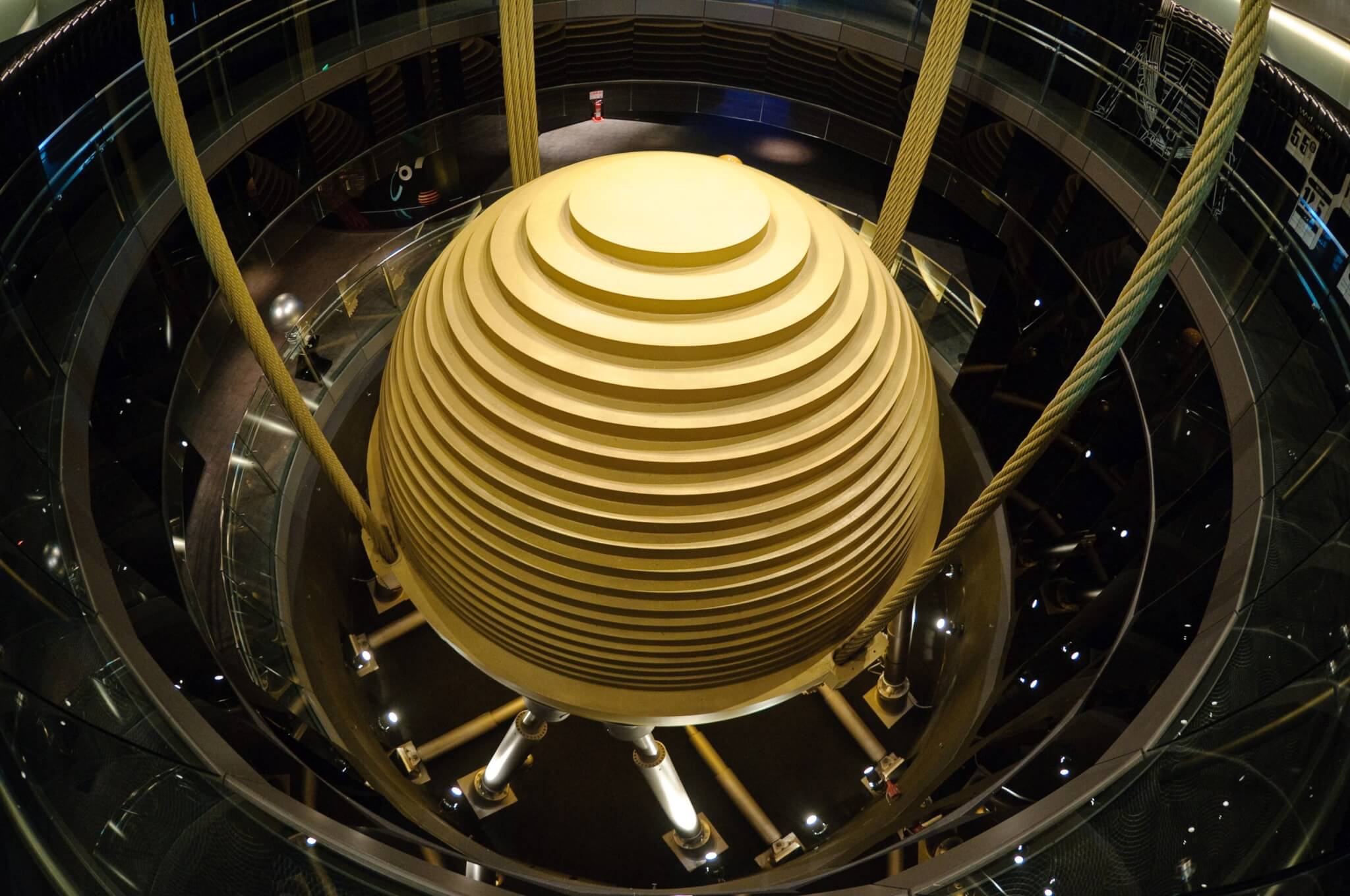
Observation decks faced with glass wrap around the massive yellow ball. The engineering feat even has its own mascot, an anthropomorphized version of itself sold as keychains and bobbleheads.
When Horrand reached Taipei 101’s precipice he spun his phone around in a celebratory moment as the crowd 1,667-feet below erupted in cheers. A few feet down he reunited with his wife. They waved hello to their sleeping kids, and the day went on.
And for Taipei 101, the descriptor high-performance building has taken on a new meaning.
→ Continue reading at The Architect's Newspaper


