
Carrie Coon as Agnes White in “Bug,” written by Tracy Letts, directed by David Cromer.
Photo by Matthew Murphy
There are plays that unfold politely, and then there’s “Bug,” which is supposed to get under your skin. Tracy Letts’ psychological thriller never leaves a rundown Oklahoma City motel room, yet it refuses to stay contained. Paranoia leaks into every corner of the space—and into the audience’s nerves—until reality itself begins to buckle. At its best, “Bug” doesn’t ask you to believe its central delusion. It asks you to feel it, to surrender to the momentum as two damaged people spiral together toward something terrifying and inescapable.
“Bug” centers on Agnes White, a lonely waitress scarred by violence and loss, and Peter Evans, a drifter whose conspiratorial worldview slowly takes hold. Their tentative connection curdles into shared paranoia, intimacy and delusion collapsing into the same dangerous impulse.
The new Broadway revival, produced by Manhattan Theatre Club in association with Steppenwolf Theatre Company, marks the play’s Broadway premiere more than two decades after its Off-Broadway debut in 2004. It reunites Tony Award-winning director David Cromer with Carrie Coon and Namir Smallwood, who previously tackled the play together in Chicago. On paper, it’s an ideal alignment of material and talent that should feel volatile, immersive, and unnervingly alive. Instead, this “Bug” is intelligent, disciplined, and often absorbing—but rarely electrifying.
Coon anchors the production with a performance of formidable control and emotional clarity. Her Agnes is guarded and brittle at first, a woman who has learned to survive by keeping the world at arm’s length. Gradually, Coon allows small fissures to appear—moments of openness and yearning. The disappearance of her character’s young son hangs over the performance like an unresolved ache. It’s deeply grounded work, recalling the emotional rigor of her turn on “The Leftovers.”
As Peter, Smallwood resists playing the character as a full-throttle maniac. His Peter is soft-spoken, attentive, and initially disarming—a man whose intelligence and sensitivity make his worldview feel plausible rather than immediately alarming. That approach lends the early scenes an unsettling sincerity. But “Bug” depends on momentum: on the sense that Peter’s certainty is tightening its grip not just on Agnes, but on the room itself. Here, the paranoia creeps but rarely explodes. The descent is measured rather than feral.
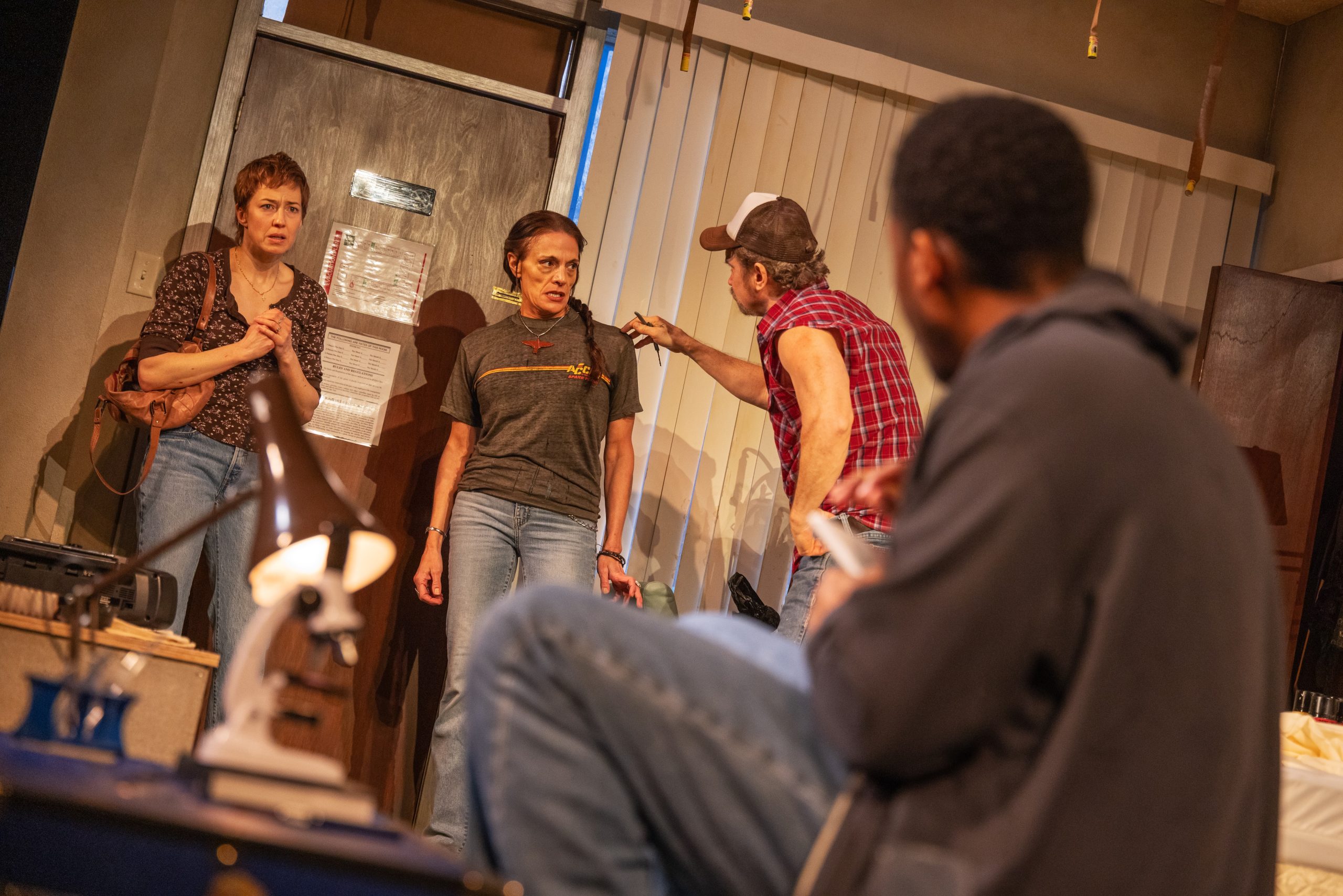
Cromer’s direction mirrors that restraint. The staging is clean and controlled, privileging clarity over chaos. The scenic design places the shabby motel room inside a blacked-out surround, like a shoebox set within a larger void. The effect is less immersive than observational: the space feels studied, almost quarantined, as if the characters are specimens under glass. At times, the framing recalls watching a movie presented in letterbox format—technically precise, visually contained, and emotionally distancing.
This approach begins to feel deliberate. In a cultural moment saturated with conspiracy theories—when paranoia no longer shocks but circulates freely—Cromer seems less interested in pulling the audience into the characters’ fever dream than in holding it up for inspection. The production frames “Bug” as a cautionary tale: a warning about how seductive, and how consuming, conspiratorial thinking can become.
I vividly remember seeing “Bug” Off-Broadway in 2004 at the Barrow Street Playhouse, where the audience sat uncomfortably close to the action and the theater’s worn-in personality amplified the play’s intensity. Michael Shannon, who played Peter in that production and later in the 2006 film adaptation, helped define the character as volatile and unsettling. You didn’t have to believe the bugs were real. You only had to believe that the characters did.
Seen on Broadway, with greater polish and physical distance, “Bug” lands differently. The problem isn’t that “Bug” no longer makes sense. It’s that this time, I never fully went with it. I understood what the play was doing. I respected the craft. I appreciated the performances. But I didn’t surrender to the descent. Where the play once swept me into its fever dream, I remained aware, analytical, outside the experience. The bugs never got under my skin.
Samuel J. Friedman Theatre, 261 W. 47th St., manhattantheatreclub.com. Through Feb. 8.
→ Continue reading at amNY

